
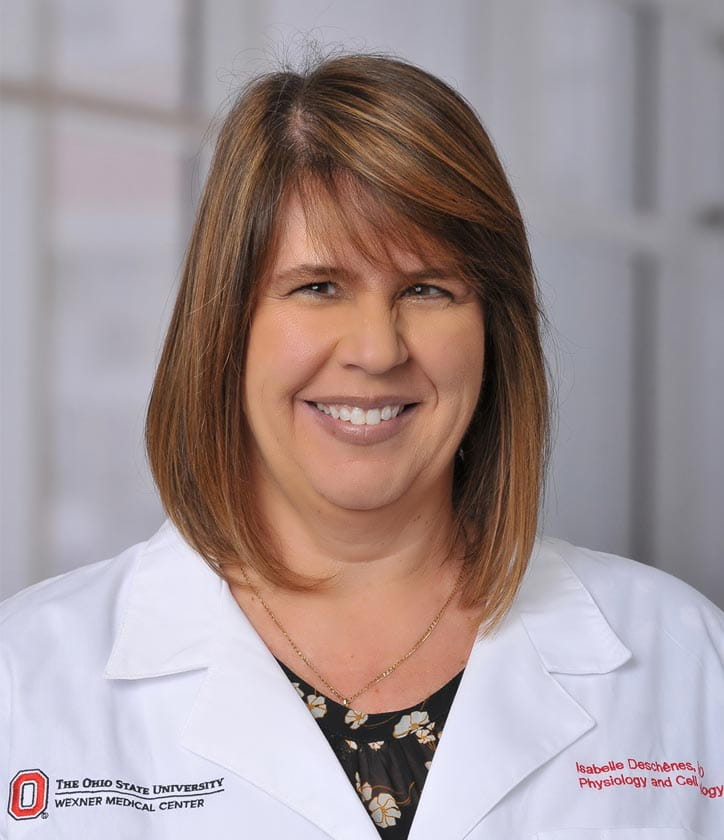
Isabelle Deschenes
· Professor and Chair, Department of Physiology and Cell BiologyOhio State University · Molecular, Cellular, and Integrative Physiology
Active 1997–2026
Academic metrics are sourced from OpenAlex and public funding records; values may differ from Google Scholar.
About
Isabelle Deschenes, PhD, is a Professor of Physiology and Cell Biology at The Ohio State University College of Medicine, where she also serves as Chair of the Department of Physiology and Cell Biology. Her research focuses on the molecular basis of cardiac arrhythmias, studying the fundamental molecules that underlie the electrical function of the heart, including ion channels and their accessory subunits. Her work investigates how regulation and dysregulation of inward and outward ion currents contribute to various clinically relevant cardiac arrhythmias, including inherited channelopathies and arrhythmias associated with acquired diseases such as heart failure. Dr. Deschenes utilizes electrophysiological, biochemical, molecular, and imaging techniques to explore the involvement of ion channels in arrhythmias. Her research includes elucidating mechanisms of incomplete penetrance in inherited cardiac channelopathies through the use of patient-specific induced pluripotent stem cells to identify modifier genes. She has also made fundamental contributions to understanding sodium channel structure, assembly, and trafficking. Additionally, her research investigates ion channel remodeling in heart failure, with a particular focus on the role of KChIP2 in regulating cardiac excitability through multiple mechanisms, including transcriptional repression of cardiac genes and microRNAs.
Research topics
- Biophysics
- Internal medicine
- Chemistry
- Biochemistry
- Medicine
- Biology
- Cell biology
- Physical therapy
Selected publications
Intercellular Sodium Regulates Repolarization in Cardiac Tissue with Sodium Channel Gain of Function
Biophysical Journal · 2020 · 32 citations
Extracellular Perinexal Separation Is a Principal Determinant of Cardiac Conduction
Circulation Research · 2023-09-08 · 21 citations
articleOpen accessBACKGROUND: Cardiac conduction is understood to occur through gap junctions. Recent evidence supports ephaptic coupling as another mechanism of electrical communication in the heart. Conduction via gap junctions predicts a direct relationship between conduction velocity (CV) and bulk extracellular resistance. By contrast, ephaptic theory is premised on the existence of a biphasic relationship between CV and the volume of specialized extracellular clefts within intercalated discs such as the peri…
Biophysical characterization of chloride intracellular channel 6 (CLIC6)
Journal of Biological Chemistry · 2023-10-12 · 18 citations
articleOpen accessChloride intracellular channels (CLICs) are a family of proteins that exist in soluble and transmembrane forms. The newest discovered member of the family CLIC6 is implicated in breast, ovarian, lung gastric, and pancreatic cancers and is also known to interact with dopamine-(D(2)-like) receptors. The soluble structure of the channel has been resolved, but the exact physiological role of CLIC6, biophysical characterization, and the membrane structure remain unknown. Here, we aimed to characteriz…
Structural basis of human Na <sub>v</sub> 1.5 gating mechanisms
Proceedings of the National Academy of Sciences · 2025-05-14 · 7 citations
articleOpen accessCorrespondingVoltage-gated Na v 1.5 channels are central to the generation and propagation of cardiac action potentials. Aberrations in their function are associated with a wide spectrum of cardiac diseases including arrhythmias and heart failure. Despite decades of progress in Na v 1.5 biology, the lack of structural insights into intracellular regions has hampered our understanding of its gating mechanisms. Here, we present two cryo-EM structures of human Na v 1.5 in open states, revealing sequential confo…
Children · 2025-05-23 · 7 citations
reviewOpen accessCongenital heart disease (CHD), the most common congenital anomaly, remains a significant lifelong burden despite advancements in medical and surgical interventions. Induced pluripotent stem cells (iPSCs) have emerged as a groundbreaking platform in CHD research, offering patient-specific models to investigate the genetic, epigenetic, and molecular mechanisms driving the disease. Utilizing technologies such as CRISPR/Cas9 gene editing, cardiac organoids, and high-throughput screening, iPSCs enab…
Recent grants
NIH · $425k · 2011
Biophysical Modulation of Cardiac Ion Channels by MicroRNA
NIH · $4.5M · 2017–2027
Sodium Channels and Cardiac Arrhythmias
NIH · $4.0M · 2010–2024
Frequent coauthors
- 62 shared
Xiaoping Wan
Shanghai First Maternity and Infant Hospital
- 51 shared
Eckhard Ficker
- 47 shared
Kenneth R. Laurita
MetroHealth
- 42 shared
Steven Poelzing
Virginia Tech
- 38 shared
Drew Nassal
The Ohio State University Wexner Medical Center
- 35 shared
Ji‐Dong Fu
The Ohio State University
- 33 shared
Jérôme Clatot
Children's Hospital of Philadelphia
- 30 shared
Krekwit Shinlapawittayatorn
Chiang Mai University
Similar researchers at Ohio State University
- Resume-aware match score
- Save to shortlist
- AI-drafted outreach
See your match with Isabelle Deschenes
PhdFit ranks faculty by your research interests, methods, and publications — grounded in their actual work, not templates.
- Free to start
- No credit card
- 30-second signup