
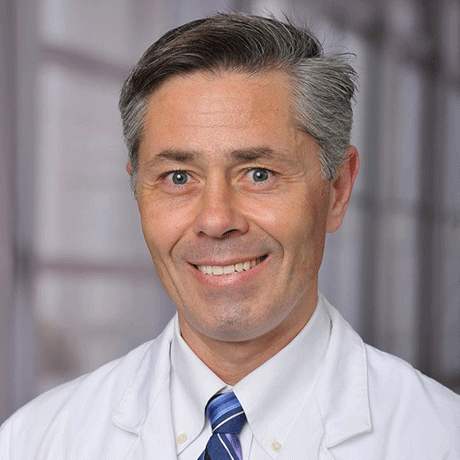
Vadim Fedorov
· ProfessorOhio State University · Molecular, Cellular, and Integrative Physiology
Active 1960–2026
Academic metrics are sourced from OpenAlex and public funding records; values may differ from Google Scholar.
About
Vadim Fedorov, PhD, is a Professor of Physiology and Cell Biology at The Ohio State University College of Medicine. His main research focus is on the mechanisms and treatments of human sinoatrial node function and atrial fibrillation, with the goal of developing new therapies for malignant cardiac arrhythmias. In his lab, he has developed an integrated approach to study heart rate disorders directly in humans using functional, molecular, and structural 3D mapping techniques, including a dual-sided high-resolution optical mapping system capable of resolving intramural activation in complex 3D atrial structures. His contributions include demonstrating that in human hearts, fatty tissue and fibrosis insulate the sinoatrial node while electrical communication is restricted to specific conduction pathways. He has shown that pathological upregulation of fibrosis and adenosine A1 receptors within the SAN may lead to tachycardia-bradycardia arrhythmias and cardiac arrest, and is developing therapies based on this data. Additionally, his research on atrial fibrillation has defined the sources of AF and their underlying mechanisms, revealing that AF is driven by intramural reentry anchored to microanatomic tracks in diseased human atria. Collaborating with clinical surgeons and electrophysiologists, he is working on highly selective, patient-specific treatments for AF.
Research topics
- Cardiology
- Medicine
- Internal medicine
- Chemistry
Selected publications
Nature Communications · 2020 · 52 citations
Senior authorCorrespondingis essential for SAN conduction, especially in fibrotic failing hearts. Our results reveal that not only cNav but nNav are also integral for preventing disease-induced failure in human SAN intranodal conduction. Disease-impaired nNav may underlie patient-specific SAN dysfunctions and should be considered to treat arrhythmias.
Pharmacologic Approach to Sinoatrial Node Dysfunction
The Annual Review of Pharmacology and Toxicology · 2020 · 47 citations
The spontaneous activity of the sinoatrial node initiates the heartbeat. Sino-atrial node dysfunction (SND) and sick sinoatrial (sick sinus) syndrome are caused by the heart's inability to generate a normal sinoatrial node action potential. In clinical practice, SND is generally considered an age-related pathology, secondary to degenerative fibrosis of the heart pacemaker tissue. However, other forms of SND exist, including idiopathic primary SND, which is genetic, and forms that are secondary t…
Heart Rhythm · 2024-11-17 · 15 citations
reviewOpen accessThe international Working Group of the Signal Summit is a consortium of experts in the field of cardiac electrophysiology dedicated to advancing knowledge on understanding and clinical application of signal recording and processing techniques. In 2023, the working group met in Reykjavik, Iceland, and laid the foundation for this manuscript. Atrial fibrillation (AF) is the most common arrhythmia in adults, with a rapidly increasing prevalence worldwide. Despite substantial research efforts, advan…
Chamber-specific wall thickness features in human atrial fibrillation
Interface Focus · 2023-12-15 · 12 citations
articleOpen accessSenior authorCorrespondingPersistent atrial fibrillation (AF) is not effectively treated due to a lack of adequate tools for identifying patient-specific AF substrates. Recent studies revealed that in 30–50% of patients, persistent AF is maintained by localized drivers not only in the left atrium (LA) but also in the right atrium (RA). The chamber-specific atrial wall thickness (AWT) features underlying AF remain elusive, though the important role of AWT in AF is widely acknowledged. We aimed to provide direct evidence o…
PLoS Computational Biology · 2023-12-18 · 8 citations
articleOpen accessSenior authorCorrespondingThe sinoatrial node (SAN), the primary pacemaker of the heart, is responsible for the initiation and robust regulation of sinus rhythm. 3D mapping studies of the ex-vivo human heart suggested that the robust regulation of sinus rhythm relies on specialized fibrotically-insulated pacemaker compartments (head, center and tail) with heterogeneous expressions of key ion channels and receptors. They also revealed up to five sinoatrial conduction pathways (SACPs), which electrically connect the SAN wi…
Recent grants
Integration of structure and signaling in cardiac pacemaker function
NIH · $4.2M · 2013–2024
Targeting the Arrhythmogenic Sources of Human Atrial Fibrillation
NIH · $5.3M · 2017–2027
Frequent coauthors
- 130 shared
Igor R. Efimov
- 114 shared
Peter J. Mohler
The Ohio State University
- 94 shared
Brian J. Hansen
The Ohio State University Wexner Medical Center
- 79 shared
Paul M.L. Janssen
The Ohio State University
- 76 shared
Halina Dobrzynski
Jagiellonian University
- 72 shared
Ning Li
Westlake University
- 65 shared
Thomas A. Csepe
- 60 shared
Jichao Zhao
University of Auckland
Education
- 1999
PhD, Physiology, Cardiac Electrophysiology
Russian Cardiology Research and Production Complex
- 1996
MS, Applied Physics and Biomedical Engineering, Physics of Living System
Moscow Institute of Physics and Technology
Similar researchers at Ohio State University
- Resume-aware match score
- Save to shortlist
- AI-drafted outreach
See your match with Vadim Fedorov
PhdFit ranks faculty by your research interests, methods, and publications — grounded in their actual work, not templates.
- Free to start
- No credit card
- 30-second signup