
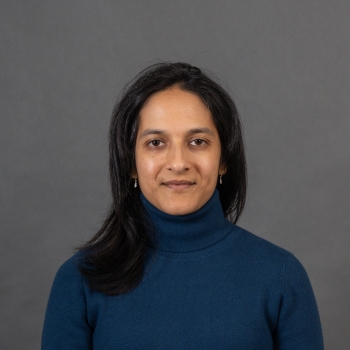
Sudha Arunachalam
· Associate Professor of Applied PsychologyNew York University · Educational Psychology
Active 1997–2026
Academic metrics are sourced from OpenAlex and public funding records; values may differ from Google Scholar.
About
Dr. Sudha Arunachalam is a Professor of Communicative Sciences and Disorders and serves as the Principal Investigator and Lab Director at the LEARN Lab at New York University. She holds a Ph.D. in Linguistics and an M.A. in Psychology from the University of Pennsylvania, as well as a B.A. in Linguistics from the University of Southern California. Her research program focuses on understanding how infants, toddlers, and preschoolers acquire their native language. She studies language development in children who are typically developing, as well as those with autism spectrum disorder and language delay. Dr. Arunachalam is particularly interested in the learning mechanisms that underlie language acquisition and the role of caregiver-child interactions in supporting this learning process. Outside of her academic work, she enjoys taking long walks in New York City and exploring new foods.
Research topics
- Linguistics
- Cognitive psychology
- Psychology
- Artificial Intelligence
- Computer Science
- Developmental psychology
- Social psychology
Selected publications
Toddlers’ word learning through overhearing: Others’ attention matters
Journal of Experimental Child Psychology · 2020 · 22 citations
Senior authorCorrespondingTwo-year-olds consolidate verb meanings during a nap
Cognition · 2020 · 15 citations
Senior authorCorrespondingCognition · 2021 · 12 citations
Senior authorCorrespondingDo focused interests support word learning? A study with autistic and nonautistic children
Autism Research · 2024-03-11 · 11 citations
articleOpen access1st authorAlthough focused interests are often associated with a diagnosis of autism, they are common in nonautistic individuals as well. Previous studies have explored how these interests impact cognitive, social, and language development. While some research has suggested that strong interests can detract from learning (particularly for autistic children), newer research has indicated that they can be advantageous. In this pre-registered study, we asked whether focused interests support word learning in…
Spoken verb learning in children with language disorder
Journal of Experimental Child Psychology · 2024-03-02 · 5 citations
articleOpen accessThe current study examined spoken verb learning in elementary school children with language disorder (LD). We aimed to replicate verb learning deficits reported in younger children with LD and to examine whether verb instrumentality, a semantic factor reflecting whether an action requires an instrument (e.g., "to chop" is an instrumental verb), influenced verb learning. The possible facilitating effect of orthographic cues presented during training was also evaluated. In an exploratory analysis,…
Recent grants
Children's real-time language processing and verb learning during interactions with caregivers
NSF · $312k · 2018–2023
Language Processing and Word Learning in Preschoolers with Autism Spectrum Disorder
NIH · $2.0M · 2018–2025
Learning new words from overhearing in children with ASD
NIH · $1.8M · 2020–2025
Frequent coauthors
- 18 shared
Rhiannon Luyster
Emerson College
- 13 shared
Sandra R. Waxman
Northwestern University
- 11 shared
Allison Fitch
Rochester Institute of Technology
- 11 shared
Sabrina Horvath
Medical University of South Carolina
- 9 shared
Angela Xiaoxue He
Hong Kong Baptist University
- 8 shared
Amy M. Lieberman
Boston University
- 5 shared
Isabelle Roy
Laboratoire de Linguistique de Nantes
- 5 shared
Elaine S. Andersen
University of Southern California
Labs
Education
- 2007
Ph.D., Linguistics
University of Pennsylvania
Awards & honors
- ASHA fellow
Similar researchers at New York University
- Resume-aware match score
- Save to shortlist
- AI-drafted outreach
See your match with Sudha Arunachalam
PhdFit ranks faculty by your research interests, methods, and publications — grounded in their actual work, not templates.
- Free to start
- No credit card
- 30-second signup