
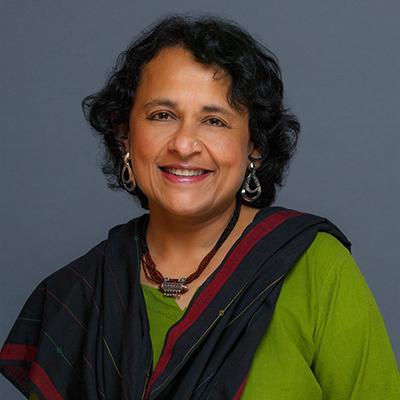
Brinda J. Mehta
· Germaine Thompson ProfessorNortheastern University · School of Education
Active 1993–2025
Academic metrics are sourced from OpenAlex and public funding records; values may differ from Google Scholar.
About
Brinda Mehta is an award-winning scholar of postcolonial feminist literature and author of over 65 articles. Her areas of specialization include postcolonial literatures from Africa, the Caribbean, France, South Asia, North Africa, and the Middle East; Indian indenture studies; transnational feminisms; diaspora and migration studies. She is the author of five books, over sixty articles, and three co-edited volumes on postcolonial global south intellectual traditions.
Research topics
- Humanities
- Political Science
- Sociology
- Law
- Art
- Literature
- Philosophy
- Gender studies
- Aesthetics
- History
Selected publications
Minnesota Review · 2020 · 20 citations
1st authorCorrespondingThe term migritude was first coined by French theorist Jacques Chevrier to characterize “extracontinental” francophone sub-Saharan literatures that have their roots in negritude and immigration. Kenyan cultural artist Shailja Patel later expanded the term to include South Asian “migrants with attitude.” This article further expands the current framings of migritude by linking it to the historical movement of kala pani, or nineteenth-century Indian indenture. The idea of kala pani migritude revea…
Dissident Writings of Arab Women: Voices against Violence
Journal of Middle East Women s Studies · 2018-07-01 · 12 citations
article1st authorCorrespondingThis is a response to Abdelkader Cheref’s review of my book Dissident Writings of Arab Women: Voices against Violence in this journal (13:3 [November 2017]: 438–41).Cheref was gratuitously patronizing, sloppy, and dismissive, as well as misinformed, in his review. I respond to only some of his egregious mistakes. Accusing me of essentialism for identifying the women writers whose works I analyze as Arab, Cheref offers genetic and racialized essentialisms as an alternative—for example, “Maghrebis…
<i>Jahaji-bahin</i>feminism: a de-colonial Indo-Caribbean consciousness
South Asian Diaspora · 2020 · 4 citations
1st authorCorrespondingThis essay examines the trope of jahaji-bahin consciousness through a de-colonial feminist lens to highlight the ways in which Indo-Caribbean women claim a sense of identity and belonging in the Caribbean while resisting colonial and patriarchal stereotypes, social marginality, and gender anomie in circumscribed spaces. What is the scope of jahaji-bahin consciousness as a form of de-colonial feminist thought? How does it engender localised forms of resistance to colonial and patriarchal forms of…
Contesting Militarized Violence in “Northeast India”
Meridians · 2021-04-01 · 2 citations
article1st authorCorrespondingAbstract The northeastern states of India have been positioned as India’s postcolonial other in mainstream politics with the aim to create xenophobic binaries between insider and outsider groups. Comprising the eight “sister” states of Arunachal Pradesh, Assam, Manipur, Meghalaya, Mizoram, Nagaland, Sikkim, and Tripura, this region represents India’s amorphous shadowlands in arbitrary political markings between the mainland and the off-centered northeastern periphery. These satellite states have…
Journal of Middle East Women s Studies · 2022 · 1 citations
1st authorCorrespondingAbstract This essay examines the poetry of the Francophone author Maram al-Masri, a diasporic feminist poet from Syria who has lived in exile in Paris since 1992. Elle va nue la liberté is an indictment of the regime of Bashar al-Assad and an ode to the creative resilience of ordinary people during the Syrian revolution (2011). This essay demonstrates how al-Masri’s poetry grafts landscapes of pain and resistance in a poetics of the gut that bears witness to horror, trauma, and resistance. It fo…
Frequent coauthors
- 2 shared
Rajender Kaur
Rhode Island College
- 2 shared
William A. Meiers
Arcadia University
- 1 shared
Bidisha Banerjee
- 1 shared
Haifa Zangana
- 1 shared
Vibha Saxena
University of Delhi
- 1 shared
Rajmohan Ramanathapillai
Gettysburg College
- 1 shared
Paget Henry
- 1 shared
Vijay Lakshmi
Education
B.A.
Elphinstone College
M.A.
University of Bombay
Ph.D.
Brown University
Similar researchers at Northeastern University
- Resume-aware match score
- Save to shortlist
- AI-drafted outreach
See your match with Brinda J. Mehta
PhdFit ranks faculty by your research interests, methods, and publications — grounded in their actual work, not templates.
- Free to start
- No credit card
- 30-second signup