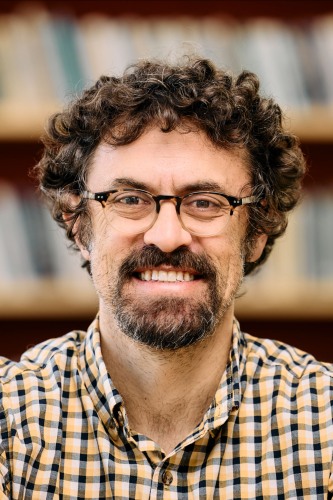
Alexander Gourevitch
· Associate Professor of Political Science, Director of Undergraduate StudiesBrown University · Political Science
Active 2002–2024
About
Alexander H Gourevitch is an associate professor of political science in the Department of Political Science at Brown University. He received his Ph.D. in political science from Columbia University in 2010 and also holds an MPH from Columbia University and a BA from Harvard University. His research interests include the history of political and economic thought, strikes and injustice, theories of freedom, work and leisure, Marxism, rights theory, republicanism, and democratic theory. Gourevitch has held positions as an assistant professor at McMaster University, a Post-Doctoral Research Associate at Brown University's Political Theory Project, and a College Fellow at Harvard University. His scholarly work explores various themes within political theory, including economic democracy, labor, republican liberty, and the political implications of work and social justice. Gourevitch has published numerous articles in reputable journals such as the American Political Science Review, Perspectives on Politics, and Political Theory, among others. He also writes political commentary for publications like Jacobin, Dissent, and Salon. His contributions to the field include analyses of the right to strike, liberty, labor repression, and the transformation of work, emphasizing the importance of economic democracy and the political significance of labor movements.
Research signals
Five dimensions sourced from public faculty / publication signals. Sign in to compare against your own profile and see your match score.
Research topics
- Political Science
- Sociology
- Law
- Philosophy
- Political economy
- Law and economics
- Epistemology
- Environmental ethics
Selected publications
Themselves Must Strike the Blow
Philosophical Topics · 2020 · 7 citations
1st authorCorresponding- Sociology
- Political Science
- Sociology
Socialists know that they ought to defend strikes, but why? The best argument is that strikes are acts of self-emancipation. The ideal of self-emancipation lies at the heart of socialist political theory. It is up to workers to emancipate themselves, not just because it takes class power to overthrow capitalism, but because there is an intrinsic connection between class struggle and socialist freedom. Workers can only possess and exercise the freedoms they are denied, but ought to enjoy, if they demand that freedom for themselves, through their own, collective activity. Strikes are an essential way of both winning and exercising those denied freedoms. They are therefore a path to, and partial realization of, the ideal of self-emancipation to which socialists are, or ought to be, committed.
Polity · 2020 · 16 citations
1st authorCorresponding- Political Science
- Sociology
- Political Science
Left-wing politics is resurgent. Self-proclaimed socialists are unexpectedly popular. Proposals like universal health care are a commonplace of Democratic campaigns. But there is not yet a clear, unifying idea behind this political shift. We propose that that idea is freedom. While the left once understood freedom as emancipation from the economy, the right spent the twentieth century neutralizing and appropriating the idea of freedom by reinventing the economy as the true site of freedom. To reclaim freedom as a value of the left, we have to begin with the daily experience of most people: the unfreedom of the workplace. The authoritarian organization of work is not just an offense against freedom; it also helps us understand how freedom requires emancipation both from the economy and within the economy, and why that emancipation requires mass struggle.
Oxford University Press eBooks · 2020 · 22 citations
1st authorCorresponding- Sociology
- Political Science
- Sociology
This chapter argues that debates around republicanism and civic virtue are structured around two unwarranted assumptions. First, neo-republicans and their critics assume that civic virtues are qualities that <italic>stabilize</italic> a free state. Second, they assume that the cultivation of virtue primarily requires coercive inculcation. I contest both assumptions through historical reconstruction of nineteenth-century ‘labour republicanism’. Labour republicans thought about civic virtue as qualities that agents exercise to <italic>transform</italic> rather than stabilize a regime. And they argued that virtue developed out of the self-education and activity of citizens themselves, not state coercion. The real danger lies not in the defence of an illiberal state but of the kinds of demands that the oppressed make on each other to act virtuously. As such, labour republicans offer us a model for thinking about the role—and risks—of virtue in emancipatory politics.
Frequent coauthors
- 31 shared
Gregory Belenky
Stony Brook University
- 26 shared
D. Donetsky
Stony Brook University
- 23 shared
David Westerfeld
Stony Brook University
- 15 shared
B. Laikhtman
Hebrew University of Jerusalem
- 14 shared
L. Shterengas
Stony Brook University
- 12 shared
Ramon U. Martinelli
- 7 shared
Leonid Glebov
University of Central Florida
- 5 shared
Vadim Smirnov
Similar researchers at Brown University
- Resume-aware match score
- Save to shortlist
- AI-drafted outreach
See your match with Alexander Gourevitch
PhdFit ranks faculty by your research interests, methods, and publications — grounded in their actual work, not templates.
- Free to start
- No credit card
- 30-second signup