
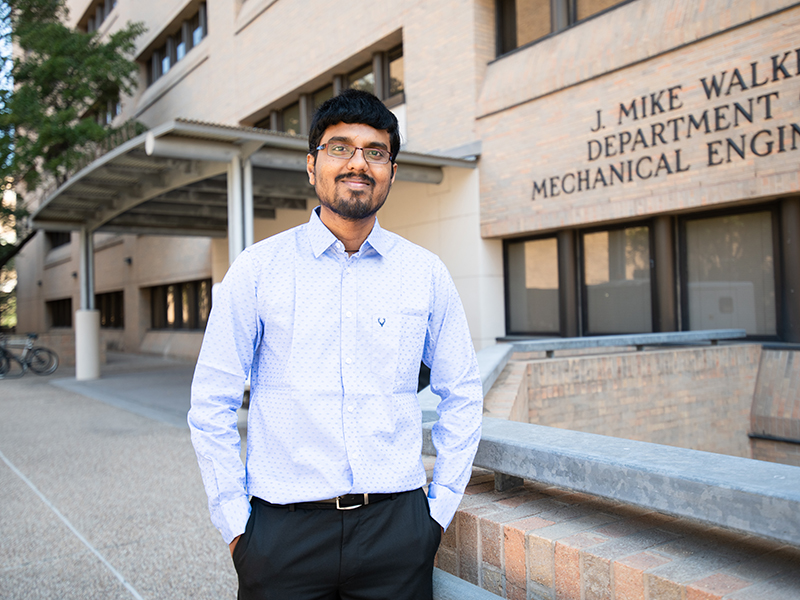
Raghavendra Bollapragada
· Assistant ProfessorUniversity of Texas at Austin · Mechanical Engineering
Active 2016–2026
Academic metrics are sourced from OpenAlex and public funding records; values may differ from Google Scholar.
About
Raghavendra Bollapragada is an Assistant Professor in the Department of Research at The University of Texas at Austin. His research areas include Analytics and Probabilistic Modeling. His work involves developing and analyzing optimization methods, including Newton-Sketch and subsampled Newton methods, as well as nonlinear acceleration of primal-dual algorithms. He has contributed to the field through various publications on stochastic optimization, distributed optimization, and machine learning, focusing on improving computational efficiency and balancing communication and computation in large-scale systems.
Research topics
- Computer Science
- Algorithm
- Mathematical optimization
- Mathematics
- Mathematical analysis
- Applied mathematics
- Economics
Selected publications
Nonlinear acceleration of momentum and primal-dual algorithms
Mathematical Programming · 2022 · 16 citations
1st authorCorrespondingConstrained and composite optimization via adaptive sampling methods
IMA Journal of Numerical Analysis · 2023-05-12 · 13 citations
articleOpen accessAbstract The motivation for this paper stems from the desire to develop an adaptive sampling method for solving constrained optimization problems, in which the objective function is stochastic and the constraints are deterministic. The method proposed in this paper is a proximal gradient method that can also be applied to the composite optimization problem min $f(x) + h(x)$, where $f$ is stochastic and $h$ is convex (but not necessarily differentiable). Adaptive sampling methods employ a mechani…
IEEE Transactions on Signal Processing · 2020 · 13 citations
In this paper, we consider minimizing a sum of local convex objective functions in a distributed setting, where the cost of communication and/or computation can be expensive. We extend and generalize the analysis for a class of nested gradient-based distributed algorithms (NEAR-DGD; Berahas, Bollapragada, Keskar and Wei, 2018) to account for multiple gradient steps at every iteration. We show the effect of performing multiple gradient steps on the rate of convergence and on the size of the neigh…
Computers & Mathematics with Applications · 2023-10-02 · 11 citations
articleOpen access1st authorOn the fast convergence of minibatch heavy ball momentum
IMA Journal of Numerical Analysis · 2024-08-08 · 5 citations
articleOpen access1st authorCorrespondingAbstract Simple stochastic momentum methods are widely used in machine learning optimization, but their good practical performance is at odds with an absence of theoretical guarantees of acceleration in the literature. In this work, we aim to close the gap between theory and practice by showing that stochastic heavy ball momentum retains the fast linear rate of (deterministic) heavy ball momentum on quadratic optimization problems, at least when minibatching with a sufficiently large batch size.…
Frequent coauthors
- 15 shared
Albert S. Berahas
University of Michigan–Ann Arbor
- 13 shared
Jorge Nocedal
- 8 shared
Stefan M. Wild
Lawrence Berkeley National Laboratory
- 7 shared
Richard Byrd
University of Colorado Boulder
- 4 shared
Tyler Chen
- 4 shared
Ermin Wei
Northwestern University
- 4 shared
Raghu Pasupathy
- 3 shared
Ping Tang
Chinese Academy of Sciences
Similar researchers at University of Texas at Austin
- Resume-aware match score
- Save to shortlist
- AI-drafted outreach
See your match with Raghavendra Bollapragada
PhdFit ranks faculty by your research interests, methods, and publications — grounded in their actual work, not templates.
- Free to start
- No credit card
- 30-second signup