
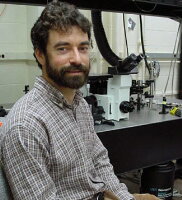
Paul R Selvin
· Professor of Biological PhysicsUniversity of Illinois Urbana-Champaign · Cell & Developmental Biology
Active 1988–2024
Academic metrics are sourced from OpenAlex and public funding records; values may differ from Google Scholar.
About
Paul R Selvin earned a Ph.D. from the University of California, Berkeley, in 1990, with a focus in biophysics. His thesis involved measuring the torsional rigidity of DNA using fluorophore intercalation, a project that resulted in a publication in Science and was later confirmed in single molecule experiments. During his postdoctoral training, he developed luminescence resonance energy transfer (LRET) based on lanthanides and used this technique to study potassium ion channels' response to voltage, as well as pioneering single molecule fluorescence measurements of FRET between a single donor and acceptor. Since joining the Department of Physics at the University of Illinois in 1997, Selvin's research has centered on molecular motors—proteins responsible for moving cargo within cells. He investigated how these motors, such as kinesin and dynein, move, whether they walk or inch along microtubules, and developed the FIONA technique to determine their movement with nanometer accuracy. His work demonstrated that these motors move in a hand-over-hand fashion, a significant scientific advance recognized by Science magazine. He extended his research to in vivo studies, measuring motor activity inside cells, and is now combining FIONA with optical trapping to explore motor function in living organisms. His future plans include in situ measurements in organisms like Planaria and C. elegans to understand motor behavior in real-life conditions.
Research topics
- Computer Science
- Materials science
- Chemistry
- Optics
- Biology
- Biochemistry
- Genetics
- Optoelectronics
- Computational biology
- Physics
Selected publications
TALEN outperforms Cas9 in editing heterochromatin target sites
Nature Communications · 2021 · 96 citations
Genome editing critically relies on selective recognition of target sites. However, despite recent progress, the underlying search mechanism of genome-editing proteins is not fully understood in the context of cellular chromatin environments. Here, we use single-molecule imaging in live cells to directly study the behavior of CRISPR/Cas9 and TALEN. Our single-molecule imaging of genome-editing proteins reveals that Cas9 is less efficient in heterochromatin than TALEN because Cas9 becomes encumbe…
Label-Free Imaging of Single Microtubule Dynamics Using Spatial Light Interference Microscopy
ACS Nano · 2016-12-20 · 54 citations
articleDue to their diameter, of only 24 nm, single microtubules are extremely challenging to image without the use of extrinsic contrast agents. As a result, fluorescence tagging is the common method to visualize their motility. However, such investigation is limited by photobleaching and phototoxicity. We experimentally demonstrate the capability of combining label-free spatial light interference microscopy (SLIM) with numerical processing for imaging single microtubules in a gliding assay. SLIM comb…
Short-Wave Infrared Quantum Dots with Compact Sizes as Molecular Probes for Fluorescence Microscopy
Journal of the American Chemical Society · 2020 · 48 citations
S shells with a small band gap. By tuning alloy composition alone, the emission can be shifted across the visible-to-SWIR (VIR) spectra while maintaining a small and equal size, allowing direct comparisons of molecular labeling performance across a broad range of wavelength. After coating with click-functional multidentate polymers, the VIR-QD spectral series has high quantum yield in the SWIR (14-33%), compact size (13 nm hydrodynamic diameter), and long-term stability in aqueous media during c…
ACS Nano · 2022 · 42 citations
targeting specificity. However, dextran-mimetic QDs provided enhanced signal-to-noise ratio for improved optical quantification, long-term photostability, and resistance to chemical fixation. In addition, the vascular circulation time for the QD-based probes was extended 9-fold compared with dextran, likely due to differences in conformational flexibility. The enhanced photophysical and photochemical properties of dextran-mimetic QDs may accelerate applications in macrophage targeting, tracking,…
Optimizing Quantum Dot Probe Size for Single-Receptor Imaging
ACS Nano · 2020-06-11 · 28 citations
articleOpen accessQuantum dots (QDs) are nanocrystals with bright fluorescence and long-term photostability, attributes particularly beneficial for single-molecule imaging and molecular counting in the life sciences. The size of a QD nanocrystal determines its physicochemical and photophysical properties, both of which dictate the success of imaging applications. Larger nanocrystals typically have better optical properties, with higher brightness, red-shifted emission, reduced blinking, and greater stability. How…
Recent grants
NIH · $402k · 2016
IDBR: Instrument Development for In Situ FIONA (Fluorescence Imaging with One Nanometer Accuracy)
NSF · $384k · 2007–2011
NIH · $4.3M · 2012
Frequent coauthors
- 24 shared
Ahmet Yıldız
University of California, Berkeley
- 23 shared
Pinghua Ge
University of Illinois Urbana-Champaign
- 20 shared
Andrew M. Smith
University of Illinois Urbana-Champaign
- 18 shared
Taekjip Ha
Howard Hughes Medical Institute
- 16 shared
John E. Hearst
- 16 shared
William N. Green
University of Chicago
- 14 shared
Gregory E. Snyder
Howard Hughes Medical Institute
- 14 shared
Okunola Jeyifous
University of Chicago
Awards & honors
- The International Raymond and Beverly Sackler Prize in Bioph…
- Fellow, American Physical Society (2004)
- Physics Sony Faculty Scholar, University of Illinois College…
- Michael & Kate Bárány Award for Young Investigators, Biophys…
- Research Innovation Award, Research Corporation (1999)
Similar researchers at University of Illinois Urbana-Champaign
- Resume-aware match score
- Save to shortlist
- AI-drafted outreach
See your match with Paul R Selvin
PhdFit ranks faculty by your research interests, methods, and publications — grounded in their actual work, not templates.
- Free to start
- No credit card
- 30-second signup