
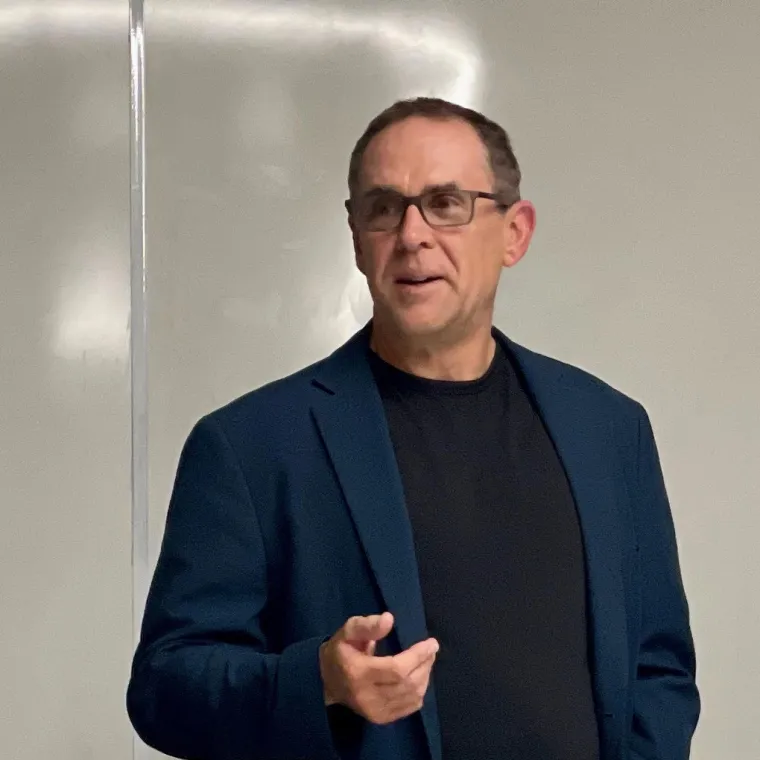
Michael McKenna
· Professor, Director, Graduate Admissions, Core FacultyUniversity of Arizona · Philosophy
Active 1982–2026
Academic metrics are sourced from OpenAlex and public funding records; values may differ from Google Scholar.
About
Michael McKenna is a professor and the Director of Graduate Admissions in the Department of Philosophy at the University of Arizona. He writes and teaches primarily on the related topics of free will and moral responsibility, and more generally in issues of metaphysics, ethics, action theory, and philosophical psychology. He arrived at the University of Arizona in 2010 and earned his Ph.D. from the University of Virginia in 1993. When not engaged in philosophical work, he enjoys cycling, skiing, and other outdoor activities, especially with his son Coen, his wife Danielle, and their four dogs.
Research topics
- Political Science
- Computer Science
- Epistemology
- Philosophy
- Criminology
- Social psychology
- Psychology
- Demography
- Medicine
- Internal medicine
Selected publications
Basically Deserved Blame and its Value
Journal of Ethics and Social Philosophy · 2019-07-01 · 72 citations
articleOpen access1st authorCorrespondingHow should we understand basic desert as a justification for blaming? Many philosophers account for free will by reference to the sort of moral responsibility that involves a blameworthy person deserving blame in a basic sense of desert; free will just is the control condition for this sort of moral responsibility. But what precisely does basic desert come to, and what is it about blame that makes it the thing that a blameworthy person deserves? As it turns out, there are challenges in attemptin…
Impact of COVID-19 on Cardiovascular Testing in the United States Versus the Rest of the World
JACC. Cardiovascular imaging · 2021 · 39 citations
OBJECTIVES: This study sought to quantify and compare the decline in volumes of cardiovascular procedures between the United States and non-U.S. institutions during the early phase of the coronavirus disease-2019 (COVID-19) pandemic. BACKGROUND: The COVID-19 pandemic has disrupted the care of many non-COVID-19 illnesses. Reductions in diagnostic cardiovascular testing around the world have led to concerns over the implications of reduced testing for cardiovascular disease (CVD) morbidity and mor…
PUNISHMENT AND THE VALUE OF DESERVED SUFFERING
Public Affairs Quarterly · 2020 · 28 citations
1st authorCorrespondingAbstract An assumption central to some forms of retributivism is that it is noninstrumentally good that a culpable wrongdoer suffers in receiving a deserved punishment. A justification for this can be built from a conversational theory of moral responsibility, and in particular deserved blame. On such a theory, deserved blame is fitting as a response to a wrongdoer insofar as it is conversationally meaningful as a reply to a wrong done. Punishment, it might be argued, has this feature too. The c…
A Lost Lesson in Keith Lehrer’s Reply to the Consequence Argument
Grazer Philosophische Studien · 2020-11-24 · 15 citations
article1st authorCorrespondingAbstract In this article, the author examines Keith Lehrer’s response to the Consequence Argument. He argues that his response has advantages over David Lewis’s. Contrary to what Lewis suggests in a footnote, Lehrer’s assessment of an ability to affect the laws of nature in deterministic settings is largely the same as Lewis’s. However, Lehrer’s position has an advantage that Lewis’s lacks. Lehrer integrates his proposal within a positive account of freedom, and this helps to explain how it coul…
Manipulation Arguments Against Compatibilism
Oxford University Press eBooks · 2022-02-14 · 7 citations
book-chapterSenior authorAbstract This chapter surveys the debate focused on manipulation arguments against the compatibility of moral responsibility in the basic desert sense and the naturalistic determination of an action by factors beyond the agent’s control. Manipulation arguments draw an analogy between such causal determination and intentional deterministic manipulation by other agents, claiming that because the intentional determination precludes responsibility, so does causal determination. The dialectical struc…
Frequent coauthors
- 32 shared
Benjamin Goebel
Eli Lilly (Germany)
- 32 shared
Leslee J. Shaw
- 20 shared
Andrew J. Einstein
Columbia University
- 20 shared
Cole B. Hirschfeld
New York Hospital Queens
- 16 shared
Michael Randazzo
University of Chicago Medical Center
- 16 shared
Kenneth Lee
University of British Columbia
- 16 shared
Eli Malkovskiy
New York Hospital Queens
- 16 shared
David Min
North Manchester General Hospital
Similar researchers at University of Arizona
- Resume-aware match score
- Save to shortlist
- AI-drafted outreach
See your match with Michael McKenna
PhdFit ranks faculty by your research interests, methods, and publications — grounded in their actual work, not templates.
- Free to start
- No credit card
- 30-second signup