
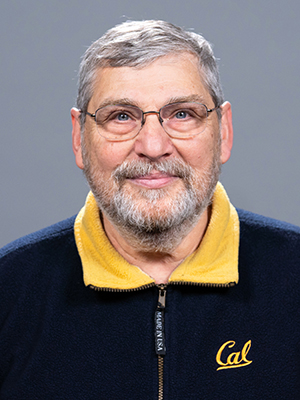
Michael Frenklach
· ProfessorUniversity of California, Berkeley · Mechanical Engineering
Active 1975–2025
Academic metrics are sourced from OpenAlex and public funding records; values may differ from Google Scholar.
About
Michael Frenklach is a Distinguished Professor of Mechanical Engineering at the University of California, Berkeley, and holds the Roscoe and Elizabeth Hughes Chair in Mechanical Engineering. His research focuses on chemical kinetics, computer modeling, and combustion chemistry, with particular interest in pollutant formation such as NOx and soot. His work encompasses the study of shock tubes, chemical vapor deposition of diamond films, and the homogeneous nucleation of silicon, silicon carbide, and diamond powders, as well as interstellar dust formation. Professor Frenklach is actively involved in advancing understanding in these areas through his research and laboratory work, contributing significantly to the field of combustion and chemical processes.
Research topics
- Materials science
- Chemical engineering
- Nanotechnology
- Physical chemistry
- Organic chemistry
- Physics
- Chemical physics
- Engineering
- Chemistry
Selected publications
On the mechanism of soot nucleation
Physical Chemistry Chemical Physics · 2020 · 207 citations
1st authorCorrespondingThe mechanism of carbon particulate (soot) inception has been a subject of numerous studies and debates. The article begins with a critical review of prior proposals, proceeds to the analysis of factors enabling the development of a meaningful nucleation flux, and then introduces new ideas that lead to the fulfillment of these requirements. In the new proposal, a rotationally-activated dimer is formed in the collision of an aromatic molecule and an aromatic radical; the two react during the life…
Why turquoise hydrogen will Be a game changer for the energy transition
International Journal of Hydrogen Energy · 2022-06-22 · 179 citations
articleSenior authorQuantifying uncertainty in kinetic simulation of engine autoignition
Combustion and Flame · 2020-03-13 · 25 citations
articleSenior authorOn the mechanism of soot nucleation. II. E-bridge formation at the PAH bay
Physical Chemistry Chemical Physics · 2020-01-01 · 24 citations
articleOpen accessCorrespondingA recently proposed mechanism of soot nucleation (M. Frenklach and A. M. Mebel, Phys. Chem. Chem. Phys., 2020, 22, 5314-5331) based upon the formation of a rotationally-activated dimer in the collision of an aromatic molecule and a radical leading to a stable, doubly-bonded E-bridge between them, rooted in the existence of a five-membered ring on the molecule edge, has been further investigated with a focus on the 5-6 E-bridge forming in the reaction of a PAH cyclopenta group with a bay site of…
On the Mechanism of Soot Nucleation. III. The Fate and Facility of the E-Bridge
The Journal of Physical Chemistry A · 2021-08-03 · 16 citations
articleOpen access1st authorCorrespondingRotationally excited dimerization of aromatic moieties is a mechanism proposed recently to explain the initial steps of soot particle inception in combustion and pyrolysis of hydrocarbons. The product of such dimerization, termed E-bridge, is an angled molecular structure composed of two aromatic rings sharing a common bond. The present study explores the immediate fate of the E-bridge. The performed theoretical analysis indicates that abstraction of a bridge H atom by a gaseous H leads to a rap…
Recent grants
Frequent coauthors
- 74 shared
William A. Lester
University of California, Berkeley
- 45 shared
Alexander M. Mebel
Florida International University
- 38 shared
Andrew Packard
University of California, Berkeley
- 26 shared
Hai Wang
Stanford University
- 21 shared
Dmitry Yu. Zubarev
- 20 shared
Nigel W. Moriarty
Lawrence Berkeley National Laboratory
- 20 shared
Russell Whitesides
Lawrence Livermore National Laboratory
- 19 shared
Alexander C. Kollias
United States Patent and Trademark Office
Similar researchers at University of California, Berkeley
- Resume-aware match score
- Save to shortlist
- AI-drafted outreach
See your match with Michael Frenklach
PhdFit ranks faculty by your research interests, methods, and publications — grounded in their actual work, not templates.
- Free to start
- No credit card
- 30-second signup