
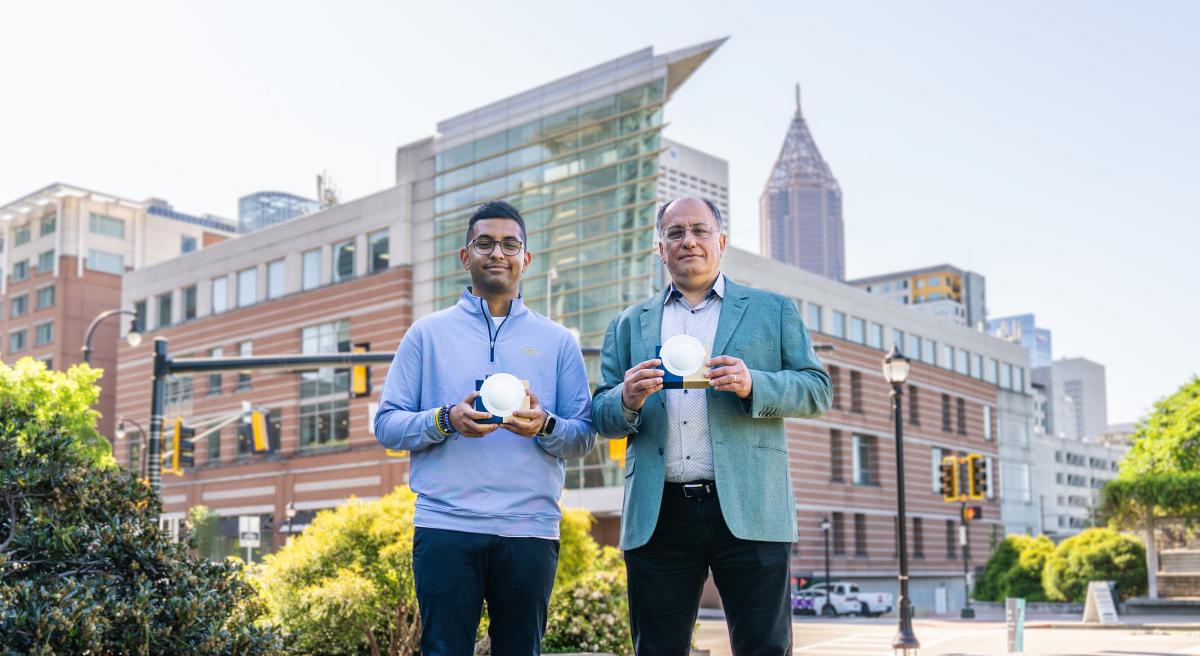
Marvin Joshi
· ProfessorGeorgia Institute of Technology · Electrical and Computer Engineering
Active 2020–2026
Academic metrics are sourced from OpenAlex and public funding records; values may differ from Google Scholar.
About
Professor Emmanouil 'Manos' Tentzeris is the Ed and Pat Joy Chair Professor in the School of Electrical and Computer Engineering at Georgia Tech. His research focuses on high-performance electromagnetic applications, particularly in the development of innovative wireless communication systems. Alongside Ph.D. candidate Marvin Joshi, he has contributed to the creation of a lens-enabled backscatter system capable of multi-gigabit data rates, reaching up to 4 Gbps while operating with minimal power consumption. This system leverages a dielectric lens to focus millimeter-wave energy onto tiny antenna elements, enabling high-speed, energy-efficient wireless communication without traditional transmitters. Professor Tentzeris's work demonstrates how advanced lens technology can overcome limitations of conventional backscatter systems, allowing for high data rates over wide angular coverage and distances up to 20 meters. His research aims to enable battery-free sensors and devices that can be deployed at scale in smart city infrastructure, disaster response, and other applications, providing fiber-like performance in a wireless, energy-efficient manner. His ongoing efforts include moving from proof-of-concept to real-world deployment, integrating these systems into mobile platforms and infrastructure, and exploring AI-based optimization to enhance system performance.
Research topics
- Artificial Intelligence
- Computer Science
- Computer vision
- Telecommunications
- Real-time computing
- Electronic engineering
- Algorithm
- Engineering
Selected publications
Proceedings of the IEEE · 2024-08-01 · 32 citations
reviewOpen accessEmerging additive manufacturing (AM) technologies, specifically additively manufactured electronics (AME), 4-D printing, and origami, are reshaping the design capabilities and functionalities of contemporary electronic devices. Cutting-edge 3-D/4-D printing technologies facilitate the prototyping and realization of complex electronic functions that are challenging to conventional methods. This article provides a comprehensive overview of the evolving techniques in AME, 4-D printing, and origami,…
IEEE Journal of Radio Frequency Identification · 2024-01-01 · 9 citations
article1st authorCorrespondingThe rise and progression of the Internet of Things (IoT) have reshaped how devices connect and share information, leading to more intelligent and interconnected settings. In this realm, the incorporation of self-sustaining millimeter-wave Identification (mmID) devices present a compelling opportunity to elevate IoT implementations, especially concerning accurate positioning and monitoring capabilities. In this work, the authors introduce a novel lens-enabled passive mmID tailored for highly accu…
IEEE Antennas and Wireless Propagation Letters · 2024-12-09 · 8 citations
article1st authorCorrespondingRecent advancements in 5G/millimeter-wave (mmWave) technologies have led to the development of next- generation IoT devices that provide large-scale connectivity and high data rates. To ensure reliable communication and consistent performance, these devices must have wide angular coverage and high detectability, allowing them to maintain stable connectivity regardless of their orientation or positioning. In this work, we introduced a 3-D lens-enabled semipassive millimeter-wave identification (m…
Machine Learning-Enhanced Gyro mmID-Sensor for Virtual Reality and Motion Tracking Applications
2021 18th European Radar Conference (EuRAD) · 2023 · 8 citations
1st authorCorrespondingThe development of virtual reality (VR) and augmented reality (AR) technologies has drawn great attention in recent times due to the wide variety of applications they can enable, spanning from surgery training to motion capture and everyday users in VR spaces. In order to further enhance the user experience, real-time and accurate orientation detection of the user, the authors propose the usage of a Frequency-Modulated Continuous-Wave (FMCW) radar system with an ultra-low-power, sticker-like mmI…
IEEE Transactions on Microwave Theory and Techniques · 2024-05-09 · 5 citations
article1st authorCorrespondingThe development of flexible phased array systems has drawn significant interest due to their adaptive beam steerability and deployable structures to support various platforms virtually on every conformal surface. Additively manufactured tile-based phased array offers a lightweight, flexible, and massively scalable solution with reduced cost and fabrication time. The main challenge for such conformal phased array systems is to maintain array performance under various deformations, which requires…
Frequent coauthors
- 11 shared
Manos M. Tentzeris
Georgia Institute of Technology
- 8 shared
Genaro Soto-Valle
Georgia Institute of Technology
- 7 shared
Charles A. Lynch
Georgia Institute of Technology
- 7 shared
Kexin Hu
Georgia Institute of Technology
- 4 shared
Abdel-Kareem Moadi
Knoxville College
- 4 shared
Aly E. Fathy
University of Tennessee at Knoxville
- 4 shared
H. Jamal
Georgia Institute of Technology
- 2 shared
Bing Zhang
Sichuan University
Labs
ATHENA LabPI
- Resume-aware match score
- Save to shortlist
- AI-drafted outreach
See your match with Marvin Joshi
PhdFit ranks faculty by your research interests, methods, and publications — grounded in their actual work, not templates.
- Free to start
- No credit card
- 30-second signup