
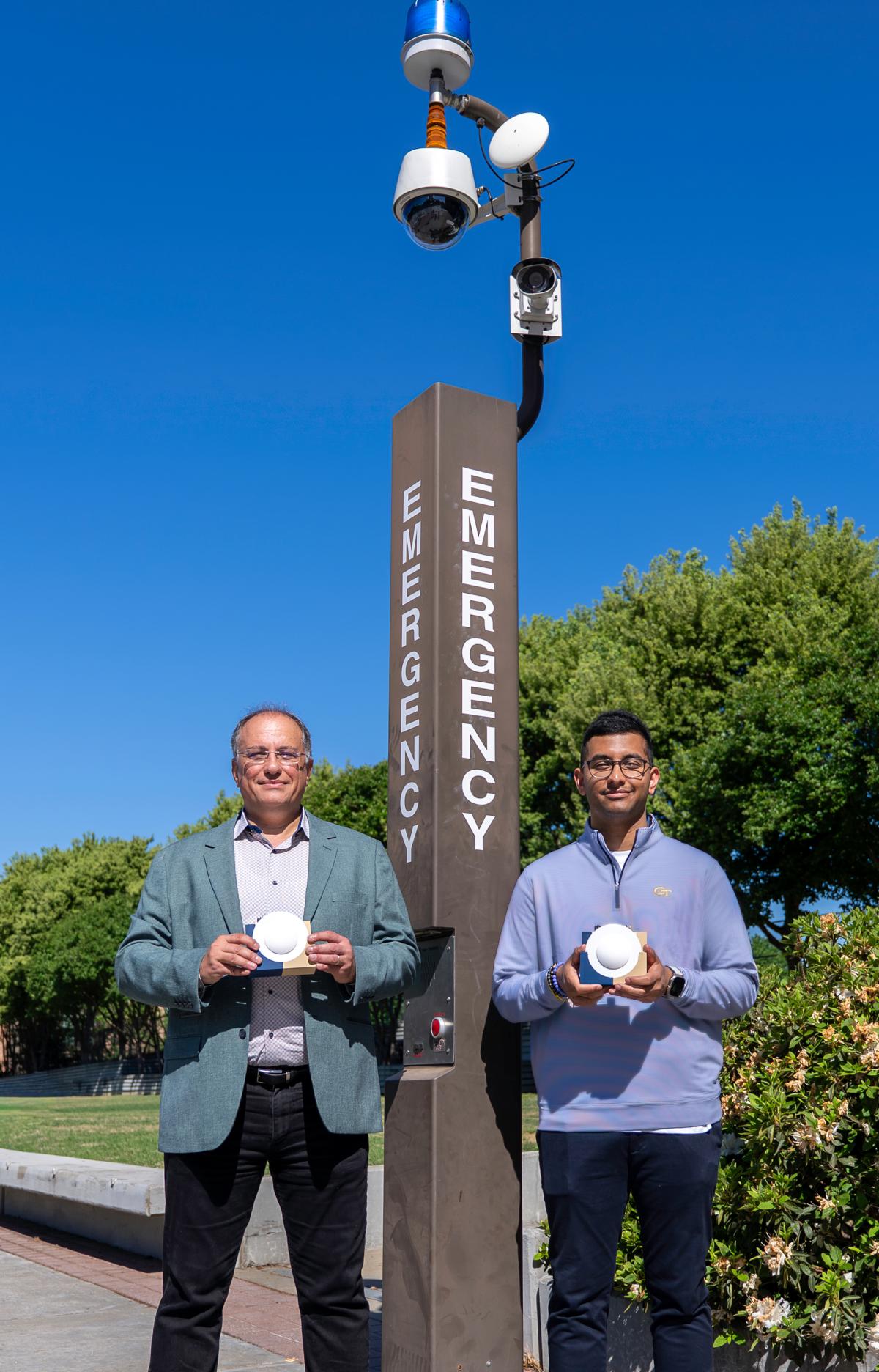
Emmanouil Tentzeris
· ProfessorGeorgia Institute of Technology · Electrical and Computer Engineering
Active 1994–2026
Academic metrics are sourced from OpenAlex and public funding records; values may differ from Google Scholar.
About
Emmanouil Tentzeris, also known as Manos, is a professor in the School of Electrical and Computer Engineering at Georgia Tech, holding the Ed and Pat Joy Chair. His research focuses on electromagnetic applications, particularly in the development of innovative wireless communication systems. He leads the Agile Technologies for High-performance Electromagnetic Novel Applications (ATHENA) lab, where his team has demonstrated groundbreaking work in high-speed, ultra-low-power wireless communication using lens-enabled backscatter systems. His recent contributions include the development of a lens‑enabled backscatter system capable of multi-gigabit data rates, reaching up to 4 Gbps while operating at a fraction of the power required by traditional wireless devices. This system leverages a dielectric lens to focus millimeter-wave energy onto tiny antenna arrays, enabling high-speed data transmission over wide angular coverage without active beam steering. The technology supports applications in smart cities, disaster response, and next-generation wireless networks, aligning with the evolving needs of 5G and 6G infrastructures. Tentzeris's work emphasizes scalable, cost-effective, and energy-efficient wireless solutions that can be integrated into everyday infrastructure and devices, pushing the boundaries of what is possible in wireless communication.
Selected publications
Proceedings of the IEEE · 2021-11-15 · 109 citations
articleOpen accessSenior authorBackscatter communication is an emerging paradigm for pervasive connectivity of low-power communication devices. Wirelessly powered backscattering wireless sensor networks (WSNs) become particularly important to meet the upcoming era of the Internet of Things (IoT), which requires the massive deployment of self-sustainable and maintenance-free low-cost sensing and communication devices. This article will introduce the state-of-the-art antenna design and radio frequency (RF) system integration fo…
Scientific Reports · 2021-01-12 · 104 citations
articleOpen accessSenior author5G has been designed for blazing fast and low-latency communications. To do so, mm-wave frequencies were adopted and allowed unprecedently high radiated power densities by the FCC. Unknowingly, the architects of 5G have, thereby, created a wireless power grid capable of powering devices at ranges far exceeding the capabilities of any existing technologies. However, this potential could only be realized if a fundamental trade-off in wireless energy harvesting could be circumvented. Here, we propo…
Nature Electronics · 2021-06-10 · 90 citations
articleOpen accessSenior authorAbstract Future devices for the Internet of Things will require communication systems that can deliver higher data rates at low power. Backscatter radio—in which wireless communication is achieved via reflection rather than radiation—is a low-complexity approach that requires a minimal number of active elements. However, it is typically limited to data rates of hundreds of megabits per second because of the low frequency bands used and the modulation techniques involved. Here we report a millime…
A Highly Efficient, Scalable, Tetra-Band Metamaterial-Based Ambient RF Energy Harvester
IEEE Transactions on Microwave Theory and Techniques · 2025-04-14 · 7 citations
articleOpen accessThis article presents an innovative metamaterial-based radio frequency (RF) energy harvesting system designed to efficiently capture ambient RF energy across multiple frequency bands, including Wi-Fi (2.45 GHz) and 5G (0.9, 1.8, 2.1 GHz). Utilizing electric inductive-capacitive resonators and a rectification circuit, the system converts ambient RF energy into direct current (dc) power with high efficiency. Specifically, a single unit cell of the proposed <inline-formula xmlns:mml="http://www.w3.…
IEEE Microwave and Wireless Technology Letters · 2025-05-28 · 4 citations
articleSenior authorFor the first time, the authors propose a 3-D lens-enabled, broadbeam energy harvester capable of mW-level of harvested power across a wide angular coverage. The design incorporates a 25-rectenna “pixel” array, each featuring a circularly polarized antenna with a highly sensitive half-wave rectifier, and an equiconvex 3-D dielectric lens to enhance power capture and angular coverage. In a proof-of-concept testing, the harvester achieved a peak power capture of 6.5 mW and maintained mW level of h…
Labs
ATHENAPI
Similar researchers at Georgia Institute of Technology
- Resume-aware match score
- Save to shortlist
- AI-drafted outreach
See your match with Emmanouil Tentzeris
PhdFit ranks faculty by your research interests, methods, and publications — grounded in their actual work, not templates.
- Free to start
- No credit card
- 30-second signup