
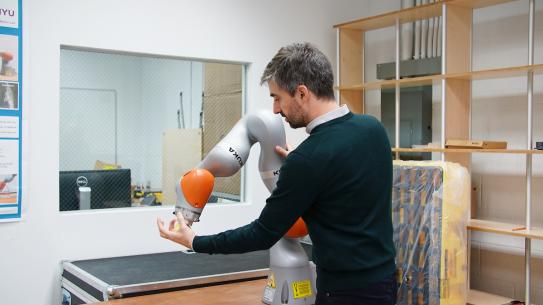
Ludovic Righetti
New York University · Computer Science
Active 2003–2026
Academic metrics are sourced from OpenAlex and public funding records; values may differ from Google Scholar.
About
Ludovic Righetti is a professor jointly appointed in the Electrical and Computer Engineering Department and the Mechanical and Aerospace Engineering Department at NYU Tandon School of Engineering. He also holds an International Chair at the Artificial and Natural Intelligence Toulouse Institute. Righetti co-created and co-directs the Center for Robotics and Embodied Intelligence and is a member of the Center for Responsible AI, the Center for Urban Science and Progress, and the Center for Advanced Technology in Telecommunications. His research focuses on the planning and control of movements for autonomous robots, with particular emphasis on legged locomotion and manipulation. He is interested in questions at the intersection of decision-making, automatic control, optimization, applied dynamical systems, and machine learning, and their applications to physical systems. Righetti studies societal implications of robotics and technology, aiming to empower people, improve quality of life, and foster just, open, and equal societies. He received his engineering diploma in Computer Science and a Doctorate in Science from the Ecole Polytechnique Fédérale de Lausanne, Switzerland, and has held postdoctoral and research positions at the University of Southern California and the Max-Planck Institute for Intelligent Systems in Germany. His work has earned numerous awards, including the Heinz Maier-Leibnitz Prize, the IEEE Robotics and Automation Society Early Career Award, and NYU's…
Research topics
- Artificial Intelligence
- Computer Science
- Simulation
- Human–computer interaction
- Engineering
Selected publications
On the use of simulation in robotics: Opportunities, challenges, and suggestions for moving forward
Proceedings of the National Academy of Sciences · 2020 · 155 citations
The last five years marked a surge in interest for and use of smart robots, which operate in dynamic and unstructured environments and might interact with humans. We posit that well-validated computer simulation can provide a virtual proving ground that in many cases is instrumental in understanding safely, faster, at lower costs, and more thoroughly how the robots of the future should be designed and controlled for safe operation and improved performance. Against this backdrop, we discuss how s…
Diffusion-based learning of contact plans for agile locomotion
2024-11-22 · 7 citations
articleLegged robots have become capable of performing highly dynamic maneuvers in the past few years. However, agile locomotion in highly constrained environments such as stepping stones is still a challenge. In this paper, we propose a combination of model-based control, search, and learning to design efficient control policies for agile locomotion on stepping stones. In our framework, we use nonlinear model predictive control (NMPC) to generate whole-body motions for a given contact plan. To efficie…
Cost Function Estimation Using Inverse Reinforcement Learning with Minimal Observations
2025-10-19 · 1 citations
articleSenior authorWe present an iterative inverse reinforcement learning algorithm to infer optimal cost functions in continuous spaces. Based on a popular maximum entropy criteria, our approach iteratively finds a weight improvement step and proposes a method to find an appropriate step size that ensures learned cost function features remain similar to the demonstrated trajectory features. In contrast to similar approaches, our algorithm can individually tune the effectiveness of each observation for the partiti…
Should We Learn Contact-Rich Manipulation Policies From Sampling-Based Planners?
IEEE Robotics and Automation Letters · 2025-04-28 · 1 citations
articleThe tremendous success of behavior cloning (BC) in robotic manipulation has been largely confined to tasks where demonstrations can be effectively collected through human teleoperation. However, demonstrations for contact-rich manipulation tasks that require complex coordination of multiple contacts are difficult to collect due to the limitations of current teleoperation interfaces. We investigate how to leverage model-based planning and optimization to generate training data for contact-rich de…
Minimal Observations Inverse Reinforcement Learning for Predicting Human Box-Lifting Motions
2025-09-30 · 1 citations
articleHeavy-load manual lifting poses a significant risk of injury, motivating the need for personalized robotic assistance. The Minimal Observations Inverse Reinforcement Learning (MO-IRL) algorithm has recently demonstrated strong capabilities in recovering underlying optimality principles from very few demonstrations of simulated robotic motions, and at a very reasonable computational cost. Building on this, the present study integrates ten biomechanically informed cost functions into a direct opti…
Recent grants
Risk-Aware Planning and Control of Robot Motion Including Intermittent Physical Contact
NSF · $403k · 2018–2022
NRI: FND: Action-perception loops over 5G millimeter wave wireless for cooperative manipulation
NSF · $750k · 2019–2023
Frequent coauthors
- 80 shared
Stefan Schaal
Google (United States)
- 78 shared
Majid Khadiv
- 41 shared
Auke Jan Ijspeert
- 41 shared
Alexander Herzog
- 33 shared
Avadesh Meduri
New York University
- 32 shared
Justin Carpentier
Département d'Informatique
- 29 shared
Bilal Hammoud
New York University
- 28 shared
Jonas Buchli
Labs
Education
- 2008
Doctorate in Science, Computer Science
École Polytechnique Fédérale de Lausanne
- 2004
Computer Science Diploma, Computer Science
École Polytechnique Fédérale de Lausanne
Awards & honors
- 2010 Georges Giralt PhD Award for the best PhD thesis in Eur…
- 2011 IEEE/RSJ International Conference on Intelligent Robots…
- 2016 IEEE Robotics and Automation Society Early Career Award
- 2016 Heinz Maier-Leibnitz Prize from the German Research Fou…
- 2024 NYU Tandon's Jacobs Excellence in Education Innovation…
Similar researchers at New York University
- Resume-aware match score
- Save to shortlist
- AI-drafted outreach
See your match with Ludovic Righetti
PhdFit ranks faculty by your research interests, methods, and publications — grounded in their actual work, not templates.
- Free to start
- No credit card
- 30-second signup