
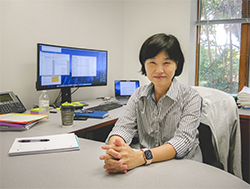
Jeongim Kim
· Associate ProfessorUniversity of Florida · Horticultural Sciences
Active 2007–2026
Academic metrics are sourced from OpenAlex and public funding records; values may differ from Google Scholar.
About
Dr. Jeongim Kim is an associate professor in the Horticultural Sciences Department at the University of Florida and a member of the Plant Molecular and Cellular Biology (PMCB) graduate program. She earned her PhD at Purdue University, where she studied auxin biosynthesis and plant abiotic stress physiology. During her post-doctoral training at Purdue, Dr. Kim focused on phenylpropanoid biosynthesis and participated in several projects aimed at increasing biofuel production. Her research interests center on understanding the molecular mechanisms underlying metabolic networks that integrate plant stress responses and growth.
Research topics
- Biochemistry
- Biology
- Chemistry
- Botany
- Food science
Selected publications
Aldoximes are precursors of auxins in Arabidopsis and maize
New Phytologist · 2021 · 43 citations
Senior authorCorrespondingTwo natural auxins, phenylacetic acid (PAA) and indole-3-acetic acid (IAA), play crucial roles in plant growth and development. One route of IAA biosynthesis uses the glucosinolate intermediate indole-3-acetaldoxime (IAOx) as a precursor, which is thought to occur only in glucosinolate-producing plants in Brassicales. A recent study showed that overproducing phenylacetaldoxime (PAOx) in Arabidopsis increases PAA production. However, it remains unknown whether this increased PAA resulted from hyd…
Occurrence, Function, and Biosynthesis of the Natural Auxin Phenylacetic Acid (PAA) in Plants
Plants · 2023-01-06 · 30 citations
reviewOpen accessSenior authorCorrespondingAuxins are a class of plant hormones playing crucial roles in a plant's growth, development, and stress responses. Phenylacetic acid (PAA) is a phenylalanine-derived natural auxin found widely in plants. Although the auxin activity of PAA in plants was identified several decades ago, PAA homeostasis and its function remain poorly understood, whereas indole-3-acetic acid (IAA), the most potent auxin, has been used for most auxin studies. Recent studies have revealed unique features of PAA distinc…
Food Chemistry Advances · 2024-05-08 · 29 citations
articleOpen accessThe potential of storing ‘Budd Blood’ blood orange fruit at different temperatures (6, 8, 10, and 12°C) for 60 days after harvest was investigated to enhance anthocyanin, total phenolic content, antioxidant activity, and to understand temperature effects on other physicochemical attributes. Fruit weight and firmness losses increased during storage, with the lowest losses occurring at 6°C. Titratable acidity (TA) decreased, and the lowest values were recorded at 10 and 12°C. Total soluble solids…
Food Chemistry Advances · 2023-03-09 · 25 citations
articleOpen access• A variation in phenolic compounds was found in juice and peel between 14 varieties. • Pomegranate peel contains the highest levels of gallic and ellagic acids. • Punicalagin a and b presented the highest phenolic content in pomegranate juice. Pomegranate ( Punica granatum L.) fruit contain several health-promoting compounds, but the profiles of these compounds and their variations in nutraceutical value are still lacking. Thus, the profile of phenolic compounds in juice and peel of fourteen po…
Aldoxime Metabolism Is Linked to Phenylpropanoid Production in Camelina sativa
Frontiers in Plant Science · 2020 · 25 citations
Senior authorCorrespondinginvolved in PAL degradation is up-regulated in the transgenic lines. Our results suggest a link between aldoxime metabolism and phenylpropanoid production in Camelina and that the molecular mechanism behind the crosstalk is conserved in Arabidopsis and Camelina.
Recent grants
CAREER:Unraveling the metabolic networks underlying plant stress adaptation
NSF · $1.1M · 2022–2027
Frequent coauthors
- 30 shared
Clint Chapple
Purdue University West Lafayette
- 15 shared
Xuebin Zhang
Henan University
- 12 shared
Jian Shi
University of Kentucky
- 12 shared
Nickolas Anderson
Pepsi (United States)
- 12 shared
Anna K. Block
United States Department of Agriculture
- 10 shared
Ray A. Bressan
- 9 shared
Ru Dai
University of Florida
- 9 shared
Blake A. Simmons
Labs
Similar researchers at University of Florida
- Resume-aware match score
- Save to shortlist
- AI-drafted outreach
See your match with Jeongim Kim
PhdFit ranks faculty by your research interests, methods, and publications — grounded in their actual work, not templates.
- Free to start
- No credit card
- 30-second signup