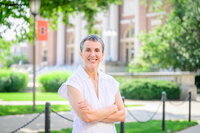
Ilana Redstone
· Associate ProfessorUniversity of Illinois Urbana-Champaign · Sociology
Active 2020–2020
About
Ilana Redstone is an Associate Professor in the Department of Sociology at Illinois College of Liberal Arts & Sciences. She earned her PhD from the University of Pennsylvania in 2005. Her research interests include viewpoint diversity, political polarization, and education. Redstone has authored the book 'The Certainty Trap: Why We Need to Question Ourselves More — and How We Can Judge Others Less,' which is available on Amazon. Her work explores how unwritten rules and social media shape discourse in American higher education, as well as ideological conditioning in education and democracy. She is affiliated with the Social & Behavioral Sciences Institute and teaches courses such as Sociology of Political Polarization, Social Problems, and Introduction to Social Statistics.
Research topics
- Computer Science
- World Wide Web
- Psychology
Selected publications
Academic Freedom, With an Asterisk
Oxford University Press eBooks · 2020
1st authorCorresponding- Computer Science
- Computer Science
- World Wide Web
Abstract Colleges tend to have policies on academic freedom that on their face appear to confer broad protection. But the actual scope of protection is a matter of interpretation, and is often much narrower. In practice, the measure of acceptable campus expression is often based on the extent to which speech offends or is viewed as harmful. The contemporary technology environment amplifies this dynamic. Social media help ensure that expression that is accused of being offensive is communicated to the very people most likely to view it as such, leading to a feedback cycle that further increases the risks that opinions or research conclusions falling outside of campus-proscribed boundaries will attract attention and protest. This is the academic freedom elephant in the room, and it plays a far more powerful role in shaping discourse and research than does the text in a university’s formal academic freedom policy.
Oxford University Press eBooks · 2020 · 9 citations
1st authorCorresponding- Psychology
Abstract Colleges and universities in the United States play a profoundly important role in American society. Currently, that role is being hampered by a climate that constrains teaching, research, hiring, and overall discourse. There are three core beliefs that define this climate. First, any initiative framed as an antidote to historical societal ills is automatically deemed meritorious, and thus exempted from objective scrutiny of its potential effectiveness. However, to use a medical analogy, not all proposed cures for a disease are good cures. Second, all differences in group-level outcomes are assumed to be due entirely to discrimination, with little tolerance given to exploring the potential role of factors such as culture or preferences. Third, everything must be interpreted through the lens of identity. Non-identity-centered perspectives, regardless of how worthy they might be, are viewed as less legitimate or even illegitimate. All of these beliefs are well intentioned and have arisen in response to important historical and continuing injustices. However, they are enforced in uncompromising terms through the use of social media, which has gained an ascendant role in shaping the culture of American campuses. The result is a climate that forecloses entire lines of research, entire discussions, and entire ways of conducting classroom teaching. The book explains these three beliefs in detail and provides an extensive list of case studies illustrating how they are impacting education and knowledge creation—and increasingly the world beyond campus. The book also provides a detailed set of recommendations on ways to help foster an environment on American campuses that would be more tolerant of diverse perspectives and open inquiry. A note about Covid-19: While the production of this book was done in spring and summer of 2020, we completed the manuscript in 2019, well before the Covid-19 pandemic shuttered American college campuses in March 2020. To put it mildly, the dynamics of campus discourse are very different when dorms have been largely emptied and instruction has been moved to Zoom. Of course, at present we cannot know when students will be able to return to campus in significant numbers. That said, we are confident that our call for a culture of more open discourse in higher education will remain relevant both during the pandemic and after it has passed.
Oxford University Press eBooks · 2020
1st authorCorresponding- Computer Science
- Computer Science
Extract This is not a book about free speech on campus. While there are some chapters where we consider speech, the real focus of the book is much broader: We examine the challenges to free inquiry and discourse that we see in academia and, increasingly, in society more broadly. At many universities today, there is a set of closely held beliefs, enforced through social media, that constrain much of what is taught, studied, and discussed—or not—on campus. Our goal in this book is to describe the state of affairs in the academy and the ways in which all arms of the academic enterprise are affected. We hope that by exploring the set of beliefs that shape teaching, research, and the campus climate more generally, we can contribute to a broader discussion on free inquiry, knowledge creation, knowledge dissemination, and the role of higher education. For readers who share our general concerns about the current academic climate, our hope is that this book can provide new and useful information and perspectives on some of the specific factors that are shaping that climate. For readers who are inclined to disagree with us—those, for example, who think that free inquiry and discourse on American college campuses is not too narrowly constrained—we hope that this book will be viewed as a respectful counterpoint to an on-campus narrative that we believe would benefit from a broader range of views.
Frequent coauthors
- 2 shared
John Villasenor
Brookings Institution
Similar researchers at University of Illinois Urbana-Champaign
- Resume-aware match score
- Save to shortlist
- AI-drafted outreach
See your match with Ilana Redstone
PhdFit ranks faculty by your research interests, methods, and publications — grounded in their actual work, not templates.
- Free to start
- No credit card
- 30-second signup