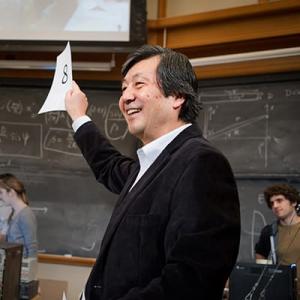
Harry Asada
· ProfessorMassachusetts Institute of Technology · Mechanical Engineering
Active 1976–2025
Academic metrics are sourced from OpenAlex and public funding records; values may differ from Google Scholar.
About
Harry Asada is the Ford Professor of Engineering and a Professor of Mechanical Engineering at the Massachusetts Institute of Technology. His research interests include augmenting human capabilities with wearable robots, modeling and understanding cell interactions through numerical simulations, and building and controlling harmonic actuators based on piezo-electric units. He has contributed to the development of assistive robots for passengers in railway stations, supernumerary robotic limbs, and underwater robots for port security, including a submersible robot capable of undetected ultrasound scans along underwater surfaces. Professor Asada's academic background includes a B.Sc., M.Sc., and Ph.D. from Kyoto University in Japan. His extensive research portfolio encompasses the design of elastic robot hands for precision operations, control of direct-drive robotic arms, and analysis of manipulator dynamics. He has received numerous awards for his work, including best paper awards, the Henry Paynter Outstanding Researcher Award, and the Ruth and Joel Spira Award for Distinguished Teaching. He is a Fellow of the IEEE and a member of the American Society of Mechanical Engineers, with a long-standing history of service at MIT, including leadership roles in control, instrumentation, and robotics committees. His contributions have significantly advanced the fields of robotics, control systems, and mechanical design.
Research topics
- Computer Science
- Artificial Intelligence
- Engineering
- Simulation
- Embedded system
- Materials science
- Biology
- Structural engineering
- Biochemistry
- Chemistry
Selected publications
Development of a Wheeled Wall-Climbing Robot with a Shape-Adaptive Magnetic Adhesion Mechanism
2020 · 76 citations
Senior authorCorrespondingThis paper presents a wheeled wall-climbing robot with a shape-adaptive magnetic adhesion mechanism for large steel structures. To travel up and down various curved ferromagnetic surfaces, we developed a 2 DOF rotational magnetic adhesion mechanism installed on each wheel that can change the orientation of the magnets to keep the magnetic force direction always normal to the contact surface. These magnetic wheels have a spherical shape and can move relative to the main body by a non-elastic susp…
Otariidae-Inspired Soft-Robotic Supernumerary Flippers by Fabric Kirigami and Origami
IEEE/ASME Transactions on Mechatronics · 2020 · 69 citations
Wearable robotic devices are receiving rapidly growing attentions for human-centered scenarios from medical, rehabilitation, to industrial applications. Supernumerary robotic limbs have been widely investigated for the augmentation of human limb functions, both as fingers and manipulator arms. Soft robotics offers an alternative approach to conventional motor-driven robot limbs toward safer and lighter systems, while pioneering soft supernumerary limbs are strongly limited in payload and dexteri…
Supernumerary Robotic Limbs to Assist Human Walking With Load Carriage
Journal of Mechanisms and Robotics · 2020 · 61 citations
Abstract Walking with load carriage is a common requirement for individuals in many situations. Legged exoskeletons can transfer the load weight to the ground with rigid-leg structures, thus reducing the load weight borne by the human user. However, the inertia of paralleled structures and the mechanical joint tend to disturb natural motions of human limbs, leading to high-energy consumption. Different from exoskeletons, Supernumerary Robotic Limbs (SuperLimbs) are kinematically independent of t…
A computational modeling of invadopodia protrusion into an extracellular matrix fiber network
Scientific Reports · 2022 · 13 citations
Senior authorCorrespondingInvadopodia are dynamic actin-rich membrane protrusions that have been implicated in cancer cell invasion and metastasis. In addition, invasiveness of cancer cells is strongly correlated with invadopodia formation, which are observed during extravasation and colonization of metastatic cancer cells at secondary sites. However, quantitative understanding of the interaction of invadopodia with extracellular matrix (ECM) is lacking, and how invadopodia protrusion speed is associated with the frequen…
IEEE Access · 2023-12-25 · 11 citations
articleOpen accessSenior authorFalls may cause serious injuries to older adults, leading to a deteriorated quality of life. Currently, fall injury prevention devices are lacking, especially for the balance impaired population who rely on mobility aids. Here, the functionality of a walker is augmented, so that it can predict a fall in real-time and prevent fall injuries with a rapidly reconfigurable mechanism. A key challenge is real-time fall prediction, which is a time-critical decision making process. A fall must be predict…
Recent grants
Collaborative Research: NRI: Remotely Operated Reconfigurable Walker Robots for Eldercare
NSF · $620k · 2022–2025
NSF · $311k · 2007–2010
Control-Configured Underwater Robots for Precision Multi-Axis Maneuvering
NSF · $375k · 2014–2017
Frequent coauthors
- 65 shared
Lee‐Ling Sharon Ong
- 57 shared
Roger D. Kamm
Massachusetts Institute of Technology
- 41 shared
Sahan C. B. Herath
Singapore-MIT Alliance for Research and Technology
- 37 shared
Peter C. Y. Chen
National University of Singapore
- 36 shared
Hai Zhu
Anhui Medical University
- 36 shared
Matthew J. Lang
Vanderbilt University
- 36 shared
Debasis Banik
University of Cambridge
- 36 shared
Ellis L. Reinherz
Dana-Farber Cancer Institute
Labs
Education
- 1978
Ph.D, Precision Engineering
Kyoto University
Awards & honors
- Best Paper Award, Aug. 1979 Society of Instrument and Contro…
- Best Paper Award Aug. 1984 Society of Instrument and Control…
- SME Outstanding Young Manufacturing Engineer Award Sept. 198…
- O.Hugo Schuck Best Paper Award, May 1985 American Control Co…
- Y.Sawargi Best Paper Award, May 1988 Japanese Association of…
Similar researchers at Massachusetts Institute of Technology
- Resume-aware match score
- Save to shortlist
- AI-drafted outreach
See your match with Harry Asada
PhdFit ranks faculty by your research interests, methods, and publications — grounded in their actual work, not templates.
- Free to start
- No credit card
- 30-second signup