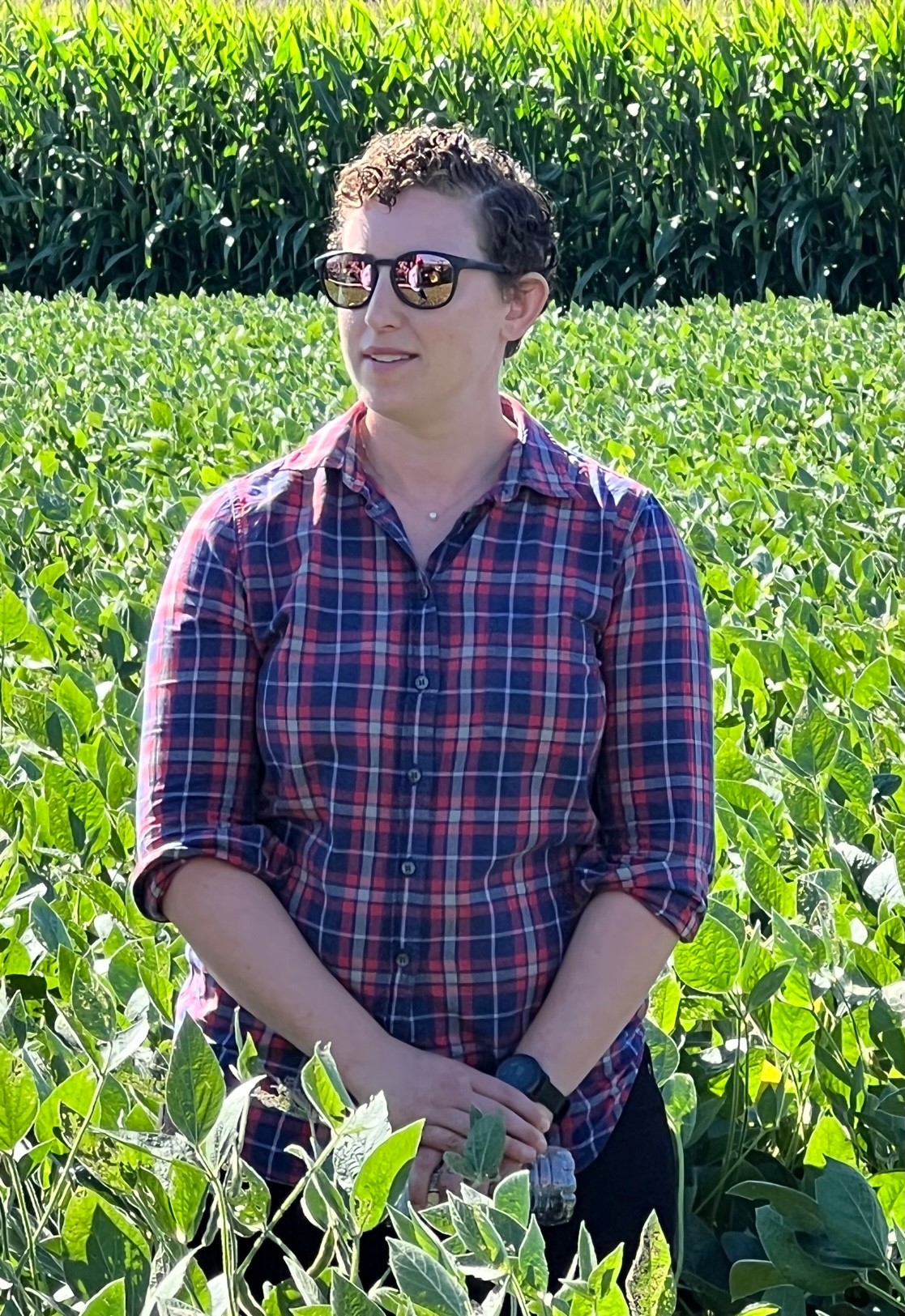
Emily Bick
· Assistant ProfessorUniversity of Wisconsin-Madison · Entomology
Active 2016–2024
About
Emily Bick is an Assistant Professor in the Department of Entomology at the University of Wisconsin-Madison. She holds a Ph.D. and M.S. in Entomology & Nematology from UC Davis, earned in 2019 and 2017 respectively, and a B.S. in Entomology from Cornell University obtained in 2013. Her research focuses on applied agroecology, digital entomology through modeling and technology, and spatial population biology. The goal of her work is to develop tools and strategies that support data-driven precision management practices in entomology. She is engaged in advancing understanding and management of insect populations with an emphasis on practical applications in agriculture.
Research topics
- Ecology
- Artificial Intelligence
- Biology
- Computer Science
- Agronomy
- Environmental science
- Remote sensing
- Horticulture
- Geography
- Real-time computing
Selected publications
Automating insect monitoring using unsupervised near-infrared sensors
Scientific Reports · 2022 · 77 citations
- Computer Science
- Artificial Intelligence
- Computer Science
Insect monitoring is critical to improve our understanding and ability to preserve and restore biodiversity, sustainably produce crops, and reduce vectors of human and livestock disease. Conventional monitoring methods of trapping and identification are time consuming and thus expensive. Automation would significantly improve the state of the art. Here, we present a network of distributed wireless sensors that moves the field towards automation by recording backscattered near-infrared modulation signatures from insects. The instrument is a compact sensor based on dual-wavelength infrared light emitting diodes and is capable of unsupervised, autonomous long-term insect monitoring over weather and seasons. The sensor records the backscattered light at kHz pace from each insect transiting the measurement volume. Insect observations are automatically extracted and transmitted with environmental metadata over cellular connection to a cloud-based database. The recorded features include wing beat harmonics, melanisation and flight direction. To validate the sensor's capabilities, we tested the correlation between daily insect counts from an oil seed rape field measured with six yellow water traps and six sensors during a 4-week period. A comparison of the methods found a Spearman's rank correlation coefficient of 0.61 and a p-value = 0.0065, with the sensors recording approximately 19 times more insect observations and demonstrating a larger temporal dynamic than conventional yellow water trap monitoring.
Hydrobiologia · 2020 · 19 citations
1st authorCorresponding- Biology
- Agronomy
- Ecology
Journal of Economic Entomology · 2020 · 10 citations
1st authorCorresponding- Biology
- Agronomy
- Horticulture
The three-cornered alfalfa hopper, Spissistilus festinus (Say), was shown to transmit Grapevine red blotch virus (GRBV), the causative agent for Grapevine red blotch disease, in a greenhouse study on grapes. GRBV is a major concern of wine grape growers due to its economic impact on wine quality. Plants in the family Fabaceae are preferred hosts of S. festinus and are commonly planted as cover crops or present in a vineyard's native vegetation. In late winter, during grapevine dormancy, S. festinus migrate into vineyards to feed and reproduce on these cover crop and weed hosts. Tilling vineyard floor vegetation provides growers an opportunity to disrupt the life cycle of early instars that are relatively immobile, reducing the S. festinus first-generation population. Nymphal presence is difficult to detect. First through third instars were not detected in sweep net samples in a 2-yr weekly sampling study, whereas fourth and fifth instars were first found on the same sample date as emerging adults. A degree-day model was developed and successfully predicted when early S. festinus instars are present in the vineyard to aid in exploiting the time period when S. festinus is most susceptible to cultural control measures.
Frequent coauthors
- 15 shared
Laurence Still
- 14 shared
Thomas Nikolajsen
- 14 shared
Jesper Lemmich
- 14 shared
James O. Eckberg
Agriculture and Food
- 14 shared
S. Rosenzweig
General Mills (United States)
- 13 shared
Klas Rydhmer
- 11 shared
Jonathan G. Lundgren
ASIS Foundation
- 11 shared
Michael M. Bredeson
Education
- 2009
Ph.D., Entomology
University of Wisconsin-Madison
- 2004
M.S., Entomology
University of Wisconsin-Madison
- 2002
B.S., Entomology
University of Wisconsin-Madison
Similar researchers at University of Wisconsin-Madison
- Resume-aware match score
- Save to shortlist
- AI-drafted outreach
See your match with Emily Bick
PhdFit ranks faculty by your research interests, methods, and publications — grounded in their actual work, not templates.
- Free to start
- No credit card
- 30-second signup