
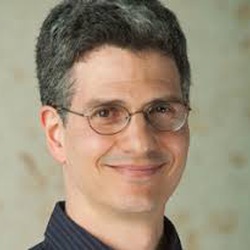
Eero Simoncelli
· Silver Professor of Neural Science, Mathematics, Data Science and PsychologyNew York University · Chemistry
Active 1987–2026
Academic metrics are sourced from OpenAlex and public funding records; values may differ from Google Scholar.
About
Eero P Simoncelli is a Silver Professor and a Professor of Neural Science, Mathematics, Data Science, and Psychology at New York University. His research interests include computational neuroscience, visual and auditory perception, and statistical image and signal processing. He earned his Ph.D. in 1993 from the Massachusetts Institute of Technology. Dr. Simoncelli's work focuses on understanding the neural mechanisms underlying sensory perception and developing computational models that mimic these processes. His contributions have advanced the fields of neural science and signal processing, integrating interdisciplinary approaches to explore how the brain interprets complex sensory information.
Research topics
- Computer Science
- Artificial Intelligence
- Cognitive science
- Mathematics
- Biology
- Data science
- Psychology
- Computer vision
- Programming language
Selected publications
Image Quality Assessment: Unifying Structure and Texture Similarity
IEEE Transactions on Pattern Analysis and Machine Intelligence · 2020 · 852 citations
Senior authorCorrespondingObjective measures of image quality generally operate by comparing pixels of a "degraded" image to those of the original. Relative to human observers, these measures are overly sensitive to resampling of texture regions (e.g., replacing one patch of grass with another). Here, we develop the first full-reference image quality model with explicit tolerance to texture resampling. Using a convolutional neural network, we construct an injective and differentiable function that transforms images to mu…
Catalyzing next-generation Artificial Intelligence through NeuroAI
Nature Communications · 2023 · 276 citations
Neuroscience has long been an essential driver of progress in artificial intelligence (AI). We propose that to accelerate progress in AI, we must invest in fundamental research in NeuroAI. A core component of this is the embodied Turing test, which challenges AI animal models to interact with the sensorimotor world at skill levels akin to their living counterparts. The embodied Turing test shifts the focus from those capabilities like game playing and language that are especially well-developed…
Toward Next-Generation Artificial Intelligence: Catalyzing the NeuroAI Revolution
arXiv (Cornell University) · 2022 · 33 citations
Neuroscience has long been an essential driver of progress in artificial intelligence (AI). We propose that to accelerate progress in AI, we must invest in fundamental research in NeuroAI. A core component of this is the embodied Turing test, which challenges AI animal models to interact with the sensorimotor world at skill levels akin to their living counterparts. The embodied Turing test shifts the focus from those capabilities like game playing and language that are especially well-developed…
A unified framework for perceived magnitude and discriminability of sensory stimuli
Proceedings of the National Academy of Sciences · 2024-06-10 · 17 citations
articleOpen accessSenior authorCorrespondingThe perception of sensory attributes is often quantified through measurements of sensitivity (the ability to detect small stimulus changes), as well as through direct judgments of appearance or intensity. Despite their ubiquity, the relationship between these two measurements remains controversial and unresolved. Here, we propose a framework in which they arise from different aspects of a common representation. Specifically, we assume that judgments of stimulus intensity (e.g., as measured throu…
Nature Communications · 2024-09-11 · 15 citations
articleOpen accessFixational eye movements alter the number and timing of spikes transmitted from the retina to the brain, but whether these changes enhance or degrade the retinal signal is unclear. To quantify this, we developed a Bayesian method for reconstructing natural images from the recorded spikes of hundreds of retinal ganglion cells (RGCs) in the macaque retina (male), combining a likelihood model for RGC light responses with the natural image prior implicitly embedded in an artificial neural network op…
Recent grants
Visual pattern representation in the extrastriate cortex
NIH · $4.5M · 2013–2029
NSF · $100k · 2014–2018
Frequent coauthors
- 61 shared
J. Anthony Movshon
New York University
- 50 shared
Timothy D. Oleskiw
Flatiron Health (United States)
- 49 shared
Robbe L. T. Goris
The University of Texas at Austin
- 36 shared
Johannes Ballé
Google (United States)
- 35 shared
Alan A. Stocker
University of Pennsylvania
- 35 shared
Corey M. Ziemba
The University of Texas at Austin
- 33 shared
E. J. Chichilnisky
Stanford University
- 33 shared
William F. Broderick
Flatiron Institute
Education
- 1993
Ph.D., Electrical Engineering & Computer Science
Massachusetts Institute of Technology
- 1988
M.S., Electrical Engineering & Computer Science
Massachusetts Institute of Technology
- 1986
Certificate of Advanced Study, Mathematics
University of Cambridge, King's College
- 1984
B.A., summa cum laude, Physics
Harvard University
Similar researchers at New York University
- Resume-aware match score
- Save to shortlist
- AI-drafted outreach
See your match with Eero Simoncelli
PhdFit ranks faculty by your research interests, methods, and publications — grounded in their actual work, not templates.
- Free to start
- No credit card
- 30-second signup