
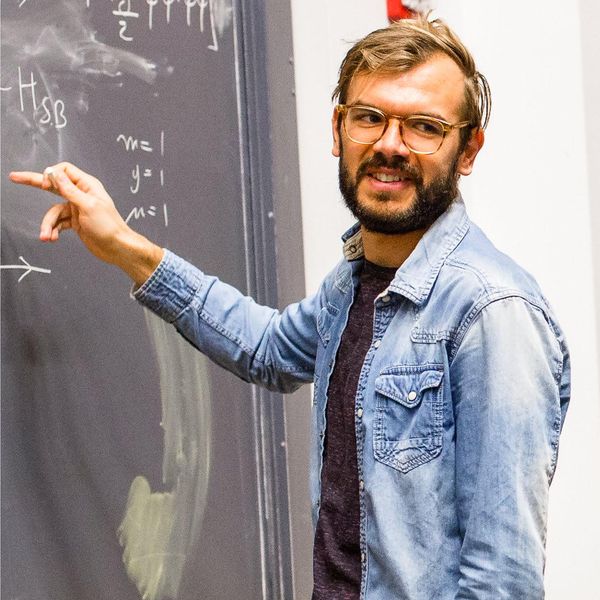
Dries Sels
· Associate ProfessorBoston University · Physics
Active 2010–2026
Academic metrics are sourced from OpenAlex and public funding records; values may differ from Google Scholar.
About
Dries Sels is an Associate Professor in the Department of Physics at Boston University. His research focuses on developing new numerical methods for simulating many-body quantum systems, exploring quantum optimal control theory and counter-diabatic driving, and investigating dynamical phenomena in complex quantum systems. He is also involved in developing quantum algorithms. Dr. Sels has received fellowships including the Sloan Research Fellowship and FWO Senior and Junior postdoctoral fellowships. His work contributes to advancing understanding and simulation of quantum phenomena, with a particular emphasis on tensor network simulation, quantum chaos, and quantum control.
Research topics
- Quantum mechanics
- Mathematics
- Physics
- Statistical physics
- Condensed matter physics
- Classical mechanics
- Mathematical physics
- Mathematical analysis
Selected publications
Dynamics of disordered quantum systems with two- and three-dimensional tensor networks
Science · 2026-05-21
articleSenior authorCorrespondingLarge-scale quantum annealing dynamics of Ising spin glasses were recently implemented on D-Wave's Advantage2 system on a range of lattices. After extensive comparison with existing numerical methods, these experiments were claimed to be beyond the reach of classical computation. Here, we simulated these spin-glass models with lattice-specific tensor networks, using belief propagation (BP) to keep up with the entanglement generated during the time evolution and then extracting expectation values…
Tensor network surrogate models for variational quantum computation
arXiv (Cornell University) · 2026-04-22
preprintOpen accessWe adopt a two-dimensional tensor-network (TN) ansatz to simulate variational quantum algorithms on two-dimensional qubit architectures, demonstrating its capability to accurately simulate deep circuits through the Quantum Approximate Optimization Algorithm (QAOA) applied to Ising spin-glass problems on heavy-hexagonal and square lattices. For heavy-hexagonal problems with up to three-body interactions, parameters trained on small instances and transferred to systems an order of magnitude larger…
Tensor network surrogate models for variational quantum computation
ArXiv.org · 2026-04-22
articleOpen accessWe adopt a two-dimensional tensor-network (TN) ansatz to simulate variational quantum algorithms on two-dimensional qubit architectures, demonstrating its capability to accurately simulate deep circuits through the Quantum Approximate Optimization Algorithm (QAOA) applied to Ising spin-glass problems on heavy-hexagonal and square lattices. For heavy-hexagonal problems with up to three-body interactions, parameters trained on small instances and transferred to systems an order of magnitude larger…
Open MIND · 2026-02-02
preprintWe investigate the stochastic dynamics of nanoscale perpendicular magnetic tunnel junctions (pMTJs) and the correlations that arise when they are electrically coupled. Individual junctions exhibit thermally activated spin-transfer torque switching with transition probabilities that are well described by a Poisson process. When two junctions are connected in parallel, circuit-mediated redistribution of voltages that occurs in real time as the junction resistances change leads to correlated switch…
ArXiv.org · 2026-02-02
articleOpen accessWe investigate the stochastic dynamics of nanoscale perpendicular magnetic tunnel junctions (pMTJs) and the correlations that arise when they are electrically coupled. Individual junctions exhibit thermally activated spin-transfer torque switching with transition probabilities that are well described by a Poisson process. When two junctions are connected in parallel, circuit-mediated redistribution of voltages that occurs in real time as the junction resistances change leads to correlated switch…
Frequent coauthors
- 59 shared
Anatoli Polkovnikov
- 38 shared
Eugene Demler
- 24 shared
C. Monroe
Keck Hospital of USC
- 22 shared
Kushal Seetharam
Harvard University
- 22 shared
Marin Bukov
Max Planck Institute for the Physics of Complex Systems
- 21 shared
Flaviano Morone
Flatiron Health (United States)
- 19 shared
Alev Orfi
- 18 shared
Crystal Noel
Duke University
Awards & honors
- Sloan Research fellow (NYU)
- FWO Senior postdoctoral fellow (Harvard)
- FWO Junior postdoctoral fellow (BU)
Similar researchers at Boston University
- Resume-aware match score
- Save to shortlist
- AI-drafted outreach
See your match with Dries Sels
PhdFit ranks faculty by your research interests, methods, and publications — grounded in their actual work, not templates.
- Free to start
- No credit card
- 30-second signup