
David R. Nelson
· David R. NelsonHarvard University · Applied Physics
Active 1974–2024
Academic metrics are sourced from OpenAlex and public funding records; values may differ from Google Scholar.
About
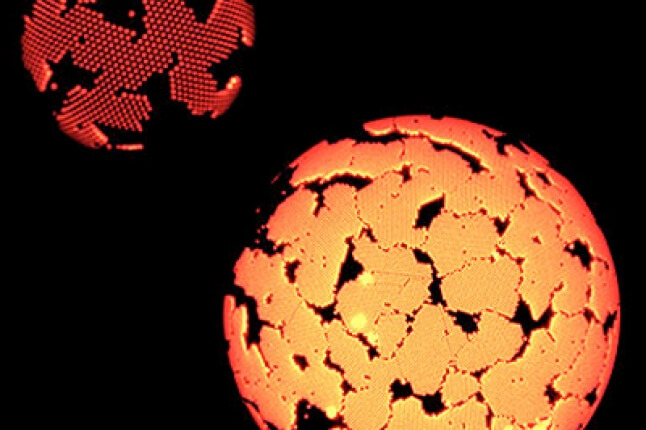
David R. Nelson is the Arthur K. Solomon Professor of Biophysics and Professor of Physics and Applied Physics at Harvard University. His primary teaching area is Applied Physics. His research areas include Applied Mathematics, Active Matter, Modeling of Physical and Biological Phenomena and Systems, and Biomaterials. His work involves studying how curved surfaces dramatically alter the shape of crystals, which has implications for coatings, drug delivery systems, and understanding how viruses assemble.
Research topics
- Physics
- Condensed matter physics
- Materials science
- Biology
- Geology
Selected publications
Antagonism between killer yeast strains as an experimental model for biological nucleation dynamics
eLife · 2021-12-06 · 21 citations
articleOpen accessAntagonistic interactions are widespread in the microbial world and affect microbial evolutionary dynamics. Natural microbial communities often display spatial structure, which affects biological interactions, but much of what we know about microbial antagonism comes from laboratory studies of well-mixed communities. To overcome this limitation, we manipulated two killer strains of the budding yeast Saccharomyces cerevisiae , expressing different toxins, to independently control the rate at whic…
Buckling and metastability in membranes with dilation arrays
Physical review. E · 2020-09-10 · 19 citations
articleOpen accessSenior authorWe study periodic arrays of impurities that create localized regions of expansion, embedded in two-dimensional crystalline membranes. These arrays provide a simple elastic model of shape memory. As the size of each dilational impurity increases (or the relative cost of bending to stretching decreases), it becomes energetically favorable for each of the M impurities to buckle up or down into the third dimension, thus allowing for of order 2^{M} metastable surface configurations corresponding to d…
Journal of The Royal Society Interface · 2021-10-01 · 16 citations
preprintOpen accessThe dynamics of a population expanding into unoccupied habitat has been primarily studied for situations in which growth and dispersal parameters are uniform in space or vary in one dimension. Here, we study the influence of finite-sized individual inhomogeneities and their collective effect on front speed if randomly placed in a two-dimensional habitat. We use an individual-based model to investigate the front dynamics for a region in which dispersal or growth of individuals is reduced to zero…
Physical review. E · 2022-08-12 · 12 citations
articleSenior authorWe investigate the ground-state configurations of two-dimensional liquid crystals with $p$-fold rotational symmetry ($p$-atics) on fixed curved surfaces. We focus on the intrinsic geometry and show that isothermal coordinates are particularly convenient as they explicitly encode a geometric contribution to the elastic potential. In the special case of a cone with half-angle $\ensuremath{\beta}$, the apex develops an effective topological charge of $\ensuremath{-}\ensuremath{\chi}$, where $2\ensu…
Physical review. E · 2022-05-31 · 9 citations
articleSenior authorConical surfaces, with a δ function of Gaussian curvature at the apex, are perhaps the simplest example of geometric frustration. We study two-dimensional liquid crystals with p-fold rotational symmetry (p-atics) on the surfaces of cones. For free boundary conditions at the base, we find both the ground state(s) and a discrete ladder of metastable states as a function of both the cone angle and the liquid crystal symmetry p. We find that these states are characterized by a set of fractional defe…
Recent grants
DMREF/Collaborative Research: Graphene Based Origami and Kirigami Metamaterials
NSF · $360k · 2014–2019
Theoretical Problems in Soft Matter and Quantitative Biology
NSF · $405k · 2010–2013
NIH · $24.4M · 2014
Frequent coauthors
- 43 shared
Andrew W. Murray
Harvard University
- 37 shared
Wladyslaw Altermann
- 30 shared
Marta Gomez‐Chiarri
- 29 shared
Yariv Kafri
- 28 shared
Gary H. Wikfors
Rogers (United States)
- 24 shared
Kirill S. Korolev
Boston University
- 24 shared
David Rowley
University of Rhode Island
- 22 shared
Federico Toschi
Eindhoven University of Technology
Education
- 1982
Postdoctoral Fellow, Microbiology and Immunology
University of California Berkeley
- 1979
Ph.D., Microbiology
University of California Los Angeles
- 1974
M.S., Bacteriology
University of Wisconsin Madison
- 1972
A.B., Bacteriology
University of California Los Angeles
Similar researchers at Harvard University
- Resume-aware match score
- Save to shortlist
- AI-drafted outreach
See your match with David R. Nelson
PhdFit ranks faculty by your research interests, methods, and publications — grounded in their actual work, not templates.
- Free to start
- No credit card
- 30-second signup