
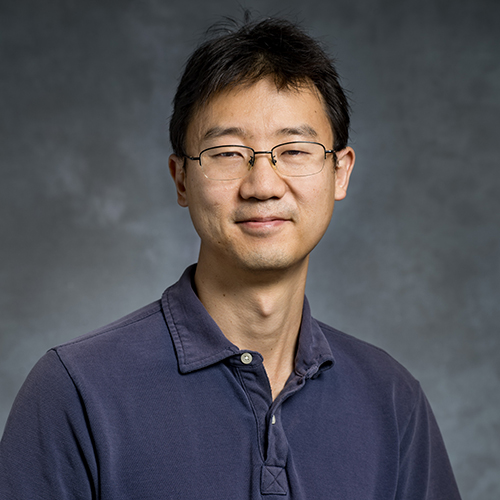
David Choi
· Associate ProfessorCarnegie Mellon University · Heinz College
Active 2003–2026
Academic metrics are sourced from OpenAlex and public funding records; values may differ from Google Scholar.
About
David S. Choi is an associate professor at Heinz College, part of Carnegie Mellon University, which includes the Schools of Public Policy and Information Systems. He also holds a courtesy appointment in the Department of Statistics. His research focuses on statistics and machine learning in network settings, including community detection, network models involving latent variables or unsupervised learning, and causal inference in the presence of social network effects, specifically interference between units. David Choi completed his graduate studies in the Department of Electrical Engineering at Stanford University under the supervision of Benjamin Van Roy. His professional experience includes roles as a technical staff member at MIT Lincoln Laboratory, a postdoctoral researcher in the School of Engineering at Harvard University, and a visiting postdoctoral researcher in the Department of Statistics at UC Berkeley.
Research topics
- Computer Science
- Composite material
- Aerospace engineering
- Chemistry
- Metallurgy
- Engineering
- Electrical engineering
- Chemical engineering
- Materials science
- Systems engineering
Selected publications
Comparison of Li-ion battery chemistries under grid duty cycles
Journal of Power Sources · 2022-08-29 · 35 citations
articleSenior authorPerformance and Degradation of Li-Ion Battery Cells for Stationary Applications
ECS Meeting Abstracts · 2024-11-22
article1st authorCorrespondingElectrochemical energy storages (EES) are being actively deployed as more renewable energy generation are integrated into the grid infrastructure. Among various EES, Li-ion batteries share more than 80% of EES utilized but reliability and performance have not been clearly evaluated and compared. In this presentation, performance of nine different commercial Li-ion battery cell chemistries under standardized grid duty cycle testing protocols developed by DOE-OE will be presented. The lifecycle de…
ECS Meeting Abstracts · 2019-09-01
articleIn recent years, zinc has gained significant attention due to its wide availability (fourth-most mined material on the Earth), low-cost nature and recyclability. Moreover, it allows water-based batteries (i.e. Zn/MnO 2 ) that could compete with LIBs for both transportation and stationary applications without safety issues. However, they are not considered rechargeable in practice yet due to the capacity limitation from the cathode materials and the detrimental zinc dendrite formation. Most of th…
Frequent coauthors
- 39 shared
Ji‐Guang Zhang
Pacific Northwest National Laboratory
- 36 shared
Wei Wang
Soochow University
- 34 shared
Zhenguo Yang
- 32 shared
Jun Liu
Fujian Normal University
- 30 shared
Zimin Nie
Pacific Northwest National Laboratory
- 29 shared
Donghai Wang
Pennsylvania State University
- 26 shared
Gordon L. Graff
- 26 shared
Vincent Sprenkle
Education
- 2005
M.S./Ph.D., materials science and engineering
Carnegie Mellon University
- 1996
B.S./M.S, Ceramic Engineering
Yonsei University
Similar researchers at Carnegie Mellon University
- Resume-aware match score
- Save to shortlist
- AI-drafted outreach
See your match with David Choi
PhdFit ranks faculty by your research interests, methods, and publications — grounded in their actual work, not templates.
- Free to start
- No credit card
- 30-second signup