
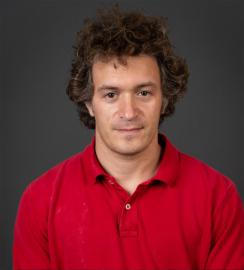
Daniel Kane
· ProfessorUniversity of California, San Diego · Mathematics
Active 2004–2025
Academic metrics are sourced from OpenAlex and public funding records; values may differ from Google Scholar.
About
Daniel Kane is a professor in the Department of Mathematics with a dual appointment in the Department of Computer Science and Engineering. He earned his Ph.D. in Mathematics from Harvard University in 2011, after completing two Bachelor of Science degrees at MIT in 2007, one in mathematics with computer science and the other in physics. Prior to his doctoral studies, Kane was a member of the USA team at the International Mathematical Olympiad, winning gold medals in 2002 and 2003. Kane's research interests encompass a broad range of mathematics and theoretical computer science, with particular focus on number theory, complexity theory, and combinatorics. He has contributed to these fields through various research projects and has been recognized for his work, including receiving the Best Paper award at the Conference on Computational Complexity in 2013. His academic and research background includes a postdoctoral fellowship at Stanford University, supported by an NSF Postdoctoral Research Fellowship, where he was a researcher in the Department of Mathematics.
Research topics
- Computer Science
- Artificial Intelligence
- Mathematics
- Algorithm
- Combinatorics
- Biology
- Economics
- Ecology
- Mathematical economics
- Statistics
Selected publications
Robustly learning mixtures of<i>k</i>arbitrary Gaussians
2022 · 21 citations
We give a polynomial-time algorithm for the problem of robustly estimating a mixture of arbitrary Gaussians in R , for any fixed , in the presence of a constant fraction of arbitrary corruptions. This resolves the main open problem in several previous works on algorithmic robust statistics, which addressed the special cases of robustly estimating (a) a single Gaussian, (b) a mixture of TVdistance separated Gaussians, and (c) a uniform mixture of two Gaussians. Our main tools are an efficient par…
Robustly Learning any Clusterable Mixture of Gaussians
2020 · 15 citations
We study the efficient learnability of high-dimensional Gaussian mixtures in the outlier-robust setting, where a small constant fraction of the data is adversarially corrupted. We resolve the polynomial learnability of this problem when the components are pairwise separated in total variation distance. Specifically, we provide an algorithm that, for any constant number of components $k$, runs in polynomial time and learns the components of an $ε$-corrupted $k$-mixture within information theoreti…
Linear Regression under Missing or Corrupted Coordinates
ArXiv.org · 2025-09-23
preprintOpen accessWe study multivariate linear regression under Gaussian covariates in two settings, where data may be erased or corrupted by an adversary under a coordinate-wise budget. In the incomplete data setting, an adversary may inspect the dataset and delete entries in up to an $η$-fraction of samples per coordinate; a strong form of the Missing Not At Random model. In the corrupted data setting, the adversary instead replaces values arbitrarily, and the corruption locations are unknown to the learner. De…
Entangled Mean Estimation in High-Dimensions
arXiv (Cornell University) · 2025-01-09
preprintOpen accessWe study the task of high-dimensional entangled mean estimation in the subset-of-signals model. Specifically, given $N$ independent random points $x_1,\ldots,x_N$ in $\mathbb{R}^D$ and a parameter $α\in (0, 1)$ such that each $x_i$ is drawn from a Gaussian with mean $μ$ and unknown covariance, and an unknown $α$-fraction of the points have identity-bounded covariances, the goal is to estimate the common mean $μ$. The one-dimensional version of this task has received significant attention in theo…
Robust Learning of Multi-index Models via Iterative Subspace Approximation
ArXiv.org · 2025-02-13
preprintOpen accessWe study the task of learning Multi-Index Models (MIMs) with label noise under the Gaussian distribution. A $K$-MIM is any function $f$ that only depends on a $K$-dimensional subspace. We focus on well-behaved MIMs with finite ranges that satisfy certain regularity properties. Our main contribution is a general robust learner that is qualitatively optimal in the Statistical Query (SQ) model. Our algorithm iteratively constructs better approximations to the defining subspace by computing low-degr…
Recent grants
CAREER: Structure and Analysis of Low Degree Polynomials
NSF · $500k · 2016–2025
PostDoctoral Research Fellowship
NSF · $135k · 2011–2015
Frequent coauthors
- 216 shared
Ilias Diakonikolas
- 83 shared
Alistair Stewart
- 50 shared
Gautam Kamath
University of Waterloo
- 49 shared
Jerry Li
Pfizer (United States)
- 48 shared
Ankur Moitra
IIT@MIT
- 42 shared
Wade Goodridge
Utah State University
- 38 shared
Natalie Shaheen
- 35 shared
Shachar Lovett
Education
- 2022
Mechanical and Aerospace Engineering, Mechanical and Aerospace Engineering
Utah State University
Awards & honors
- Best Paper award at the Conference on Computational Complexi…
- Gold Medal at the International Mathematical Olympiad (2002)
- Gold Medal at the International Mathematical Olympiad (2003)
Similar researchers at University of California, San Diego
- Resume-aware match score
- Save to shortlist
- AI-drafted outreach
See your match with Daniel Kane
PhdFit ranks faculty by your research interests, methods, and publications — grounded in their actual work, not templates.
- Free to start
- No credit card
- 30-second signup