
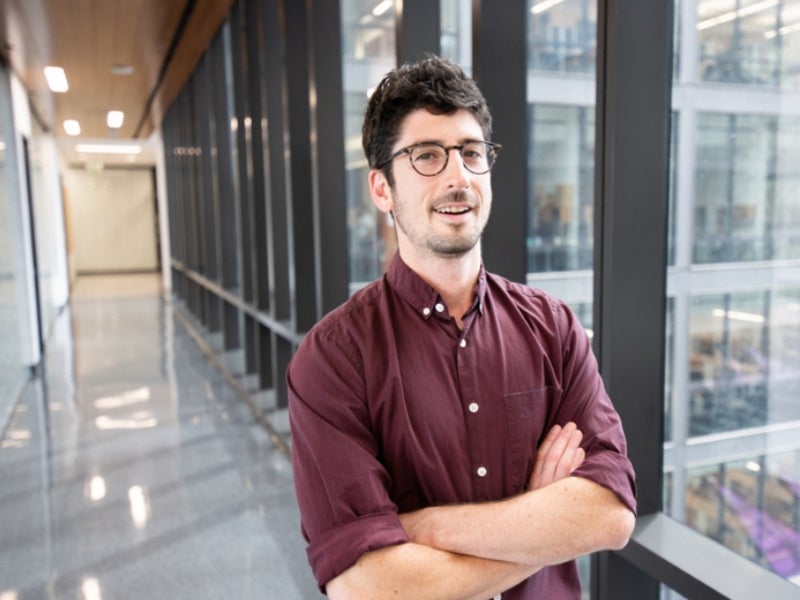
Brian Belardi
· Assistant Professor of Chemical EngineerUniversity of Texas at Austin · Chemistry
Active 2007–2026
Academic metrics are sourced from OpenAlex and public funding records; values may differ from Google Scholar.
About
Brian Belardi is an Assistant Professor in the McKetta Department of Chemical Engineering at The University of Texas at Austin. He serves on the Graduate Studies Committee for both the Interdisciplinary Life Sciences and the Department of Chemistry. Dr. Belardi completed his Ph.D. in Chemistry at the University of California, Berkeley, where he was mentored by Professor Carolyn Bertozzi. He also conducted postdoctoral research as an NIH Postdoctoral Fellow in Bioengineering at the University of California, Berkeley under the mentorship of Professor Daniel Fletcher. Prior to his graduate studies, he earned a B.S. in Chemistry from Carnegie Mellon University, working with Professor Krzysztof Matyjaszewski.
Research topics
- Biology
- Cell biology
- Biochemistry
- Biophysics
- Chemistry
Selected publications
Advanced Drug Delivery Reviews · 2023-06-02 · 39 citations
reviewOpen accessSenior authorCorrespondingLight-Activated Assembly of Connexon Nanopores in Synthetic Cells
Journal of the American Chemical Society · 2023-02-01 · 20 citations
articleOpen accessSenior authorCorrespondingDuring developmental processes and wound healing, activation of living cells occurs with spatiotemporal precision and leads to rapid release of soluble molecular signals, allowing communication and coordination between neighbors. Nonliving systems capable of similar responsive release hold great promise for information transfer in materials and site-specific drug delivery. One nonliving system that offers a tunable platform for programming release is synthetic cells. Encased in a lipid bilayer s…
Steric pressure between glycosylated transmembrane proteins inhibits internalization by endocytosis
Proceedings of the National Academy of Sciences · 2023-04-06 · 20 citations
articleOpen accessClathrin-mediated endocytosis is essential for the removal of transmembrane proteins from the plasma membrane in all eukaryotic cells. Many transmembrane proteins are glycosylated. These proteins collectively comprise the glycocalyx, a sugar-rich layer at the cell surface, which is responsible for intercellular adhesion and recognition. Previous work has suggested that glycosylation of transmembrane proteins reduces their removal from the plasma membrane by endocytosis. However, the mechanism re…
Engineering Tissue-Scale Properties with Synthetic Cells: Forging One from Many
ACS Synthetic Biology · 2023-07-07 · 16 citations
reviewOpen accessSenior authorCorrespondingIn metazoans, living cells achieve capabilities beyond individual cell functionality by assembling into multicellular tissue structures. These higher-order structures represent dynamic, heterogeneous, and responsive systems that have evolved to regenerate and coordinate their actions over large distances. Recent advances in constructing micrometer-sized vesicles, or synthetic cells, now point to a future where construction of synthetic tissue can be pursued, a boon to pressing material needs in…
ACS Central Science · 2022-01-14 · 15 citations
articleOpen accesscan act as a dynamically tunable biocatalyst in complex environments. In summary, our results demonstrate how EET can expand the reaction scope available to living systems by enabling cellular control of CuAAC.
Recent grants
NSF · $1.5M · 2022–2026
Investigating Tight Junction-Mediated Spatial Organization in Polarized Epithelia.
NIH · $163k · 2015–2018
A Molecular Toolkit for Controlling and Probing Cell Junction-Actin Interactions
NIH · $1.9M · 2021–2027
Frequent coauthors
- 31 shared
Daniel A. Fletcher
Berkeley College
- 22 shared
Carolyn R. Bertozzi
Stanford University
- 10 shared
Krzysztof Matyjaszewski
Carnegie Mellon University
- 9 shared
Geoff P. O’Donoghue
University of California, San Francisco
- 9 shared
Adam W. Smith
Texas Tech University
- 9 shared
Lorraine Tessier
CEA Paris-Saclay
- 9 shared
Jay T. Groves
University of California, Berkeley
- 9 shared
François Stoffelbach
Institut Parisien de Chimie Moléculaire
Labs
Education
- 2008
B.S.
Carnegie Mellon University
- 2014
Ph.D., Chemistry
University of California, Berkeley
- 2014
Other, Bioengineering
University of California, Berkeley
Awards & honors
- David and Lucile Packard Foundation Packard Fellowship for S…
- Advanced Drug Delivery Reviews Emerging Voices in Drug Deliv…
- Maximizing Investigators’ Research Award – National Institut…
- Postdoctoral Association Award – University of California, B…
- Ruth L. Kirschstein NRSA Fellowship – National Institutes of…
Similar researchers at University of Texas at Austin
- Resume-aware match score
- Save to shortlist
- AI-drafted outreach
See your match with Brian Belardi
PhdFit ranks faculty by your research interests, methods, and publications — grounded in their actual work, not templates.
- Free to start
- No credit card
- 30-second signup