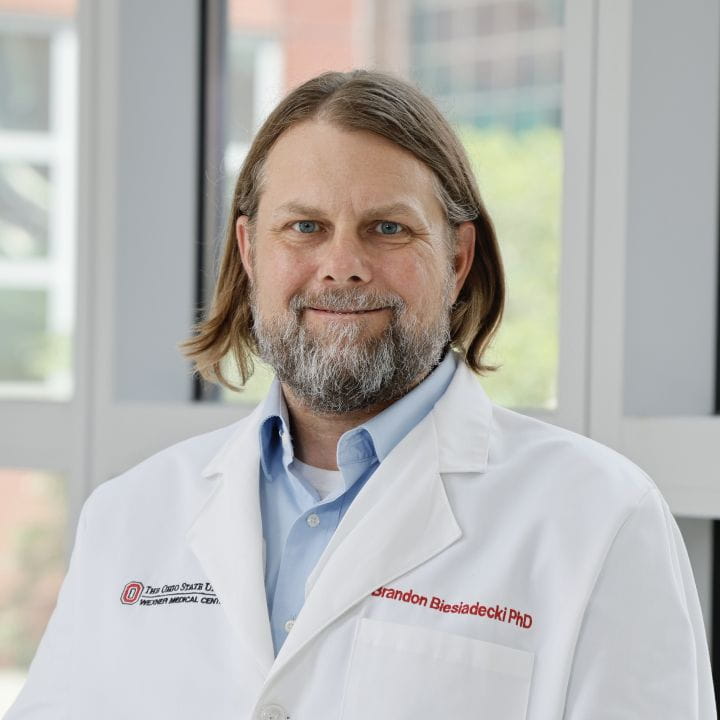
Brandon Biesiadecki
· Professor and Vice ChairOhio State University · Molecular, Cellular, and Integrative Physiology
Active 2009–2024
About
Brandon Biesiadecki, PhD, is a Professor in the Department of Physiology and Cell Biology at Ohio State College of Medicine, serving as Vice Chair of the department. His research focuses on understanding the molecular mechanisms by which muscle protein post-translational modifications, such as phosphorylation, radical modification, and degradation, alter heart function. His laboratory employs an integrated approach combining molecular biology, biochemistry, and physiology to develop novel treatments for heart dysfunction. His work specifically investigates how modifications to cardiac muscle regulatory proteins, including troponin and tropomyosin, influence the interaction of myosin with actin and consequently affect cardiac contractility. By studying the physiological and pathological effects of stress-induced phosphorylation of these proteins, Dr. Biesiadecki aims to elucidate their role in modulating cardiac muscle response to calcium and their impact on heart function. His background includes a PhD from Case Western Reserve University and postdoctoral training at the University of Illinois at Chicago, with a focus on muscle protein regulation and heart physiology.
Research topics
- Cardiology
- Medicine
- Chemistry
- Biochemistry
- Internal medicine
Selected publications
Circulation Research · 2024
Senior authorCorresponding- Cardiology
- Medicine
- Internal medicine
Heart failure with systolic dysfunction is characterized by insufficient contractility. Standards of care for heart failure treat symptoms, however there are currently no approved therapies to increase contractility to directly improve the ability of the heart to pump blood. Previously tested positive inotropes increased heart function through mechanisms that increased intracellular calcium. Unfortunately, these early inotropes were associated with detrimental effects and worsened outcomes and therefore are not approved for long-term use. There remains a need for an alternative mechanism to increase contractility without increasing intracellular calcium. We previously demonstrated that phosphorylation of the inhibitory subunit of the troponin complex, troponin I (TnI) at serine residue 150 (S150) increases force development in ex vivo muscle by increasing calcium sensitivity. Increasing the sensitivity of the myofilament to calcium is an alternative mechanism to increase contractility without increasing intracellular calcium. We therefore hypothesize that increasing TnI-S150 phosphorylation in vivo would improve systolic function without harmful effects. To determine the effects of TnI-S150 phosphorylation in vivo , we generated a phosphorylation-mimetic mouse with TnI-S150 mutated to aspartic acid (TnI-pS150). Structural and functional measurements derived from echocardiography and hemodynamics demonstrate that TnI-pS150 mice have increased cardiac systolic function and contractility in vivo . We confirm that the mechanism for increasing in vivo function is through increased myofilament calcium sensitivity. Detrimental effects commonly observed with the use of inotropes (e.g. hypertrophy, hypertension, severe diastolic dysfunction, increased arrythmia susceptibility, increased mortality) were not observed in TnI-pS150 mice. Additionally, we did not observe any adverse long-term detrimental effects on cardiac structure and function in aged TnI-pS150 mice. These results support the phosphorylation of TnI-S150 as a novel signaling mechanism to increase systolic function without detrimental effects and is therefore a novel target for systolic heart failure therapies.
Nature Communications · 2020 · 52 citations
- Medicine
- Cardiology
- Internal medicine
is essential for SAN conduction, especially in fibrotic failing hearts. Our results reveal that not only cNav but nNav are also integral for preventing disease-induced failure in human SAN intranodal conduction. Disease-impaired nNav may underlie patient-specific SAN dysfunctions and should be considered to treat arrhythmias.
Frequent coauthors
- 5 shared
Jonathan P. Davis
- 2 shared
Cheavar A. Blair
University of Kentucky
- 2 shared
Mark T. Ziolo
The Ohio State University
- 2 shared
Kenneth S. Campbell
- 1 shared
Noah Weisleder
The Ohio State University Wexner Medical Center
- 1 shared
Thomas J. Hund
The Ohio State University
- 1 shared
Jian‐Ping Jin
University of Illinois Chicago
- 1 shared
Lorien Salyer
The Ohio State University
Similar researchers at Ohio State University
- Resume-aware match score
- Save to shortlist
- AI-drafted outreach
See your match with Brandon Biesiadecki
PhdFit ranks faculty by your research interests, methods, and publications — grounded in their actual work, not templates.
- Free to start
- No credit card
- 30-second signup