
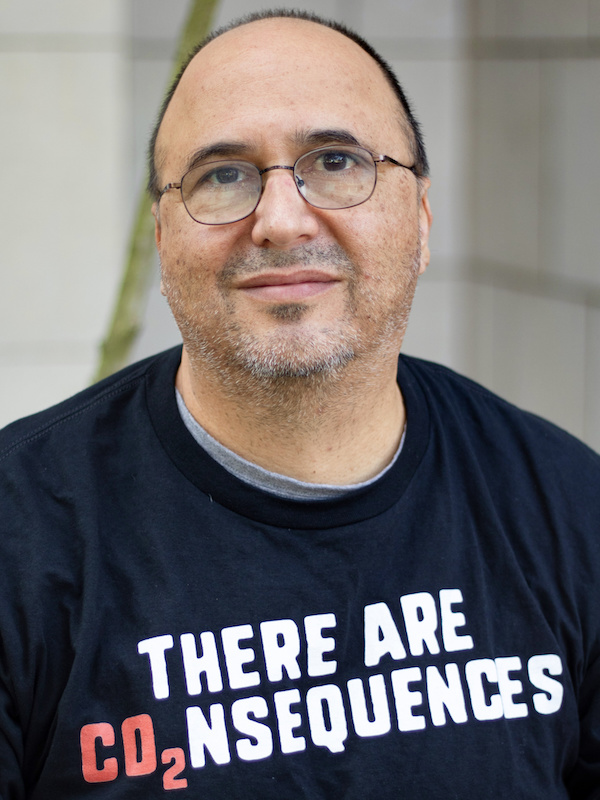
Andrew Dessler
· Director, Texas Center for Extreme Weather; ProfessorTexas A&M University · Atmospheric Sciences
Active 1990–2026
Academic metrics are sourced from OpenAlex and public funding records; values may differ from Google Scholar.
About
Andrew Dessler is a professor at Texas A&M University in the College of Arts and Sciences, serving as the Director of the Texas Center for Extreme Weather. His research interests encompass climate impacts, global climate physics, atmospheric chemistry, and climate change policy. His work has shifted towards understanding how climate change affects human society, including the quantification of climate extremes and the analysis of how climate change stresses energy, water, and other critical infrastructure and human systems. Dessler's earlier research focused on global climate physics, including estimating feedbacks such as water vapor and cloud feedbacks, as well as climate sensitivity, with the aim of improving understanding of atmospheric physics and testing the validity of climate models. He also studied the chemistry of the stratosphere, working on water vapor and ozone instruments and analyzing satellite measurements related to ozone chemistry, although he no longer works in this area. His experience includes serving as a Senior Policy Analyst in the White House Office of Science and Technology Policy, where he gained insight into the use and misuse of science in policy debates. Based on this, he authored a book explaining how science is used in the context of climate change policy. Dessler holds a Ph.D. from Harvard University and a B.A. from Rice University. He is a fellow of the American Geophysical Union (AGU) and the American Association for the Advancement of…
Research topics
- Geology
- Climatology
- Environmental science
- Political Science
- Oceanography
- Business
- Atmospheric sciences
- Optics
- Physics
- Geography
Selected publications
Greater committed warming after accounting for the pattern effect
Nature Climate Change · 2021 · 86 citations
Cloud and Aerosol Distributions From SAGE III/ISS Observations
Journal of Geophysical Research Atmospheres · 2021 · 47 citations
Senior authorCorrespondingAbstract We describe our Solar Aerosol and Gas Experiment (SAGE) III/ISS cloud detection algorithm and observations. We identify three types of clouds: visible cirrus (extinction coefficient > 3 x 10 −2 km −1 ), subvisible cirrus (extinction coefficient between 3 x 10 −2 km −1 and 10 −3 km −1 ), and very low extinction cloud‐aerosol mixtures (extinction coefficient between 10 −3 km −1 and 10 −4 km −1 ). Visible cirrus cannot be quantitatively measured by SAGE because of its high extinction, b…
The Estimated Climate Impact of the Hunga Tonga‐Hunga Ha'apai Eruption Plume
Geophysical Research Letters · 2023-09-26 · 43 citations
articleOpen accessAbstract On 15 January 2022, the Hunga Tonga‐Hunga Ha'apai (HT) eruption injected SO 2 and water into the middle stratosphere. The SO 2 is rapidly converted to sulfate aerosols. The aerosol and water vapor anomalies have persisted in the Southern Hemisphere throughout 2022. The water vapor anomaly increases the net downward IR radiative flux whereas the aerosol layer reduces the direct solar forcing. The direct solar flux reduction is larger than the increased IR flux. Thus, the net tropospheric…
Persistent high latitude amplification of the Pacific Ocean over the past 10 million years
Nature Communications · 2022-11-27 · 31 citations
articleOpen accessAbstract While high latitude amplification is seen in modern observations, paleoclimate records, and climate modeling, better constraints on the magnitude and pattern of amplification would provide insights into the mechanisms that drive it, which remain actively debated. Here we present multi-proxy multi-site paleotemperature records over the last 10 million years from the Western Pacific Warm Pool (WPWP) – the warmest endmember of the global ocean that is uniquely important in the global radia…
Evolution of the Climate Forcing During the Two Years After the Hunga Tonga‐Hunga Ha'apai Eruption
Journal of Geophysical Research Atmospheres · 2024-07-24 · 30 citations
articleOpen accessSenior authorAbstract We calculate the climate forcing for the 2 ys after the 15 January 2022, Hunga Tonga‐Hunga Ha'apai (Hunga) eruption. We use satellite observations of stratospheric aerosols, trace gases and temperatures to compute the tropopause radiative flux changes relative to climatology. Overall, the net downward radiative flux decreased compared to climatology. The Hunga stratospheric water vapor anomaly initially increases the downward infrared radiative flux, but this forcing diminishes as the a…
Recent grants
NSF · $150k · 2010–2013
Understanding Long-term Variations in Stratospheric Water Vapor
NSF · $259k · 2013–2017
Understanding Measurements of Climate Sensitivity
NSF · $428k · 2017–2021
Frequent coauthors
- 45 shared
M. R. Schoeberl
Science and Technology Corporation (Norway)
- 34 shared
Tao Wang
China General Nuclear Power Corporation (China)
- 28 shared
E. M. Weinstock
Partners In Care
- 25 shared
Edward A. Parson
Environmental Law Institute
- 25 shared
Steven C. Sherwood
ARC Centre of Excellence for Climate System Science
- 24 shared
J. G. Anderson
Intermountain Medical Center
- 23 shared
E. J. Hintsa
- 20 shared
Wandi Yu
Lawrence Livermore National Laboratory
Education
- 1990
Ph.D., Atmospheric Chemistry
Massachusetts Institute of Technology
- 1985
M.S., Atmospheric Chemistry
University of California, Berkeley
- 1983
B.S., Chemistry
University of California, Berkeley
Awards & honors
- Fellow of the AGU
- Fellow of the AAAS
Similar researchers at Texas A&M University
- Resume-aware match score
- Save to shortlist
- AI-drafted outreach
See your match with Andrew Dessler
PhdFit ranks faculty by your research interests, methods, and publications — grounded in their actual work, not templates.
- Free to start
- No credit card
- 30-second signup