
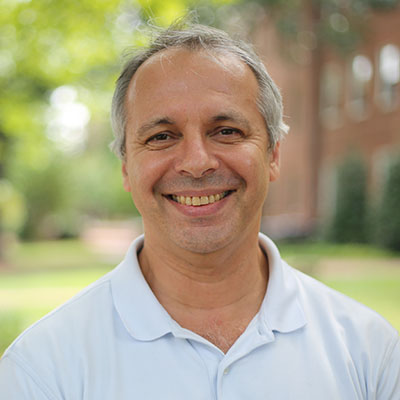
Alexander Tropsha
· KH Lee Distinguished Professor and Associate DeanUniversity of North Carolina at Chapel Hill · Toxicology
Active 1991–2025
Academic metrics are sourced from OpenAlex and public funding records; values may differ from Google Scholar.
About
Alexander Tropsha is the KH Lee Distinguished Professor and Associate Dean at the University of North Carolina Eshelman School of Pharmacy. His major research area is Biomolecular Informatics, which involves understanding the relationships between molecular structures—both organic and macromolecular—and their properties, such as activity or function. He focuses on building validated and predictive quantitative models that relate molecular structure to biological function, utilizing statistical and machine learning approaches. These models are exploited to make verifiable predictions about the putative functions of untested molecules.
Research topics
- Computer Science
- Machine Learning
- Medicine
- Pharmacology
- Bioinformatics
- Virology
- Data science
- Biology
Selected publications
Chemical Society Reviews · 2020 · 829 citations
Senior authorCorrespondingPrediction of chemical bioactivity and physical properties has been one of the most important applications of statistical and more recently, machine learning and artificial intelligence methods in chemical sciences. This field of research, broadly known as quantitative structure-activity relationships (QSAR) modeling, has developed many important algorithms and has found a broad range of applications in physical organic and medicinal chemistry in the past 55+ years. This Perspective summarizes r…
A critical overview of computational approaches employed for COVID-19 drug discovery
Chemical Society Reviews · 2021 · 207 citations
Senior authorCorrespondingCOVID-19 has resulted in huge numbers of infections and deaths worldwide and brought the most severe disruptions to societies and economies since the Great Depression. Massive experimental and computational research effort to understand and characterize the disease and rapidly develop diagnostics, vaccines, and drugs has emerged in response to this devastating pandemic and more than 130 000 COVID-19-related research papers have been published in peer-reviewed journals or deposited in preprint se…
Proteins Structure Function and Bioinformatics · 2025-10-20 · 12 citations
articleOpen accessIn the CASP16 experiment, our team employed hybrid computational strategies to predict both protein-protein and protein-ligand complex structures. For protein-protein docking, we combined physics-based sampling-using ClusPro FFT docking and molecular dynamics-with AlphaFold (AF)-based sampling, followed by AF-based refinement. Our method produced numerous high-accuracy complex models, including cases where AF alone failed, underscoring the critical role of physics-based sampling alongside deep l…
Molecular Plant · 2025-06-12 · 10 citations
articleOpen accessProtein–ligand data at scale to support machine learning
Nature Reviews Chemistry · 2025-07-23 · 10 citations
review
Recent grants
NIH · $3.0M · 2013
ARAGORN: Autonomous Relay Agent for Generation Of Ranked Networks
NIH · $4.7M · 2020–2024
Drug Repurposing for Cancer Therapy: From Man to Molecules to Man
NIH · $1.2M · 2016–2020
Frequent coauthors
- 227 shared
Eugene Muratov
- 129 shared
Denis Fourches
North Carolina State University
- 101 shared
Vinícius M. Alves
- 84 shared
Alexander Golbraikh
University of North Carolina at Chapel Hill
- 64 shared
Igor V. Tetko
- 58 shared
Stephen J. Capuzzi
University of North Carolina at Chapel Hill
- 51 shared
Alexandre Varnek
Centre National de la Recherche Scientifique
- 49 shared
Hao Zhu
Obstetrics and Gynecology Hospital of Fudan University
Education
- 1993
Ph.D., Toxicology
University of North Carolina at Chapel Hill
- 1989
M.S., Toxicology
University of North Carolina at Chapel Hill
- 1984
B.S., Chemistry
University of Belgrade
Similar researchers at University of North Carolina at Chapel Hill
- Resume-aware match score
- Save to shortlist
- AI-drafted outreach
See your match with Alexander Tropsha
PhdFit ranks faculty by your research interests, methods, and publications — grounded in their actual work, not templates.
- Free to start
- No credit card
- 30-second signup