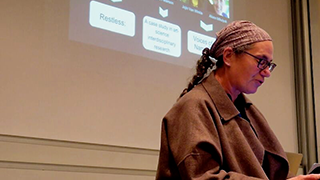
Laurie Beth Clark
· 4-DUniversity of Wisconsin-Madison · Art
Active 1976–2024
Research topics
- Sociology
- Political Science
- Geography
- Social Science
- Economics
- Regional science
- Environmental planning
- Public relations
- Ecology
- Environmental resource management
Selected publications
Frontiers in Sustainable Food Systems · 2022 · 17 citations
- Sociology
- Political Science
- Sociology
The wicked nature of sustainability challenges facing food systems demands intentional and synergistic actions at multiple scales and sectors. The Southern Cone of Latin America, with its historical legacy of “feeding the world,” presents interesting opportunities for generating insights into potential trajectories and processes for food system transformation. To foster such changes would require the development of collective understanding and agency to effectively realize purposeful and well-informed action toward desirable and sustainable food futures. This in turn demands the transdisciplinary engagement of academia, the private sector, government/policy-makers, community groups, and other institutions, as well as the broader society as food consumers. While the need for contextualized knowledge, priorities and definitions of what sustainable food systems change means is recognized, there is limited literature reporting these differences and critically reflecting on the role of knowledge brokers in knowledge co-production processes. The political nature of these issues requires arenas for dialogue and learning that are cross-sectoral and transcend knowledge generation. This paper presents a case study developed by SARAS Institute, a bridging organization based in Uruguay. This international community of practice co-designed a 3-year multi-stakeholder transdisciplinary process entitled “Knowledges on the Table.” We describe how the process was designed, structured, and facilitated around three phases, two analytical levels and through principles of knowledge co-production. The case study and its insights offer a model that could be useful to inform similar processes led by transdisciplinary communities of practice or bridging institutions in the early stages of transformative work. In itself, it also represents a unique approach to generate a language of collaboration, dialogue, and imagination informed by design skills and methods. While this is part of a longer-term process toward capitalizing on still-unfolding insights and coalitions, we hope that this example helps inspire similar initiatives to imagine, support, and realize contextualized sustainable food system transformations.
Ecosystems and People · 2021 · 7 citations
- Political Science
- Sociology
- Regional science
Sustainability requires a combination of meaningful co-production of locally relevant solutions, synthesis of insights gained across regions, and increased cooperation between science, policy and practice. The Programme for Ecosystem Change and Society (PECS) has been coordinating Place-Based Social-Ecological Sustainability Research (PBSESR) across the globe and emphasizes the need for regional scientific nodes from diverse biocultural regions to inform sustainability science and action. In this paper, we assess the strengths of the PBSESR communities in Latin America and the Caribbean (LAC). We provide an overview of PBSESR literature associated with this region and highlight the achievements of two prominent regional networks: The Social-Ecological Systems and Sustainability Research Network from Mexico (SocioEcoS) and the South American Institute for Resilience and Sustainability Studies from Uruguay (SARAS Institute). Finally, we identify the potential in these nodes to constitute a regional PECS node in Latin America and discuss the capacity needed to ensure such function. The results of the literature review show that while still loosely interconnected across the region, networks play key roles in connecting otherwise cloistered teams and we illustrate how the SocioEcoS network (focusing on transdisciplinary co-production of knowledge towards sustainability) and the SARAS Institute (focusing on innovative approaches for looking at complex social-ecological problems, rooted in slow science and arts) operate as key connectors in the region. We conclude that these organizations combined can embody a Latin American node for PECS, and would thereby not only contribute to regional but also global capacities to advance the sustainability agenda.
Frequent coauthors
- 8 shared
Michael Peterson
- 3 shared
Leigh A. Payne
University of Oxford
- 3 shared
Mariana Meerhoff
Aarhus University
- 3 shared
Lisa Deutsch
- 3 shared
Estéban G. Jobbágy
Centro Científico Tecnológico - San Luis
- 3 shared
Néstor Mazzeo
- 2 shared
Mauricio Cheguhem
Universidad de Salamanca
- 2 shared
Henrik Österblom
Stockholm University
Similar researchers at University of Wisconsin-Madison
- Resume-aware match score
- Save to shortlist
- AI-drafted outreach
See your match with Laurie Beth Clark
PhdFit ranks faculty by your research interests, methods, and publications — grounded in their actual work, not templates.
- Free to start
- No credit card
- 30-second signup