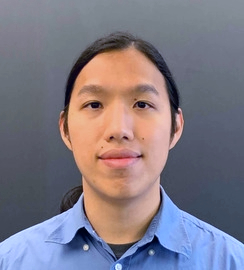
Morris Ang
· Assistant ProfessorUniversity of California, San Diego · Mathematics
Active 2008–2026
About
Morris Ang is an Assistant Professor in Mathematics at UC San Diego. His research focuses on probability theory, particularly random conformal geometry, including Schramm-Loewner evolution, conformal loop ensembles, Liouville quantum gravity, random planar maps, and conformal field theories.
Research topics
- Mathematical analysis
- Mathematics
- Physics
- Mathematical physics
- Quantum mechanics
- Geometry
- Combinatorics
Selected publications
Exact solution of three-point functions in critical loop models
arXiv (Cornell University) · 2026-04-07
preprintOpen access1st authorCorrespondingWe propose an exact formula for three-point functions on the sphere in critical loop models with primary fields $V_{(r,s)}$ characterized by $2r$ legs and a parameter \(s\) that describes diagonal fields for $r=0$ and the momentum of legs for $r>0$. We demonstrate its validity in three ways: the conformal bootstrap method for 4-point functions, a transfer-matrix study of the lattice model, and a probabilistic method based on conformal loop ensemble and Liouville quantum gravity. This work provides a crucial missing piece for solving critical loop models and reveals a deep unity between three fundamental approaches to 2D statistical physics: transfer matrix, conformal field theory, and probability theory.
Quantum Loewner evolution in quantum natural time: phases and Markov properties
arXiv (Cornell University) · 2026-05-05
preprintOpen access1st authorCorrespondingQuantum Loewner evolution (QLE)$(γ^2, η)$ is a family of growth processes in random environments, introduced by Miller and Sheffield (arXiv:1312.5745) as candidate scaling limits of growth processes (such as diffusion-limited aggregation) on random planar maps. The random environments are Liouville quantum gravity (LQG) surfaces with parameter $γ$, and the parameter $η$ plays a role analogous to that in dielectric breakdown models. Their construction applies to pairs $(γ^2, η)$ lying on a curve in parameter space, and the associated time parametrization is independent of the underlying LQG surface. In later work (arXiv:1507.00719), they defined a quantum natural time variant of QLE$(8/3, 0)$ whose time parametrization encodes a notion of distance in the LQG geometry, leading to the identification of $\sqrt{8/3}$-LQG with the Brownian map. In this paper we construct quantum natural time QLE$(γ^2, η)$ for a different but overlapping subset of the same parameter curve. Its time parametrization conjecturally corresponds to the scaling limit of time parametrizations of discrete growth processes on random planar maps. We prove that it exhibits three phases, mirroring those of Schramm-Loewner evolution (SLE); this answers a question of Miller and Sheffield for quantum natural time QLE. Moreover, we establish stationarity of the unexplored surface and, in the relevant phases, identify the random surfaces cut out or swallowed by the process as quantum disks. Our construction builds on recent radial LQG-SLE coupling results of Ang and Yu (arXiv:2309.05176, arXiv:2411.19810).
Exact solution of three-point functions in critical loop models
ArXiv.org · 2026-04-07
articleOpen access1st authorCorrespondingWe propose an exact formula for three-point functions on the sphere in critical loop models with primary fields $V_{(r,s)}$ characterized by $2r$ legs and a parameter \(s\) that describes diagonal fields for $r=0$ and the momentum of legs for $r>0$. We demonstrate its validity in three ways: the conformal bootstrap method for 4-point functions, a transfer-matrix study of the lattice model, and a probabilistic method based on conformal loop ensemble and Liouville quantum gravity. This work provides a crucial missing piece for solving critical loop models and reveals a deep unity between three fundamental approaches to 2D statistical physics: transfer matrix, conformal field theory, and probability theory.
Quantum Loewner evolution in quantum natural time: phases and Markov properties
ArXiv.org · 2026-05-05
articleOpen access1st authorCorrespondingQuantum Loewner evolution (QLE)$(γ^2, η)$ is a family of growth processes in random environments, introduced by Miller and Sheffield (arXiv:1312.5745) as candidate scaling limits of growth processes (such as diffusion-limited aggregation) on random planar maps. The random environments are Liouville quantum gravity (LQG) surfaces with parameter $γ$, and the parameter $η$ plays a role analogous to that in dielectric breakdown models. Their construction applies to pairs $(γ^2, η)$ lying on a curve in parameter space, and the associated time parametrization is independent of the underlying LQG surface. In later work (arXiv:1507.00719), they defined a quantum natural time variant of QLE$(8/3, 0)$ whose time parametrization encodes a notion of distance in the LQG geometry, leading to the identification of $\sqrt{8/3}$-LQG with the Brownian map. In this paper we construct quantum natural time QLE$(γ^2, η)$ for a different but overlapping subset of the same parameter curve. Its time parametrization conjecturally corresponds to the scaling limit of time parametrizations of discrete growth processes on random planar maps. We prove that it exhibits three phases, mirroring those of Schramm-Loewner evolution (SLE); this answers a question of Miller and Sheffield for quantum natural time QLE. Moreover, we establish stationarity of the unexplored surface and, in the relevant phases, identify the random surfaces cut out or swallowed by the process as quantum disks. Our construction builds on recent radial LQG-SLE coupling results of Ang and Yu (arXiv:2309.05176, arXiv:2411.19810).
Boundary touching probability and nested-path exponent for nonsimple CLE
The Annals of Probability · 2025-05-01 · 1 citations
article1st authorCorrespondingThe conformal loop ensemble (CLE) has two phases: for κ∈(8/3,4], the loops are simple and do not touch each other or the boundary; for κ∈(4,8), the loops are nonsimple and may touch each other and the boundary. For κ∈(4,8), we derive the probability that the loop surrounding a given point touches the domain boundary. We also obtain the law of the conformal radius of this loop seen from the given point conditioned on the loop touching the boundary or not, refining a result of Schramm–Sheffield–Wilson (Comm. Math. Phys. (2009) 288 43–53). As an application, we exactly evaluate the CLE counterpart of the nested-path exponent for the Fortuin–Kasteleyn (FK) random cluster model recently introduced by Song–Tan–Zhang–Jacobsen–Nienhuis–Deng (J. Phys. A 55 (2022) Paper No. 204002). This exponent describes the asymptotic behavior of the number of nested open paths in the open cluster containing the origin when the cluster is large. For Bernoulli percolation, which corresponds to κ=6, the exponent was derived recently in Song–Jacobsen–Nienhuis–Sportiello–Deng (2023) by a color switching argument. For κ≠6 and, in particular, for the FK-Ising case, our formula appears to be new. Our derivation begins with Sheffield’s construction of CLE from which the quantities of interest can be expressed by radial SLE. We solve the radial SLE problem using the coupling between SLE and Liouville quantum gravity, along with the exact solvability of Liouville conformal field theory.
The moduli of annuli in random conformal geometry
Annales Scientifiques de l École Normale Supérieure · 2025-09-15 · 1 citations
article1st authorCorrespondingLiouville conformal field theory and the quantum zipper
The Annals of Probability · 2025-11-01 · 2 citations
article1st authorCorrespondingSheffield showed that conformally welding a γ-Liouville quantum gravity (LQG) surface to itself gives a Schramm–Loewner evolution (SLE) curve with parameter κ=γ2 as the interface, and Duplantier–Miller–Sheffield proved similar results for κ=16γ2 for γ-LQG surfaces with boundaries decorated by looptrees of disks or by continuum random trees. We study these dynamics for LQG surfaces coming from Liouville conformal field theory (LCFT). At stopping times depending only on the curve, we give an explicit description of the surface and curve in terms of LCFT and SLE. This has applications to both LCFT and SLE. We prove the boundary BPZ equations for LCFT, a crucial input for subsequent work with Remy, Sun and Zhu deriving the structure constants of boundary LCFT. With Yu we prove the reversibility of whole-plane SLEκ for κ>8 via a novel radial mating-of-trees and will show the space of LCFT surfaces is closed under conformal welding.
Conformal welding of quantum disks and multiple SLE: the non-simple case
Probability Theory and Related Fields · 2025-09-27
article1st authorCorrespondingThe $p$-$θ$ relation in mating of trees
ArXiv.org · 2025-10-15
preprintOpen access1st authorCorrespondingIn the mating-of-trees approach to Schramm-Loewner evolution (SLE) and Liouville quantum gravity (LQG), it is natural to consider two pairs of correlated Brownian motions coupled together. This arises in the scaling limit of bipolar-orientation-decorated planar maps (Gwynne-Holden-Sun, 2016) and in the related skew Brownian permuton studied by Borga et al. There are two parameters that can be used to index the coupling between the two pairs of Brownian motions, denoted as $p$ and $θ$ in the literature: $p$ describes the Brownian motions, whereas $θ$ describes the SLE curves on LQG surfaces. In this paper, we derive an exact relation between the two parameters and demonstrate its application to computing statistics of the skew Brownian permuton. Our derivation relies on the synergy between mating-of-trees and Liouville conformal field theory (LCFT), where the boundary three-point function in LCFT provide the exact solvable inputs.
SLE Loop Measure and Liouville Quantum Gravity
arXiv (Cornell University) · 2024-09-25 · 1 citations
preprintOpen access1st authorCorrespondingAs recently shown by Holden and two of the authors, the conformal welding of two Liouville quantum gravity (LQG) disks produces a canonical variant of SLE curve whose law is called the SLE loop measure. In this paper, we demonstrate how LQG can be used to study the SLE loop measure. Firstly, we show that for $κ\in (8/3,8)$, the loop intensity measure of the conformal loop ensemble agrees with the SLE loop measure as defined by Zhan (2021). The former was initially considered by Kemppainen and Werner (2016) for $κ\in (8/3,4]$, and the latter was constructed for $κ\in (0,8)$. Secondly, we establish a duality for the SLE loop measure between $κ$ and $16/κ$. Thirdly, we obtain the exact formula for the moment of the electrical thickness for the shape (probability) measure of the SLE loop, which in the regime $κ\in (8/3,8)$ was conjectured by Kenyon and Wilson (2004). This relies on the exact formulae for the reflection coefficient and the one-point disk correlation function in Liouville conformal field theory. Finally, we compute several multiplicative constants associated with the SLE loop measure, which are not only of intrinsic interest but also used in our companion paper relating the conformal loop ensemble to the imaginary DOZZ formulae.
Frequent coauthors
- 13 shared
Xin Sun
- 7 shared
Nina Holden
Courant Institute of Mathematical Sciences
- 5 shared
Ewain Gwynne
University of Chicago
- 4 shared
Yu Pu
Nanjing University
- 4 shared
Xin Sun
- 4 shared
Guillaume Remy
Institute for Advanced Study
- 3 shared
Minjae Park
- 3 shared
Pu Yu
Courant Institute of Mathematical Sciences
Awards & honors
- Simons Society of Fellows, Junior Fellow
- Resume-aware match score
- Save to shortlist
- AI-drafted outreach
See your match with Morris Ang
PhdFit ranks faculty by your research interests, methods, and publications — grounded in their actual work, not templates.
- Free to start
- No credit card
- 30-second signup