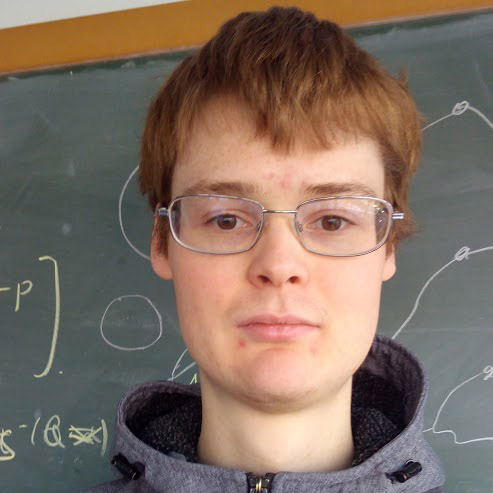
Ewain Gwynne
· ProfessorUniversity of Chicago · Mathematics
Active 2011–2026
About
Ewain Gwynne is a professor of mathematics at the University of Chicago, where he is also a member of the Committee on Computational and Applied Mathematics (CCAM) and an affiliate member of the statistics department. Prior to his current position, he was a postdoctoral researcher at the University of Cambridge and earned his Ph.D. from MIT in 2018 under the supervision of Scott Sheffield. His academic background includes undergraduate studies at Northwestern University. Gwynne's research interests focus on probability theory, particularly random geometric objects that arise in statistical mechanics. His work encompasses topics such as Schramm-Loewner evolution, Liouville quantum gravity, random planar maps, random permutations, random walk in random environments, and various random growth processes. He has contributed to the understanding of the geometry and metrics of Liouville quantum gravity, the properties of random surfaces, and the interplay between SLE and LQG, among other areas. Gwynne is also actively involved in organizing conferences and serves as an associate editor of Probability and Mathematical Physics.
Research topics
- Artificial Intelligence
- Computer Science
- Quantum mechanics
- Mathematics
- Mathematical analysis
- Algorithm
- Geometry
- Physics
Selected publications
CaTherine wheels from trees and Liouville quantum gravity
arXiv (Cornell University) · 2026-04-18
preprintOpen accessSenior authorA CaTherine wheel is a space-filling curve $f : S^1\to S^2$ such that for every closed interval $J\subset S^1$, $f(J)$ is homeomorphic to a closed disk and $f(\partial J)$ is contained in $\partial f(J)$. A CaTherine wheel gives rise to a pair of disjoint, dense topological trees in $S^2$ which roughly speaking lie to the left and right of $f$. We give necessary and sufficient conditions for a topological tree in $S^2$ to arise as one of these trees for some CaTherine wheel $f$. We apply this result to show that there is a unique CaTherine wheel corresponding to the geodesic tree rooted at $\infty$ for the $γ$-Liouville quantum gravity (LQG) metric, for $γ\in (0,2)$. In other words, we construct the space-filling curve which is the contour exploration of the LQG geodesic tree.
CaTherine wheels from trees and Liouville quantum gravity
arXiv (Cornell University) · 2026-04-18
articleOpen accessSenior authorA CaTherine wheel is a space-filling curve $f : S^1\to S^2$ such that for every closed interval $J\subset S^1$, $f(J)$ is homeomorphic to a closed disk and $f(\partial J)$ is contained in $\partial f(J)$. A CaTherine wheel gives rise to a pair of disjoint, dense topological trees in $S^2$ which roughly speaking lie to the left and right of $f$. We give necessary and sufficient conditions for a topological tree in $S^2$ to arise as one of these trees for some CaTherine wheel $f$. We apply this result to show that there is a unique CaTherine wheel corresponding to the geodesic tree rooted at $\infty$ for the $γ$-Liouville quantum gravity (LQG) metric, for $γ\in (0,2)$. In other words, we construct the space-filling curve which is the contour exploration of the LQG geodesic tree.
Random walk on sphere packings and Delaunay triangulations in arbitrary dimension
Proceedings of the London Mathematical Society · 2025-09-01
articleOpen accessSenior authorAbstract We prove that random walks on a family of tilings of ‐dimensional Euclidean space, with a canonical choice of conductances, converge to Brownian motion modulo time parameterization. This class of tilings includes Delaunay triangulations (the dual of Voronoi tessellations) and sphere packings. Our regularity assumptions are deterministic and mild. For example, our results apply to Delaunay triangulations with vertices sampled from a ‐dimensional Gaussian multiplicative chaos measure. As part of our proof, we establish the uniform convergence of certain finite‐volume schemes for the Laplace equation, with quantitative bounds on the rate of convergence. In the special case of two dimensions, we give a new, short proof of the main result of Gurel‐Gurevich et al. [Adv. Math. 374 (2020), no. 53, 107379].
Inverting the operation of conditioning a branching process on extinction
Electronic Journal of Probability · 2025-01-01
articleOpen access1st authorCorrespondingIt is well-known that conditioning a supercritical (multi-type) branching process on the event that it eventually becomes extinct yields a subcritical branching process. We study the corresponding inverse problem: given a subcritical branching process, does there exist a supercritical branching process with the property that when we condition it on extinction, we get back the original subcritical branching process? We show that such a supercritical branching process (which we call a conjugate branching process) exists under mild hypotheses on the original subcritical branching process. We also show by example that if there are at least two types, then the conjugate branching process is not necessarily unique. Our results are relevant to the problem of constructing natural random planar maps whose scaling limit is given by supercritical Liouville quantum gravity. Moreover, conjugate branching processes can also be used to give alternative evolutionary hypotheses in cancer modeling.
Gaussian curvature on random planar maps and Liouville quantum gravity
Probability Theory and Related Fields · 2025-10-09
articleOpen accessSenior authorAbstract We investigate the notion of curvature in the context of Liouville quantum gravity (LQG) surfaces. We define the Gaussian curvature for LQG, which we conjecture is the scaling limit of discrete curvature on random planar maps. Motivated by this, we study asymptotics for the discrete curvature of $$\epsilon $$ <mml:math xmlns:mml="http://www.w3.org/1998/Math/MathML"> <mml:mi>ϵ</mml:mi> </mml:math> -mated CRT maps. More precisely, we prove that the discrete curvature integrated against a $$C_c^2$$ <mml:math xmlns:mml="http://www.w3.org/1998/Math/MathML"> <mml:msubsup> <mml:mi>C</mml:mi> <mml:mi>c</mml:mi> <mml:mn>2</mml:mn> </mml:msubsup> </mml:math> test function is of order $$\epsilon ^{o(1)},$$ <mml:math xmlns:mml="http://www.w3.org/1998/Math/MathML"> <mml:mrow> <mml:msup> <mml:mi>ϵ</mml:mi> <mml:mrow> <mml:mi>o</mml:mi> <mml:mo>(</mml:mo> <mml:mn>1</mml:mn> <mml:mo>)</mml:mo> </mml:mrow> </mml:msup> <mml:mo>,</mml:mo> </mml:mrow> </mml:math> which is consistent with our scaling limit conjecture. On the other hand, we prove the total discrete curvature on a fixed space-filling SLE segment scaled by $$\epsilon ^{\frac{1}{4}}$$ <mml:math xmlns:mml="http://www.w3.org/1998/Math/MathML"> <mml:msup> <mml:mi>ϵ</mml:mi> <mml:mfrac> <mml:mn>1</mml:mn> <mml:mn>4</mml:mn> </mml:mfrac> </mml:msup> </mml:math> converges in distribution to an explicit random variable.
Liouville Brownian motion and quantum cones in dimension $d > 2$
ArXiv.org · 2025-01-27
preprintOpen accessSenior authorFor $d > 2$ and $γ\in (0, \sqrt{2d})$, we study the Liouville Brownian motion associated with the whole-space log-correlated Gaussian field in $\mathbb{R}^d$. We compute its spectral dimension, i.e., the short-time asymptotics of the heat kernel along the diagonal, which, in contrast to the two-dimensional case, depends on both $γ$ and on the thickness of the starting point. Furthermore, for even dimensions $d > 2$, we show that the spherical average process of the whole-space log-correlated Gaussian field in $\mathbb{R}^d$ can be identified with the integral of a stationary Gaussian Markov process of order $(d-2)/2$. Exploiting this representation, we construct the higher-dimensional analogue of the $β$-quantum cone for $β\in (-\infty, Q)$, with $Q = d/γ+ γ/2$. Lastly, for $α= Q - \sqrt{Q^2-4}$, we prove that the law of the $d$-dimensional $α$-quantum cone is invariant under shifts along the trajectories of the associated Liouville Brownian motion.
Scaling limits of planar maps under the Smith embedding
The Annals of Probability · 2025-05-01
articleThe Minkowski content measure for the Liouville quantum gravity metric
The Annals of Probability · 2024-03-01
article1st authorCorrespondingA Liouville quantum gravity (LQG) surface is a natural random two-dimensional surface, initially formulated as a random measure space and later as a random metric space. We show that the LQG measure can be recovered as the Minkowski measure with respect to the LQG metric, answering a question of Gwynne and Miller (Invent. Math. 223 (2021) 213–333). As a consequence, we prove that the metric structure of a γ-LQG surface determines its conformal structure for every γ∈(0,2). Our primary tool is the continuum mating-of-trees theory for space-filling SLE. In the course of our proof, we also establish a Hölder continuity result for space-filling SLE with respect to the LQG metric.
Advances in Mathematics · 2024-01-15 · 2 citations
articleSenior authorHarmonic balls in Liouville quantum gravity
Proceedings of the London Mathematical Society · 2024-12-19
articleOpen accessSenior authorAbstract Harmonic balls are domains that satisfy the mean‐value property for harmonic functions. We establish the existence and uniqueness of harmonic balls on Liouville quantum gravity (LQG) surfaces using the obstacle problem formulation of Hele–Shaw flow. We show that LQG harmonic balls are neither Lipschitz domains nor LQG metric balls, and that the boundaries of their complementary connected components are Jordan curves. We conjecture that LQG harmonic balls are the scaling limit of internal diffusion limited aggregation on random planar maps. In a companion paper, we prove this in the special case of mated‐CRT maps.
Frequent coauthors
- 40 shared
Jason Miller
University of Cambridge
- 22 shared
Xin Sun
- 21 shared
Joshua Pfeffer
Columbia University
- 17 shared
Nina Holden
Courant Institute of Mathematical Sciences
- 16 shared
Jason Miller
West Virginia University
- 15 shared
Scott Sheffield⋆
Massachusetts Institute of Technology
- 10 shared
Jian Ding
- 9 shared
Jian Ding
Peking University
Labs
- Resume-aware match score
- Save to shortlist
- AI-drafted outreach
See your match with Ewain Gwynne
PhdFit ranks faculty by your research interests, methods, and publications — grounded in their actual work, not templates.
- Free to start
- No credit card
- 30-second signup