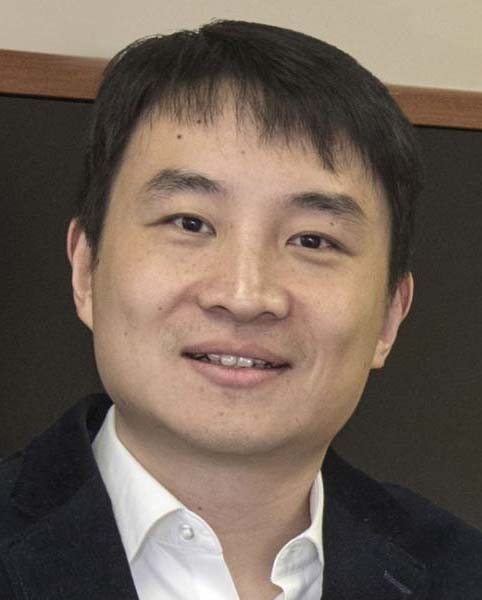
Yuewei Lin
· Research Associate ProfessorStony Brook University · Computer Science
Active 2006–2024
About
Yuewei Lin is a Senior Computational Scientist at the Brookhaven National Laboratory, Upton, NY. He obtained his PhD degree from the University of South Carolina in Columbia, SC. Prior to that, he earned his M.S. and B.S. degrees from Chongqing University and Sichuan University in China, respectively. His research interests include AI for Science, adversarial attack and defense, domain adaptation and generalization, and computer vision techniques applied in large-scale scientific data analysis.
Research topics
- Artificial Intelligence
- Computer Science
- Machine Learning
- Computer Security
- Engineering
- Remote sensing
- Geography
- Computer vision
Selected publications
2021 · 51 citations
- Computer Science
- Artificial Intelligence
- Computer Science
Remote sensing (RS) scene classification has wide applications in the environmental monitoring and geological survey. In the real-world applications, the RS scene images taken by the satellite might have two scenarios: clear and cloudy environments. However, most of existing methods did not consider these two environments simultaneously. In this paper, we assume that the global and local features are discriminative in either clear or cloudy environments. Many existing Convolution Neural Networks (CNN) based models have made excellent achievements in the image classification, however they somewhat ignored the global and local features in their network structure. In this paper, we pro-pose a new CNN based network (named GLNet) with the Global Encoder and Local Encoder to extract the discriminative global and local features for the RS scene classification, where the constraints for inter-class dispersion and intra-class compactness are embedded in the GLNet training. The experimental results on two publicized RS scene classification datasets show that the proposed GLNet could achieve better performance based on many existing CNN backbones under both clear and cloudy environments.
Point Adversarial Self-Mining: A Simple Method for Facial Expression Recognition
IEEE Transactions on Cybernetics · 2021 · 43 citations
- Computer Science
- Computer Science
- Artificial Intelligence
In this article, we propose a simple yet effective approach, called point adversarial self mining (PASM), to improve the recognition accuracy in facial expression recognition (FER). Unlike previous works focusing on designing specific architectures or loss functions to solve this problem, PASM boosts the network capability by simulating human learning processes: providing updated learning materials and guidance from more capable teachers. Specifically, to generate new learning materials, PASM leverages a point adversarial attack method and a trained teacher network to locate the most informative position related to the target task, generating harder learning samples to refine the network. The searched position is highly adaptive since it considers both the statistical information of each sample and the teacher network capability. Other than being provided new learning materials, the student network also receives guidance from the teacher network. After the student network finishes training, the student network changes its role and acts as a teacher, generating new learning materials and providing stronger guidance to train a better student network. The adaptive learning materials generation and teacher/student update can be conducted more than one time, improving the network capability iteratively. Extensive experimental results validate the efficacy of our method over the existing state of the arts for FER.
Transparent Object Tracking Benchmark
2021 IEEE/CVF International Conference on Computer Vision (ICCV) · 2021 · 33 citations
- Computer Science
- Artificial Intelligence
- Computer Science
Visual tracking has achieved considerable progress in recent years. However, current research in the field mainly focuses on tracking of opaque objects, while little attention is paid to transparent object tracking. In this paper, we make the first attempt in exploring this problem by proposing a Transparent Object Tracking Benchmark (TOTB). Specifically, TOTB consists of 225 videos (86K frames) from 15 diverse transparent object categories. Each sequence is manually labeled with axis-aligned bounding boxes. To the best of our knowledge, TOTB is the first benchmark dedicated to transparent object tracking. In order to understand how existing trackers perform and to provide comparison for future research on TOTB, we extensively evaluate 25 state-of-the-art tracking algorithms. The evaluation results exhibit that more efforts are needed to improve transparent object tracking. Besides, we observe some nontrivial findings from the evaluation that are discrepant with some common beliefs in opaque object tracking. For example, we find that deeper features are not always good for improvements. Moreover, to encourage future research, we introduce a novel tracker, named TransATOM, which leverages transparency features for tracking and surpasses all 25 evaluated approaches by a large margin. By releasing TOTB, we expect to facilitate future research and application of transparent object tracking in both the academia and industry. The TOTB and evaluation results as well as TransATOM are available at https: //hengfan2010.github.io/projects/TOTB/.
Frequent coauthors
- 27 shared
Shinjae Yoo
Brookhaven National Laboratory
- 21 shared
Song Wang
Guangzhou Medical University
- 15 shared
Hongkai Yu
Cleveland State University
- 12 shared
Yuan Yan Tang
Shandong Academy of Sciences
- 11 shared
Youjie Zhou
Shandong University
- 9 shared
Zibo Meng
- 9 shared
Haibin Ling
- 7 shared
Bin Fang
Labs
Similar researchers at Stony Brook University
- Resume-aware match score
- Save to shortlist
- AI-drafted outreach
See your match with Yuewei Lin
PhdFit ranks faculty by your research interests, methods, and publications — grounded in their actual work, not templates.
- Free to start
- No credit card
- 30-second signup