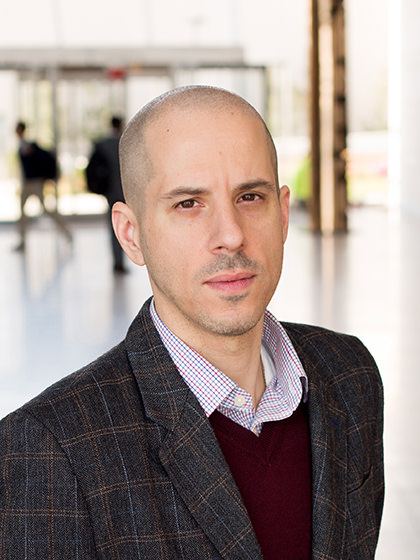
Vasili Byros
Northwestern University · Strings
Active 2009–2025
About
Vasili Byros is an Associate Professor of Music Theory and Cognition at Northwestern University's Bienen School of Music. His research focuses on the compositional, listening, and pedagogical practices of the long 18th century, taking a holistic view that combines perspectives from schema theory, Formenlehre, topic theory, and historical pedagogies. His work aims to reconstruct 'insider' perspectives on music of that period, exploring issues of key perception, tonality, interactions between local and large-scale musical grammars, and the intersections between syntax, semantics, musical meaning, and communication. He has published extensively in various scholarly journals and contributed chapters to edited volumes, with a particular interest in how historical pedagogical documents relate to free composition and period style.
Research topics
- Aesthetics
- Art
- Visual arts
- Literature
- History
- Sociology
- Political Science
- Artificial Intelligence
- Computer Science
- Art history
- Philosophy
- Mathematics
- Cognitive science
- Epistemology
- Linguistics
- Law
- Mechanical engineering
- Engineering
- Psychology
Selected publications
Mining for Meaning with Late Beethoven
2025-03-20
book-chapter1st authorCorrespondingAbstract This chapter meditates on the problem of meaning in late Beethoven by reconstructing key themes of suffering, faith, and longing for transcendence in Beethoven’s life and music via the cultural unit, while considering the relevance of these connotations for today’s world. Cultural units are abstractions existing in culture that are irreducible to single lexemes or natural language, not limited to the constraints and realities of the physical world, and uniquely articulated by different linguistic, literary, and artistic media. Central to the chapter’s reconstruction are Beethoven’s innovations regarding the expressive and philosophical weight and breadth of the cultural unit’s musical realizations: these are enabled by a threefold expansion of dialogic form, one already latent in Hepokoski and Darcy’s conceptualization, while two others are unique consequences of Beethoven’s search for metaphysical and existential truth and communion with God via the medium of music. The cultural unit is explored in sketch evidence, Beethoven’s Tagebuch and letters, historically informed analysis of the late piano sonatas Op. 101, Op. 110, and Op. 111 and their revisiting of ideas from the Appassionata, op. 57, and the Cello Sonata, op. 69, along with key references to the Ninth Symphony and Missa Solemnis, to reveal a picture of a man who asks deep and lasting questions of us, our human condition, and how to respond to it all.
Of Elegant Tones and Fantastical Progressions
Oxford University Press eBooks · 2022
1st authorCorresponding- Computer Science
- Artificial Intelligence
- Cognitive science
Abstract This chapter reconstructs aspects of diminished-seventh chord usage and modulation in the long eighteenth century that have been lost to and distorted by modern conceptualizations. The reconstruction centers on the “diatonic” foundations of scale degree ♯4 and the diminished seventh chord build upon it. Corpus study is a methodological driver of the project, but with a reflective and critical eye that questions conventional understanding and ultimately leads to a novel, practical, and hands-on realization of the method that operationalizes DIM7 modulation and the history of theory via schemata and comprovisation. Using the diminished seventh chord as its object of inquiry, this chapter tells a story of musical epistemology and the different role that corpora may play in its creation—the different types of knowledge their analysis might produce as well as the varieties of its representation, according to their particular alignment with different ways of doing music theory.
The Hero Who Practices Resignation: Beethoven’s<i>Eroica</i>as ‘Late’ Work
Cambridge University Press eBooks · 2020 · 1 citations
1st authorCorresponding- Sociology
- Art
- Aesthetics
Historically informed analysis reveals a very different conception of hero in the Eroica than the one sustained in the popular imagination and perpetuated by the majority of its reception history: a militaristic or Napoleonic Heldenleben. By combining analytic perspectives from schema theory and topic theory with key passages from Beethoven's epistolary life and Tagebuch, this chapter illustrates that the Eroica's narrative is akin to religious drama, conveying the same theme of abnegation found in the contemporary oratorio Christus am Ölberge and the Heiligenstadt Testament, the Eroica's 'literary prototype'. Unlike some middle-period works which communicate a 'tragic-to-triumphant' expressive genre, the Eroica is cast in the 'tragic-to-transcendent' type, which became characteristic of Beethoven's late style. A central component of this spiritual genre is the strategic positioning of structural and semantic oppositions in an unresolved state of suspension. The Eroica manifests this most overtly through a governing opposition between death 'ombra' and pastoral 'Ländler, contredanse' music, and the association of this stylistic opposition with the tonalities of G minor and E flat major, respectively. Rather than a programmatic narrative about a hero who overcomes, the Eroica is a conceptually 'late' work that meditates on suffering as a spiritual necessity and its implications for transcendence.
The Cambridge Companion to the <I>Eroica</I> Symphony
Cambridge University Press eBooks · 2020 · 21 citations
- Political Science
- Art
- Literature
This Companion provides orientation for those embarking on the study of Beethoven's much-discussed Eroica Symphony, as well as providing fresh insights that will appeal to scholars, performers and listeners more generally. The book addresses the symphony in three thematic sections, on genesis, analysis and reception history, and covers key topics including political context, dedication, sources of the Symphony's inspiration, 'heroism' and the idea of a 'watershed' work. Critical studies of writings and analyses from Beethoven's day to ours are included, as well as a range of other relevant responses to the work, including compositions, recordings, images and film. The Companion draws on previous literature but also illuminates the work from new angles, based on new evidence and a range of approaches by twelve leading scholars in Beethoven research.
Eighteenth Century Music · 2019-02-14
article1st authorCorrespondingAn abstract is not available for this content. As you have access to this content, full HTML content is provided on this page. A PDF of this content is also available in through the ‘Save PDF’ action button.
Bach · 2018-01-01
article1st authorCorrespondingOver the past decade or so, historically informed theory, pedagogy, and (more recently) composition have emerged fully as outgrowths of the historically informed performance (HIP) movement, for which Bach's music has been instrumental. In this light, "Bach in the music theory classroom" is a metaphor for a broader HI initiative, one where, in my own teaching, historically informed theory (HIT) becomes the basis for structuring a curriculum centered on period composition. In this article, I discuss the materials, process, rationale, and philosophical implications for a mini-curriculum that constitutes the first of a three-course HIT sequence. My aim with this first leg is to change students' thinking from the "know-what" types of knowledge characteristic of present-day music theory curricula to a "know-how" mind-set consistent with eighteenth-century pedagogy.
Hauptruhepuncte des geistes: Punctuation schemas and the late-eighteenth-century sonata
2015-01-01 · 19 citations
article1st authorCorrespondingLeuven University Press eBooks · 2015-04-15 · 51 citations
book-chapter1st authorCorrespondingMusic Theory Online · 2015-09-01 · 12 citations
articleOpen access1st authorCorrespondingThis article examines a hypothetical compositional and pedagogical use of the Langloz manuscript, a collection of German partimenti, during the time of J. S. Bach. The partimento is reconceptualized as a bridge to free composition, by aligning it with what Bach and his Thuringian and Hamburgian neighbors (including Werckmeister, Walther, Niedt, and Mattheson) called inventiones : materials for free composition that are subject to substantial development, involving processes of elaboration, variation, extension, and expansion. My argument is borne out by a historically informed practical demonstration: my own composition of a Prelude in D minor, which broadly derives from the partimento-prelude numbered 48 in the manuscript. The transformation of a simple thoroughbass into a fully worked-out composition pivots on two species of invention and their development, one structural, the other stylistic: 1) a genre-specific structuring principle that is coded into the partimento; for the prelude genre, this concerns long-range scale-harmonizations spanning 1–4 octaves; the principle recurs in several preludes of The Langloz Manuscript and of The Well-Tempered Clavier ; and 2) the subject ( thema ) of a composition, which results from novel combinations of musical topics ( Manieren ), and the constructive imitation of other composers’ uses of styles and genres ( locus exemplorum ).
The Oxford handbook of topic theory
Oxford University Press eBooks · 2014-10-16 · 11 citations
book
Frequent coauthors
- 36 shared
Mark Anson‐Cartwright
- 36 shared
Andrew Clark
Beatson West of Scotland Cancer Centre
- 36 shared
Louis Brouillette
- 36 shared
Erick Arenas
- 4 shared
Nancy November
- 2 shared
Elaine R. Sisman
- 2 shared
Melanie Lowe
Université de Tours
- 1 shared
Joel Galand
Awards & honors
- Outstanding Publication Award from the Society for Music The…
- Charles Deering McCormick Professorship, Northwestern Univer…
- Faculty Honor Roll of Northwestern’s Associated Student Gove…
- Resume-aware match score
- Save to shortlist
- AI-drafted outreach
See your match with Vasili Byros
PhdFit ranks faculty by your research interests, methods, and publications — grounded in their actual work, not templates.
- Free to start
- No credit card
- 30-second signup