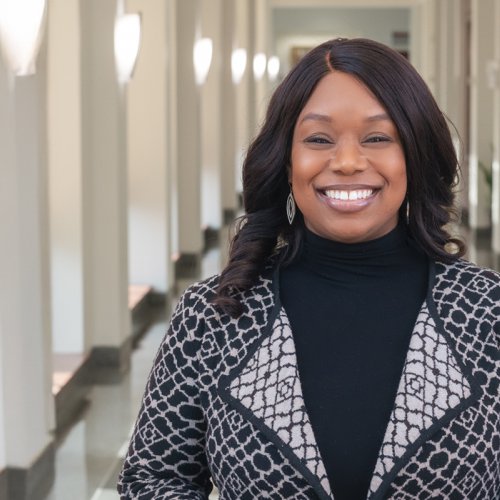
About
Dr. Tolulope Oyesanya is an Associate Professor at Duke University School of Nursing, trained as a PhD-prepared registered nurse and health services researcher. Her research centers on improving the health, wellbeing, and quality of life of diverse adult patients with traumatic brain injury (TBI) in both acute and post-acute settings, as well as their family caregivers. She focuses particularly on the transitional care needs of patients with TBI who are discharged home from acute hospital care without inpatient rehabilitation, emphasizing post-discharge improvements in patient quality of life, patient and family needs, and self- and family-management of TBI-related health and healthcare. Her work also addresses disparities in TBI-related outcomes based on factors such as insurance, access to care, race/ethnicity, and language. Although originally trained as a qualitative researcher, Dr. Oyesanya employs mixed methods research, including community-engaged qualitative studies and quantitative analyses using large datasets to investigate predictors of TBI outcomes. Her expertise and contributions have led to appointments on several TBI best practices and clinical guidelines committees and expert panels. Dr. Oyesanya earned her BSN, MSN, and PhD in Nursing from the University of Wisconsin-Madison and completed a post-doctoral fellowship in Brain Injury Research at Shepherd Center in Atlanta, Georgia. Her research has been consistently supported by federal and internal awards. She is actively involved in professional organizations, serving as Founder and Chair of the Transitional Care New Forming Group and Chair of the Career Development Networking Group within the American Congress of Rehabilitation Medicine, and as a member of the Association of Rehabilitation Nurses and the International Brain Injury Association.
Research topics
- Medicine
- Sociology
- Psychology
- Political Science
- Nursing
- Clinical psychology
- Medical emergency
- Psychiatry
- Physical therapy
- Family medicine
Selected publications
Western Journal of Nursing Research · 2026-04-07
articleSenior authorCorrespondingBACKGROUND: The Hispanic or Latino community account for under 8% of US clinical trial samples. Research is needed to facilitate increased enrollment of Hispanic or Latino individuals into trials. OBJECTIVES: The purpose of this study was to describe cultural and linguistic adaptation of the BETTER traumatic brain injury (TBI) transitional care intervention and accompanying participant workbook to be suitable for Spanish-speaking patients with TBI and their families. METHODS: Building on intervention development with Spanish-speaking patients and families, the cultural adaptation (phase I) included incorporating perspectives from qualitative interviews of interpreters and providers on the overall intervention. Rapid qualitative analysis was employed in phase I, allowing for efficient implementation of cultural adaptation findings in the BETTER clinical trial. Linguistic adaptation (phase II) included workbook translation, cognitive user-testing, and participant feedback. RESULTS: Health care providers and interpreters (n = 10, phase I) and one workbook reviewer (phase II) participated. Participants' mean age was 45.5 years, majority were female (n = 8), and all were bilingual. Phase I analysis produced 2 themes: (1) centering culture to advance patient outcomes, and (2) enhancing uptake of BETTER. The main recommendations received in phase II were related to orthographic changes (25%) and limiting use of English idioms (19%), which did not hold meaning in the Spanish language. CONCLUSION: Study findings supported cultural and linguistic adaptation of BETTER and the accompanying participant workbook. Steps taken in this study can serve as a model for researchers seeking to culturally and linguistically adapt interventions to engage non-English speaking and minoritized participants in research.
"God chose me for a reason”: A Qualitative Study of the Experiences of Bereaved Latine Caregivers
Journal of Pain and Symptom Management · 2026-05-12
articleJournal of Advanced Nursing · 2025-09-01
articleOpen accessSenior authorAIM: To describe nurses' roles in transitional care planning during intensive care unit (ICU) family meetings for patients with prolonged mechanical ventilation (PMV). DESIGN: A qualitative descriptive study. METHODS: Using secondary data from a trial of a decision aid about PMV, transcripts from 19 unstructured ICU family meetings were purposively sampled and analysed using directed content analysis. FINDINGS: Among 76 recorded ICU family meetings where nurses engaged and spoke at length beyond introduction, nurses spoke at length in 19 (25%) of them. These 19 family meetings were analysed in depth. Three themes were identified describing the roles nurses served: (1) Transitional care liaisons (e.g., introducing next levels of care, identifying/engaging family members, providing patient/family education, managing medications, planning for discharge, assessing patient/family needs, coordinating care, setting goals, providing care continuity, offering provider guidance and referring to resources); (2) information and communication facilitators (e.g., moderating family meetings, facilitating family understanding and serving as communication intermediaries) and (3) family support providers (e.g., providing emotional support, describing expectations and advocating for patients/families). CONCLUSION: Although nurses play a central role in patient care, they engage in only a minority of ICU family meetings addressing transitional care planning. Increased nursing involvement in these discussions may enhance care coordination and better support families navigating complex care transitions. IMPLICATIONS FOR CLINICAL PRACTICE: Findings suggest that more consistent engagement of nurses in ICU family meetings has the potential to support transitional care planning and family-centred care for patients with PMV and their families. IMPACT: This work adds to a growing body of knowledge about nurses' role in ICU transitional care planning. These findings provide valuable guidance for future research and development of transitional care standards to guide nurses in ICU transitional care planning. REPORTING METHOD: The Consolidated Criteria for Reporting Qualitative Research Checklist (COREQ). PATIENT OR PUBLIC CONTRIBUTION: No patient or public contribution.
Archives of Physical Medicine and Rehabilitation · 2025-11-21
article“I can't let it stop me”: perspectives on aging from older adults with sickle cell disease
Journal of sickle cell disease. · 2025-01-01 · 1 citations
articleOpen accessObjectives: More individuals with SCD are living beyond initial life expectancy. Despite a growing population of older adults with SCD, little is known about their unique experiences and needs. Understanding the perspectives of older adults with SCD (age ≥ 50 years) could provide insight on the most pressing concerns that healthcare providers should focus on and strategies to promote healthy aging. The purpose of this study was to describe the aging experiences of older adults with SCD. Methods: In this qualitative descriptive study, we conducted semi-structured interviews with 19 older adults with SCD who received care at a single comprehensive sickle cell program in the Southeastern United States. Data were analyzed using conventional content analysis. Results: A total of 3 themes were identified. Theme 1 was "challenges with aging" with 2 subthemes: (a) internal challenges and (b) external challenges. Theme 2 was "wisdom gained with age for prevention and management of complications" with 2 subthemes: (a) lifestyle modifications and preventing complications and (b) managing sickle cell pain. Theme 3 was "living beyond life expectancy" with 2 subthemes: (a) differences in expectations for life expectancy and (b) factors contributing to longevity. Conclusion: These perspectives from older adults with SCD provide guidance for healthcare providers on areas that are most important to them as they age. This also provides practical strategies for prevention and self-management of SCD complications that our participants reported contributed to their quality of life and longevity.
Development and satisfaction of a mentoring-match algorithm
Mentoring & Tutoring Partnership in Learning · 2025-06-30 · 1 citations
article1st authorCorrespondingTeaching and learning in nursing · 2025-06-18
articleCritical Care Medicine · 2025-12-26
articleOpen accessSenior authorOBJECTIVES: To examine how accurately ICU clinicians perceived family-reported prognostic expectations (FPEs) for patients with prolonged mechanical ventilation (PMV). DESIGN: A cross-sectional, exploratory design using secondary analysis. SETTING: Thirteen ICUs across five hospitals in the United States. SUBJECTS: Family members of patients with PMV and ICU clinicians, including physicians and nurses. INTERVENTIONS: None. MEASUREMENTS AND MAIN RESULTS: Latent profile analysis was used to identify profiles of accuracy in clinician perception of FPE, followed by bivariate analyses and multinomial logistic regression to examine associations between patient, family, and clinician characteristics and profile membership. A total of 554 participants (239 family members, 150 physicians, and 165 nurses) were included. Five distinct latent profiles of accuracy in clinician perception of FPE were identified: 1) clinician underestimation of FPE; 2) clinician overestimation of FPE; 3) accurate perception: low prognosis; 4) accurate perception: moderate prognosis; and 5) accurate perception: high prognosis. Families in profile 1 (clinician underestimation of FPE) were more likely to be spouses/partners of patients and reported higher levels of hope and optimism, whereas those in profile 2 (clinician overestimation of FPE) reported lower levels. Patient characteristics, including age, employment status, admission to medical ICU, and pulmonary-related hospital diagnosis, were statistically significantly associated with the profile membership. CONCLUSIONS: Understanding how accurately clinicians perceive FPE is vital to improving shared decision-making and developing goal-concordant care for patients with PMV. Further research examining strategies for clinicians to accurately perceive what families believe about prognosis is needed to identify potential misalignment, initiate timely and empathetic conversations, and build toward shared decision-making and goal-concordant care.
Archives of Physical Medicine and Rehabilitation · 2025-11-24
articleUNC Libraries · 2025-05-09
articleOpen accessOBJECTIVE: The aim of the study was to determine the association of sex and race/ethnicity with acute hospital readmissions ("within-stay readmissions") during inpatient rehabilitation facility care versus patients discharged home without a within-stay readmission among traumatic brain injury patients. DESIGN: The study used a secondary analysis ( N = 210,440) of Uniform Data System for Medical Rehabilitation data using multiple logistic regression. RESULTS: Within-stay readmissions occurred for 11.79% of female and 11.77% of male traumatic brain injury patients. Sex-specific models identified insurance, comorbidities, and complications factored differently in likelihood of within-stay readmissions among female than male patients but association of all other factors were similar per group. Within-stay readmissions differences were more pronounced by race/ethnicity: White, 11.63%; Black, 11.32%; Hispanic/Latino, 9.78%; and other, 10.61%. Descriptive bivariate analysis identified racial/ethnic patients with within-stay readmissions had greater days from traumatic brain injury to inpatient rehabilitation facility admission (White, 17.66; Black, 21.70; Hispanic/Latino, 23.81; other, 20.66) and lower admission cognitive and motor function. Factors differed across models predicting within-stay readmissions for race/ethnic groups; age, admission motor and cognitive function, complications, and length of stay were consistent across groups. CONCLUSIONS: This study demonstrates disparities by race/ethnicity for inpatient rehabilitation facility within-stay readmissions among traumatic brain injury patients and factors predictive of this potentially preventable outcome by sex and race/ethnicity. Findings could inform care planning and quality improvement efforts for TBI patients.
Recent grants
Inpatient Rehabilitation for Women with Traumatic Brain Injury and Their Families
NIH · $34k · 2015–2017
Frequent coauthors
- 21 shared
Janet Prvu Bettger
- 15 shared
Ronald T. Seel
Kessler Institute for Rehabilitation
- 12 shared
Karthik Arulselvam
Duke University
- 12 shared
Lindsey Byom
University of North Carolina at Chapel Hill
- 12 shared
Nicole Thompson
Shepherd Center
- 11 shared
Courtney H. Van Houtven
Duke University
- 9 shared
Kathy A. Johnson
- 9 shared
Eileen J. Porter
University of Missouri Hospital
Labs
Education
Ph.D., Nursing Science
Duke University School of Nursing
M.S., Neuroscience
University of North Carolina at Chapel Hill
B.S., Nursing
University of North Carolina at Chapel Hill
Awards & honors
- American Congress of Rehabilitation Medicine (ACRM) Career D…
- Resume-aware match score
- Save to shortlist
- AI-drafted outreach
See your match with Tolu Oyesanya
PhdFit ranks faculty by your research interests, methods, and publications — grounded in their actual work, not templates.
- Free to start
- No credit card
- 30-second signup