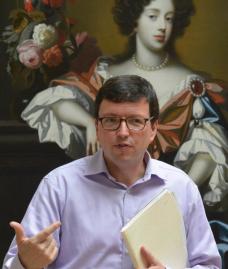
Tim Barringer
· Paul Mellon Professor in the History of ArtYale University · Art History
Active 1993–2024
About
Tim Barringer is the Paul Mellon Professor of the History of Art at Yale University, with a specialization in the art of Britain and the British Empire since 1700, nineteenth-century American art, and art and music. He holds degrees from Trinity Hall, University of Cambridge (B.A.), the Institute of Fine Arts, New York University (M.A.), and the University of Sussex (D.Phil.). Barringer has held positions at the Victoria and Albert Museum, the Universities of London and Birmingham before joining Yale in 1998. He has also served as Slade Professor at the University of Cambridge, held a J. Clawson Mills Fellowship at the Metropolitan Museum of Art, and delivered the Paul Mellon Lectures at the National Gallery in London. His academic career includes visiting professorships at York and Bristol Universities in the UK.
Research topics
- Computer Science
- Ancient history
- Engineering
- Visual arts
- Physics
- Art
- History
- Mechanical engineering
- Multimedia
- Operating system
- Medicine
- Optometry
- Thermodynamics
- Mathematics
Selected publications
The Tudors: Art and Majesty in Renaissance England
West 86th · 2024-03-01 · 1 citations
article1st authorCorrespondingAn Exhibition History of Victorian Leeds
Northern History · 2024-06-04
article1st authorCorrespondingJBR volume 62 issue 2 Cover and Front matter
Journal of British Studies · 2023 · 1 citations
- Computer Science
- Computer Science
- Engineering
An abstract is not available for this content so a preview has been provided. As you have access to this content, a full PDF is available via the ‘Save PDF’ action button.
Manchester University Press eBooks · 2023-03-07
paratextOpen access146 slave economy 61, 63, 66-7, 68, 74-5 and slave trade 64-5 Barbados Assembly 56, 67
Ambiguities of Imperial Mourning: The Patcham Chattri
Art History · 2022-06-01
article1st authorCorrespondingThe Chattri Indian Monument , erected upon the Sussex Downs above Brighton in 1921, commemorates the Hindu and Sikh soldiers who died in hospitals in Brighton as a result of wounds received fighting for the British Empire in the First World War. The form and name of the monument reference the chatrī , an architectural element characteristic of historical palaces and tombs of northern India. The monument, designed by an Indian architect, Elias Henriques, was intended by the India Office and officials in Brighton to be legible as a hybrid structure, both Indian and British. Conceived as a respectful act of eulogy in honour of Indian soldiers who died in the imperial forces, it nonetheless enshrines the ideology of white supremacy upon which the British Empire rested, and thus embodies the ambiguities of imperial mourning.
The Art Bulletin · 2022 · 7 citations
Senior authorCorresponding- Art
- History
- Visual arts
Afterword: Intersectional Albertopolis
Bloomsbury Academic eBooks · 2022-08-30
book-chapter1st authorCorrespondingForum: Victoria and the Politics of Representation
19 Interdisciplinary Studies in the Long Nineteenth Century · 2021-11-29
articleOpen accessSenior authorSeven contemporary commentators whose experience has been touched by Queen Victoria’s history and its legacy address the question: how should we curate Victoria today?
Sonic Spectacles of Empire: The Audio-Visual Nexus, Delhi-London, 1911-12
Routledge eBooks · 2020 · 3 citations
1st authorCorresponding- Computer Science
- Art
- Visual arts
This chapter considers the significance of the combination of hearing and sight in the historical experience of imperial pageantry, in India and in London. It chapter discusses performances and pageants by which empire was represented both in Delhi and in London. These ephemeral, though profoundly influential, events have left historical traces through programs and descriptions, surviving texts, musical scores, and photographs. They spoke, like all forms of organized mass ritual, to the senses of both sight and hearing. The evidential and interpretative challenges involved in writing an experiential history incorporating both hearing and sight, a history of sensory affect and response, are considerable. The cultural promotion of the British Empire was prosecuted through a range of practices, from ceremonial to theater and music hall.
JBR volume 59 issue 1 Cover and Front matter
Journal of British Studies · 2020 · 1 citations
- Computer Science
- Computer Science
- Engineering
An abstract is not available for this content so a preview has been provided. As you have access to this content, a full PDF is available via the ‘Save PDF’ action button.
Frequent coauthors
- 18 shared
Bárbaro Martínez-Ruiz
- 17 shared
Gillian Forrester
- 11 shared
Deborah E. Harkness
McGill University
- 9 shared
Tara Contractor
- 8 shared
Elizabeth Prettejohn
- 7 shared
Philippa Levine
The University of Texas at Austin
- 7 shared
Victoria Hepburn
- 6 shared
Matt Houlbrook
Awards & honors
- Slade Professor at the University of Cambridge (2009)
- J. Clawson Mills Fellowship at the Metropolitan Museum of Ar…
- Paul Mellon Lectures at the National Gallery in London (2019…
- Alfred Barr Prize of the College Art Association (2007)
- Sarai Ribicoff teaching prize (2004)
- Resume-aware match score
- Save to shortlist
- AI-drafted outreach
See your match with Tim Barringer
PhdFit ranks faculty by your research interests, methods, and publications — grounded in their actual work, not templates.
- Free to start
- No credit card
- 30-second signup