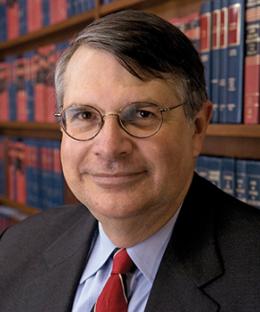
Thomas W. Merrill
Columbia University · Columbia Law School
Active 1976–2025
About
Thomas W. Merrill is the Charles Evans Hughes Professor of Law at Columbia Law School. He is one of the most cited legal scholars in the United States, with expertise in administrative law, constitutional law, and property law. Merrill's research and teaching focus on issues such as administrative interpretation of law, the role of courts and agencies in lawmaking, and property rights, including the public trust doctrine and property theory. His experience in both the public sector, including clerking for Chief Judge David L. Bazelon and Justice Harry A. Blackmun, and the private sector, notably as a deputy solicitor general of the U.S. Department of Justice and counsel at Sidley & Austin, informs his scholarly work. Merrill has authored influential articles, co-authored casebooks, and contributed to the development of legal doctrine through his role as a co-reporter for the American Law Institute’s Restatement (Fourth) of Property. He has also delivered notable lectures, including the annual Hands Lecture on Learned Hand and statutory interpretation, and authored books such as 'Lakefront: Public Trust and Private Rights in Chicago.' Merrill is a member of the American Law Institute and the American Academy of Arts and Sciences, and has served on faculties at Northwestern and Yale Law Schools.
Research topics
- Computer Science
- Sociology
- Political Science
- Law
- Philosophy
- Law and economics
- Computer Security
- Epistemology
- Finance
- Business
Selected publications
The Demise of Deference — And the Rise of Delegation to Interpret?
SSRN Electronic Journal · 2025-01-01 · 6 citations
articleOpen access1st authorCorresponding<i>Briggs v. Southwestern Energy Production</i>: Hydraulic Fracturing and Subsurface Trespass
Journal of Tort Law · 2023-03-01 · 2 citations
article1st authorCorrespondingAbstract The tort of trespass to land has proven to be controversial as applied to airplane overflights (and more recently to drones) as well as to oil and gas production using hydraulic fracking technology. The key to applying trespass to intrusions above and below the surface of land is to distinguish between possession of land and the right to possess land. Surface owners have the right to possess the column of space above and below the surface (a kind of option value), but only to the extent that this space is subject to possible effective possession. The Pennsylvania Supreme Court in Briggs v. Southwestern Energy Production concluded that fracking can result in physical intrusions that can be detected using available monitoring technology. The court further concluded that such physical intrusions should be subject to trespass liability. We argue that these conclusions are correct insofar as such intrusions interfere with a surface owner’s possible effective possession – the action of the intruder necessarily means that the surface owner could also find it economically advantageous to engage in production activity in this portion of subsurface space itself. The decision confirms the utility of the law of trespass to the architecture of property, in that it establishes an indispensable baseline against which exchanges of rights and regulatory modifications of rights can occur.
Antitrust Rulemaking: The FTC’s Delegation Deficit
SSRN Electronic Journal · 2023-01-01 · 2 citations
articleOpen access1st authorCorrespondingThe Major Questions Doctrine: Right Diagnosis, Wrong Remedy
SSRN Electronic Journal · 2023-01-01 · 4 citations
articleOpen access1st authorCorresponding2023-04-20
book-chapterOpen access1st authorCorrespondingAbstract The central feature of the American Law Institute’s Restatement of Property is that it remains incomplete after nearly seventeen volumes produced over nearly ninety years. The principal explanation for this is the proclivities of the Reporters who have been responsible for the first three iterations of this effort. Some of these proclivities, such as a commitment to meticulous research, have been commendable. But the incompleteness of the effort has reduced the influence of the property Restatement, relative to other Restatements like contracts and torts. The chapter concludes with a description of the Fourth Restatement of Property, now underway, and the organizational structure it has adopted in an effort to produce, at long last, a complete Restatement of Property.
Harvard University Press eBooks · 2022-05-13
book-chapter1st authorCorresponding12. Improving the Quality of Agency Interpretations
Harvard University Press eBooks · 2022-05-13
book-chapter1st authorCorresponding1. Judicial Review of Agency Interpretation—Four Values
Harvard University Press eBooks · 2022-05-13
book-chapter1st authorCorresponding11. Discerning the Boundaries of Agency Authority to Interpret
Harvard University Press eBooks · 2022-05-13
book-chapter1st authorCorrespondingHarvard University Press eBooks · 2022-05-13
book-chapter1st authorCorresponding
Frequent coauthors
- 30 shared
Joseph D. Kearney
- 17 shared
Henry E. Smith
- 9 shared
David D. Corey
- 9 shared
Jean Yarbrough
- 9 shared
Michelle Clarke
- 9 shared
Wilson Me
- 9 shared
Williams Tinder
Bowdoin College
- 9 shared
Mary Nichols
Southwest Watershed Research Center
Education
B.A.
Yale University
Other
Harvard Law School
Awards & honors
- Brigham-Kanner Award for Scholarship in Property Law 2013
- ABA Administrative Law Award for Distinguished Scholarship (…
- Honorary Doctor of Laws, Grinnell College 1995
- ABA Administrative Law Award for Distinguished Scholarship O…
- Legal Scholar in Residence, General Motors Corporation May –…
- Resume-aware match score
- Save to shortlist
- AI-drafted outreach
See your match with Thomas W. Merrill
PhdFit ranks faculty by your research interests, methods, and publications — grounded in their actual work, not templates.
- Free to start
- No credit card
- 30-second signup