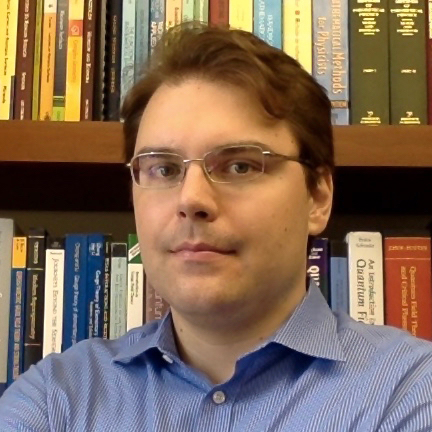
Thomas Dumitrescu
· Associate ProfessorUniversity of California, Los Angeles · Physics and Astronomy
Active 2007–2026
About
Thomas Dumitrescu is an Associate Professor in the Department of Physics & Astronomy at UCLA. He received his B.A. in Physics and Mathematics from Columbia University in 2008 and completed his Ph.D. in Physics at Princeton University in 2013 under the supervision of Professor Nathan Seiberg at the Institute for Advanced Study. Prior to joining UCLA, he was a five-year postdoctoral fellow at Harvard University. His research interests encompass a broad range of theoretical physics, including quantum field theory, particle physics, condensed matter physics, supersymmetry, string theory, and mathematical physics. He is particularly focused on developing new theoretical tools for analyzing strongly-coupled quantum field theories, which are beyond the reach of conventional perturbation theory.
Research topics
- Quantum mechanics
- Mathematics
- Geometry
- Theoretical physics
- Sociology
- Physics
- Pure mathematics
- Mathematical physics
Selected publications
From QED$_3$ to Self-Dual Multicriticality in the Fradkin-Shenker Model
ArXiv.org · 2026-02-26
articleOpen access1st authorCorrespondingWe consider the Fradkin-Shenker ${\mathbb Z}_2$ gauge-Higgs lattice model in 2+1 dimensions, i.e. the toric code deformed by an in-plane magnetic field. Its phase diagram contains a multicritical CFT with gapless, mutually non-local electric and magnetic particles, exchanged by a ${\mathbb Z}_2^{\mathsf{D}}$ self-duality symmetry. We introduce a staggered generalization of the model in which these particles carry global $U(1)_e$ and $U(1)_m$ charges, respectively, and we propose a continuum QFT description in terms of QED$_3$ with $N_f = 2$ Dirac fermion flavors and a charge-two Higgs field with Yukawa couplings. The conjectured phase diagram harbors a multicritical CFT with $(O(2)_e \times O(2)_m)\rtimes\mathbb{Z}_2^\mathsf{D}$ symmetry, some of which is emergent in the QFT description. We compute the scaling dimensions of some operators using a large-$N_f$ expansion and find agreement with the emergent selection rules. The staggered model admits a deformation to the original Fradkin-Shenker model, which maps to unit-charge monopole operators in Higgs-Yukawa-QED$_3$ that break the $U(1)_e \times U(1)_m$ symmetry. We show explicitly that this deformation reproduces all features of the Fradkin-Shenker phase diagram. Finally, we propose a multicritical duality between Higgs-Yukawa-QED$_3$ and the easy-plane $\mathbb{ CP}^1$ model (i.e. two-flavor scalar QED$_3$ with a suitable potential), which describes spin-1/2 anti-ferromagnets on a square lattice. This duality implies a first-order line of Néel-VBS transitions ending in a deconfined quantum multicritical point, described by the same $O(2)_e \times O(2)_m$ symmetric CFT that arises in the staggered Fradkin-Shenker model, which separates it from a gapped ${\mathbb Z}_2$ spin liquid phase.
From QED$_3$ to Self-Dual Multicriticality in the Fradkin-Shenker Model
Open MIND · 2026-02-26
preprint1st authorCorrespondingWe consider the Fradkin-Shenker ${\mathbb Z}_2$ gauge-Higgs lattice model in 2+1 dimensions, i.e. the toric code deformed by an in-plane magnetic field. Its phase diagram contains a multicritical CFT with gapless, mutually non-local electric and magnetic particles, exchanged by a ${\mathbb Z}_2^{\mathsf{D}}$ self-duality symmetry. We introduce a staggered generalization of the model in which these particles carry global $U(1)_e$ and $U(1)_m$ charges, respectively, and we propose a continuum QFT description in terms of QED$_3$ with $N_f = 2$ Dirac fermion flavors and a charge-two Higgs field with Yukawa couplings. The conjectured phase diagram harbors a multicritical CFT with $(O(2)_e \times O(2)_m)\rtimes\mathbb{Z}_2^\mathsf{D}$ symmetry, some of which is emergent in the QFT description. We compute the scaling dimensions of some operators using a large-$N_f$ expansion and find agreement with the emergent selection rules. The staggered model admits a deformation to the original Fradkin-Shenker model, which maps to unit-charge monopole operators in Higgs-Yukawa-QED$_3$ that break the $U(1)_e \times U(1)_m$ symmetry. We show explicitly that this deformation reproduces all features of the Fradkin-Shenker phase diagram. Finally, we propose a multicritical duality between Higgs-Yukawa-QED$_3$ and the easy-plane $\mathbb{ CP}^1$ model (i.e. two-flavor scalar QED$_3$ with a suitable potential), which describes spin-1/2 anti-ferromagnets on a square lattice. This duality implies a first-order line of Néel-VBS transitions ending in a deconfined quantum multicritical point, described by the same $O(2)_e \times O(2)_m$ symmetric CFT that arises in the staggered Fradkin-Shenker model, which separates it from a gapped ${\mathbb Z}_2$ spin liquid phase.
2025-07-28
reportOpen accessQuantum field theory is a unifying language that pervades many areas of modern physics. The project revolves around the study of strongly-coupled quantum field theories that are not amenable to conventional perturbative techniques – with a particular focus on strongly- coupled gauge theories.
Phases of Giant Magnetic Vortex Strings
ArXiv.org · 2025-11-25
preprintOpen access1st authorCorrespondingWe consider Abrikosov-Nielsen-Olesen magnetic vortex strings in 3+1 dimensional Abelian Higgs models. We systematically analyze the giant vortex regime using a combination of analytic and numerical methods. In this regime the strings are infinitely long, axially symmetric, and support a large magnetic flux n along the symmetry axis in their core that causes them to spread out in the transverse directions. Extending previous observations, we show that the non-linear equations governing giant vortices can essentially be solved exactly. The solutions fall into different universality classes, reflecting the properties of the Higgs potential, that become sharply distinct phases in the large-n limit. We use this understanding to shed light on the binding energies and stability of vortex strings in each universality class.
Physics Reports · 2025-11-08 · 2 citations
articleOpen accessHiggs-confinement transitions in QCD from symmetry protected topological phases
SciPost Physics · 2024-09-26 · 11 citations
articleOpen access1st authorCorrespondingIn gauge theories with fundamental matter there is typically no sharp way to distinguish confining and Higgs regimes, e.g. using generalized global symmetries acting on loop order parameters. It is standard lore that these two regimes are continuously connected, as has been explicitly demonstrated in certain lattice and continuum models. We point out that Higgsing and confinement sometimes lead to distinct symmetry protected topological (SPT) phases – necessarily separated by a phase transition – for ordinary global symmetries. We present explicit examples in 3+1 dimensions, obtained by adding elementary Higgs fields and Yukawa couplings to QCD while preserving parity \mathsf{P} <mml:math xmlns:mml="http://www.w3.org/1998/Math/MathML" display="inline"> <mml:mstyle mathvariant="sans-serif"> <mml:mi>𝖯</mml:mi> </mml:mstyle> </mml:math> and time reversal \mathsf{T} <mml:math xmlns:mml="http://www.w3.org/1998/Math/MathML" display="inline"> <mml:mstyle mathvariant="sans-serif"> <mml:mi>𝖳</mml:mi> </mml:mstyle> </mml:math> . In a suitable scheme, the confining phases of these theories are trivial SPTs, while their Higgs phases are characterized by non-trivial \mathsf{P} <mml:math xmlns:mml="http://www.w3.org/1998/Math/MathML" display="inline"> <mml:mstyle mathvariant="sans-serif"> <mml:mi>𝖯</mml:mi> </mml:mstyle> </mml:math> - and \mathsf{T} <mml:math xmlns:mml="http://www.w3.org/1998/Math/MathML" display="inline"> <mml:mstyle mathvariant="sans-serif"> <mml:mi>𝖳</mml:mi> </mml:mstyle> </mml:math> -invariant theta-angles \theta_f, \theta_g = \pi <mml:math xmlns:mml="http://www.w3.org/1998/Math/MathML" display="inline"> <mml:mrow> <mml:msub> <mml:mi>θ</mml:mi> <mml:mi>f</mml:mi> </mml:msub> <mml:mo>,</mml:mo> <mml:msub> <mml:mi>θ</mml:mi> <mml:mi>g</mml:mi> </mml:msub> <mml:mo>=</mml:mo> <mml:mi>π</mml:mi> </mml:mrow> </mml:math> for flavor or gravity background gauge fields, i.e. they are topological insulators or superconductors. Finally, we consider conventional three-flavor QCD (without elementary Higgs fields) at finite U(1)_B <mml:math xmlns:mml="http://www.w3.org/1998/Math/MathML" display="inline"> <mml:mrow> <mml:mi>U</mml:mi> <mml:mo stretchy="false" form="prefix">(</mml:mo> <mml:mn>1</mml:mn> <mml:msub> <mml:mo stretchy="false" form="postfix">)</mml:mo> <mml:mi>B</mml:mi> </mml:msub> </mml:mrow> </mml:math> baryon-number chemical potential \mu_B <mml:math xmlns:mml="http://www.w3.org/1998/Math/MathML" display="inline"> <mml:msub> <mml:mi>μ</mml:mi> <mml:mi>B</mml:mi> </mml:msub> </mml:math> , which preserves \mathsf{P} <mml:math xmlns:mml="http://www.w3.org/1998/Math/MathML" display="inline"> <mml:mstyle mathvariant="sans-serif"> <mml:mi>𝖯</mml:mi> </mml:mstyle> </mml:math> and \mathsf{T} <mml:math xmlns:mml="http://www.w3.org/1998/Math/MathML" display="inline"> <mml:mstyle mathvariant="sans-serif"> <mml:mi>𝖳</mml:mi> </mml:mstyle> </mml:math> . At very large \mu_B <mml:math xmlns:mml="http://www.w3.org/1998/Math/MathML" display="inline"> <mml:msub> <mml:mi>μ</mml:mi> <mml:mi>B</mml:mi> </mml:msub> </mml:math> , three-flavor QCD is known to be a completely Higgsed color superconductor that also spontaneously breaks U(1)_B <mml:math xmlns:mml="http://www.w3.org/1998/Math/MathML" display="inline"> <mml:mrow> <mml:mi>U</mml:mi> <mml:mo stretchy="false" form="prefix">(</mml:mo> <mml:mn>1</mml:mn> <mml:msub> <mml:mo stretchy="false" form="postfix">)</mml:mo> <mml:mi>B</mml:mi> </mml:msub> </mml:mrow> </mml:math> . We argue that this high-density phase is in fact a gapless SPT, with a gravitational theta-angle \theta_g = \pi <mml:math xmlns:mml="http://www.w3.org/1998/Math/MathML" display="inline"> <mml:mrow> <mml:msub> <mml:mi>θ</mml:mi> <mml:mi>g</mml:mi> </mml:msub> <mml:mo>=</mml:mo> <mml:mi>π</mml:mi> </mml:mrow> </mml:math> that safely co-exists with the U(1)_B <mml:math xmlns:mml="http://www.w3.org/1998/Math/MathML" display="inline"> <mml:mrow> <mml:mi>U</mml:mi> <mml:mo stretchy="false" form="prefix">(</mml:mo> <mml:mn>1</mml:mn> <mml:msub> <mml:mo stretchy="false" form="postfix">)</mml:mo> <mml:mi>B</mml:mi> </mml:msub> </mml:mrow> </mml:math>
SciPost Physics · 2024-05-29 · 42 citations
articleOpen accessSenior authorWe study four-dimensional adjoint QCD with gauge group SU(2) <mml:math xmlns:mml="http://www.w3.org/1998/Math/MathML" display="inline"> <mml:mrow> <mml:mi>S</mml:mi> <mml:mi>U</mml:mi> <mml:mrow> <mml:mo stretchy="true" form="prefix">(</mml:mo> <mml:mn>2</mml:mn> <mml:mo stretchy="true" form="postfix">)</mml:mo> </mml:mrow> </mml:mrow> </mml:math> and two Weyl fermion flavors, which has an SU(2)_R <mml:math xmlns:mml="http://www.w3.org/1998/Math/MathML" display="inline"> <mml:mrow> <mml:mi>S</mml:mi> <mml:mi>U</mml:mi> <mml:msub> <mml:mrow> <mml:mo stretchy="true" form="prefix">(</mml:mo> <mml:mn>2</mml:mn> <mml:mo stretchy="true" form="postfix">)</mml:mo> </mml:mrow> <mml:mi>R</mml:mi> </mml:msub> </mml:mrow> </mml:math> chiral symmetry. The infrared behavior of this theory is not firmly established. We explore candidate infrared phases by embedding adjoint QCD into {\mathcal N}=2 <mml:math xmlns:mml="http://www.w3.org/1998/Math/MathML" display="inline"> <mml:mrow> <mml:mi>𝒩</mml:mi> <mml:mo>=</mml:mo> <mml:mn>2</mml:mn> </mml:mrow> </mml:math> supersymmetric Yang-Mills theory deformed by a supersymmetry-breaking scalar mass M <mml:math xmlns:mml="http://www.w3.org/1998/Math/MathML" display="inline"> <mml:mi>M</mml:mi> </mml:math> that preserves all global symmetries and ’t Hooft anomalies. This includes ’t Hooft anomalies that are only visible when the theory is placed on manifolds that do not admit a spin structure. The consistency of this procedure is guaranteed by a nonabelian spin-charge relation involving the SU(2)_R <mml:math xmlns:mml="http://www.w3.org/1998/Math/MathML" display="inline"> <mml:mrow> <mml:mi>S</mml:mi> <mml:mi>U</mml:mi> <mml:msub> <mml:mrow> <mml:mo stretchy="true" form="prefix">(</mml:mo> <mml:mn>2</mml:mn> <mml:mo stretchy="true" form="postfix">)</mml:mo> </mml:mrow> <mml:mi>R</mml:mi> </mml:msub> </mml:mrow> </mml:math> symmetry that is familiar from topologically twisted {\mathcal N}=2 <mml:math xmlns:mml="http://www.w3.org/1998/Math/MathML" display="inline"> <mml:mrow> <mml:mi>𝒩</mml:mi> <mml:mo>=</mml:mo> <mml:mn>2</mml:mn> </mml:mrow> </mml:math> theories. Since every vacuum on the Coulomb branch of the {\mathcal N}=2 <mml:math xmlns:mml="http://www.w3.org/1998/Math/MathML" display="inline"> <mml:mrow> <mml:mi>𝒩</mml:mi> <mml:mo>=</mml:mo> <mml:mn>2</mml:mn> </mml:mrow> </mml:math> theory necessarily matches all ’t Hooft anomalies, we can generate candidate phases for adjoint QCD by deforming the theories in these vacua while preserving all symmetries and ’t Hooft anomalies. One such deformation is the supersymmetry-breaking scalar mass M <mml:math xmlns:mml="http://www.w3.org/1998/Math/MathML" display="inline"> <mml:mi>M</mml:mi> </mml:math> itself, which can be reliably analyzed when M <mml:math xmlns:mml="http://www.w3.org/1998/Math/MathML" display="inline"> <mml:mi>M</mml:mi> </mml:math> is small. In this regime it gives rise to an exotic Coulomb phase without chiral symmetry breaking. By contrast, the theory near the monopole and dyon points can be deformed to realize a candidate phase with monopole-induced confinement and chiral symmetry breaking. The low-energy theory consists of two copies of a \mathbb{CP}^1 <mml:math xmlns:mml="http://www.w3.org/1998/Math/MathML" display="inline"> <mml:msup> <mml:mrow> <mml:mi>ℂ</mml:mi> <mml:mi>ℙ</mml:mi> </mml:mrow> <mml:mn>1</mml:mn> </mml:msup> </mml:math> sigma model, which we analyze in detail. Certain topological couplings that are likely to be present in this \mathbb{CP}^1 <mml:math xmlns:mml="http://www.w3.org/1998/Math/MathML" display="inline"> <mml:msup> <mml:mrow> <mml:mi>ℂ</mml:mi> <mml:mi>ℙ</mml:mi> </mml:mrow> <mml:mn>1</mml:mn> </mml:msup> </mml:math> model turn the confining solitonic string of the model into a topological insulator. We also examine the behavior of various candidate phases under fermion mass deformations. We speculate on the possible large- M <mml:math xmlns:mml="http://www.w3.org/1998/Math/MathML" display="inline"> <mml:mi>M</mml:mi> </mml:math> behavior of the deformed {\mathcal N}=2 <mml:math xmlns:mml="http://www.w3.org/1998/Math/MathML" display="inline"> <mml:mrow> <mml:mi>𝒩</mml:mi> <mml:mo>=</mml:mo> <mml:mn>2</mml:mn> </mml:mrow> </mml:math> </jats:alternati
arXiv (Cornell University) · 2024-12-29 · 1 citations
preprintOpen accessWe argue that adjoint QCD in 3+1 dimensions, with any $SU(N)$ gauge group and two Weyl fermion flavors (i.e. one adjoint Dirac fermion), confines and spontaneously breaks its chiral symmetries via the condensation of a fermion bilinear. We flow to this theory from pure $\mathscr{N}=2$ SUSY Yang-Mills theory with the same gauge group, by giving a SUSY-breaking mass $M$ to the scalars in the $\mathscr{N} = 2$ vector multiplet. This flow can be analyzed rigorously at small $M$, where it leads to a deconfined vacuum at the origin of the $\mathscr{N}=2$ Coulomb branch. The analysis can be extended to all $M$ using an Abelian dual description that arises from the $N$ multi-monopole points of the $\mathscr{N} = 2$ theory. At each such point, there are $N-1$ hypermultiplet Higgs fields $h_m^{i = 1, 2}$, which are $SU(2)_R$ doublets. We provide a detailed study of the phase diagram as a function of $M$, by analyzing the semi-classical phases of the dual using a combination of analytic and numerical techniques. The result is a cascade of first-order phase transitions, along which the Higgs fields $h_m^i$ successively turn on, and which interpolates between the Coulomb branch at small $M$, where all $h_m^i = 0$, and a maximal Higgs branch, where all $h_m^i \neq 0$, at sufficiently large $M$. We show that this maximal Higgs branch precisely matches the confining and chiral symmetry breaking phase of two-flavor adjoint QCD, including its broken and unbroken symmetries, its massless spectrum, and the expected large-$N$ scaling of various observables. The spontaneous breaking pattern $SU(2)_R \to U(1)_R$, consistent with the Vafa-Witten theorem, is ensured by an intricate alignment mechanism for the $h_m^i$ in the dual, and leads to a $\mathbb{C}\mathbb{P}^1$ sigma model of increasing radius along the cascade.
Symmetry Breaking from Monopole Condensation in QED$_3$
arXiv (Cornell University) · 2024-10-07 · 3 citations
preprintOpen access1st authorCorrespondingQED in three dimensions with an $SU(2)_f$ doublet $ψ^i$ of massless, charge-1 Dirac fermions (and no Chern-Simons term) has a $U(2) = (SU(2)_f \times U(1)_m)/\mathbb{Z}_2$ symmetry that acts on gauge-invariant local operators, including monopole operators charged under $U(1)_m$. We establish that there are only two possible IR scenarios: either the theory flows to a CFT with $U(2)$ symmetry (a scenario strongly constrained by conformal bootstrap bounds); or it spontaneously breaks $U(2) \to U(1)$ via the condensation of a monopole operator of smallest $U(1)_m$ charge, which is a $U(2)$ doublet. This leads to three Nambu-Goldstone bosons described by a sigma model into a squashed three-sphere $S^3$ with $U(2)$ isometry. We further show that the conventional $SU(2)_f$-triplet order parameter $i \bar ψ\vec σ\, ψ$ also gets a vev, exactly aligned with the monopole vev, such that the triplet parametrizes the $\mathbb{CP}^1$ base of the $S^3$ Hopf bundle, with the monopoles providing the $S^1$ fibers. We also recall why this scenario is compatible with the Vafa-Witten theorem. We obtain these results by analyzing the phase diagram as a function of the fermion triplet mass $\vec m$: we show that for all $\vec m \neq 0$ there is a Coulomb phase with only a weakly-coupled photon at low energies, arising from a monopole vev that is aligned with $\vec m$ via the Hopf map. We then argue that taking $\vec m \to 0$ leads to the symmetry-breaking scenario above. Throughout, we give a detailed account of anomaly matching, which leads to a $θ=π$ term in the $S^3$ sigma model. In one presentation, it can be understood as a Hopf term in a suitably gauged version of the $\mathbb{CP}^1$ sigma model.
2023-11-05
peer-reviewOpen accessSenior authorWe study four-dimensional adjoint QCD with gauge group SU (2) and two Weyl fermion flavors, which has an SU (2) R chiral symmetry.The infrared behavior of this theory is not firmly established.We explore candidate infrared phases by embedding adjoint QCD into N = 2 supersymmetric Yang-Mills theory deformed by a supersymmetry-breaking scalar mass M that preserves all global symmetries and 't Hooft anomalies.This includes 't Hooft anomalies that are only visible when the theory is placed on manifolds that do not admit a spin structure.The consistency of this procedure is guaranteed by a nonabelian spin-charge relation involving the SU (2) R symmetry that is familiar from topologically twisted N = 2 theories.Since every vacuum on the Coulomb branch of the N = 2 theory necessarily matches all 't Hooft anomalies, we can generate candidate phases for adjoint QCD by deforming the theories in these vacua while preserving all symmetries and 't Hooft anomalies.One such deformation is the supersymmetry-breaking scalar mass M itself, which can be reliably analyzed when M is small.In this regime it gives rise to an exotic Coulomb phase without chiral symmetry breaking.By contrast, the theory near the monopole and dyon points can be deformed to realize a candidate phase with monopoleinduced confinement and chiral symmetry breaking.The low-energy theory consists of two copies of a CP 1 sigma model, which we analyze in detail.Certain topological couplings that are likely to be present in this CP 1 model turn the confining solitonic string of the model into a topological insulator.We also examine the behavior of various candidate phases under fermion mass deformations.We speculate on the possible large-M behavior of the deformed N = 2 theory and conjecture that the CP 1 phase eventually becomes dominant.
Frequent coauthors
- 18 shared
Clay Córdova
- 11 shared
Zohar Komargodski
- 10 shared
Kenneth Intriligator
University of California, San Diego
- 8 shared
Guido Festuccia
- 6 shared
Cyril Closset
University of Birmingham
- 6 shared
Emily Nardoni
The University of Tokyo
- 6 shared
Taku Izubuchi
RIKEN BNL Research Center
- 5 shared
Eric D’Hoker
- Resume-aware match score
- Save to shortlist
- AI-drafted outreach
See your match with Thomas Dumitrescu
PhdFit ranks faculty by your research interests, methods, and publications — grounded in their actual work, not templates.
- Free to start
- No credit card
- 30-second signup