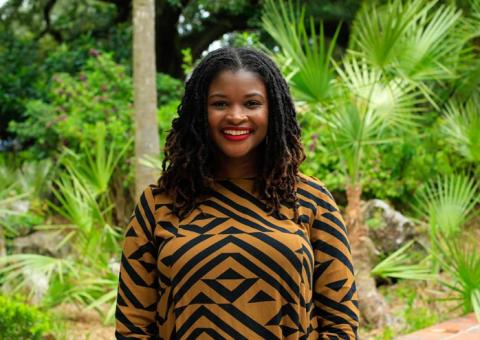
Taryrn T.C. Brown
· Assistant ProfessorVerifiedUniversity of Florida · Education
Active 2017–2026
About
Taryrn T.C. Brown is an Associate Professor in the College of Education at the University of Florida, with a focus on science education and STEM teaching. Her interdisciplinary team examines how youth, educators, and local communities utilize science to effect change, primarily through place-based initiatives that support learners’ engagement in authentic science practices to address local challenges in the life and marine sciences. Her scholarship employs design-based research methods to develop, assess, and refine interventions that are theoretically grounded and responsive to specific, contextualized problems. A key aspect of her work involves partnering with multiple stakeholders, including STEM educators, faculty, aquatic veterinarians, local communities, and policymakers, to promote effective science education and community engagement.
Research topics
- Sociology
- Psychology
- Gender studies
- Political Science
- History
- Social Science
- Pedagogy
- Law
- Social psychology
- Criminology
- Anthropology
Selected publications
School-University Partnerships · 2026-01-08
articleOpen access1st authorCorrespondingPurpose This research aims to develop a Youth Participatory Action Research (YPAR) curriculum that empowers Black youth as change agents, enhancing their self-esteem and sense of belonging while fostering community resilience. This curriculum aims to integrate embodied multiliteracies and community cultural wealth and to contribute to the academic conversation around community-engaged participatory action research. Furthermore, it seeks to highlight the importance of youth activism in shaping future visions, particularly in the context of current political challenges. Design/methodology/approach The methodology of this research centers on YPAR. This approach involves collaborating closely with Black youth to develop a curriculum that supports their roles as change agents. The curriculum is structured around concepts of embodied multiliteracies and community cultural wealth, crucial elements for fostering community resilience. By embedding these components within the framework of a CDF Freedom School, the research seeks to engage youth deeply in the learning process. Additionally, it aims to enrich the academic conversation surrounding community-engaged participatory action research, focusing on empowering youth to drive positive change in their communities and influence future visions, particularly in the current political landscape. Findings The research findings indicate that nurturing community resilience in Black youth through participatory approaches significantly enhances their self-esteem and sense of belonging. By implementing a YPAR curriculum developed in collaboration with Black youth, the study emphasizes key components such as embodied multiliteracies and community cultural wealth. Moreover, it highlights the importance of youth activism in today's political climate, showcasing their essential role as agents of positive change in their communities and in broader societal contexts. The collaborative curriculum not only enriches understanding and support within youth but also aims to contribute to scholarly discussions on community-engaged action research. Research limitations/implications The collaborative development of the YPAR curriculum with Black youth highlights a significant research implication regarding how participatory curricula can empower marginalized communities, combining education with fostering youth engagement as change agents. This underscores the importance of further studies examining the impact of such curricula across various settings. Additionally, the focus on youth activism as a response to the current political landscape underscores the need for research into youth-led initiatives, exploring how these young leaders can influence community resilience and shape future visions by intersecting political engagement with educational practices to cultivate effective youth leadership. Practical implications One practical implication of this research is that nurturing community resilience and cultural wealth alongside Black youth as change agents enhances their self-efficacy. By engaging these young individuals in research like YPAR, they can acquire skills that empower them to take initiative in addressing community issues, ultimately fostering leadership qualities and active participation in societal change. It also highlights the impact of Freedom Schools as culturally responsive school-community partnerships, which serve as incubators for youth development and change. Social implications In this research, one of the most salient social implications of the work is that the impact of empowerment not only helps in the personal development of these youth but also encourages a broader movement toward systemic change, as they engage with and influence their communities positively. Originality/value This work’s originality lies in its much-needed focus on Black youth as agents of change at a crucial moment for censorship legislation. Its value also resides in highlighting the essential role of community resilience through a customized YPAR curriculum. This curriculum recognizes and incorporates embodied multiliteracies and community cultural wealth, making it particularly relevant and beneficial for the intended demographic. By situating the project within a CDF Freedom School context, the paper promotes theoretical frameworks and methodologies that emphasize community engagement, placing youth at the forefront of driving positive change.
When We All We Got, Gatherings of Solidarity: Black Feminist Mentoring in Liberatory Research Teams
2026-02-25
book-chapter1st authorCorrespondingToward Culturally Responsive Algebra: Evaluating and Revising Mathematical Tasks
International Journal of Science and Mathematics Education · 2026-04-27
articleOpen accessPersistent inequities in mathematics education point to a critical need to reimagine curricular tasks to better support marginalized student groups. While culturally responsive pedagogy has received growing attention, mainstream algebra curricula still largely fail to reflect students' lived experiences or sociopolitical realities in meaningful ways. This study evaluates two units from a widely used algebra curriculum, synthesizes conceptual frameworks for developing culturally relevant materials, and reimagines traditional math tasks to better reflect the experiences of Black and Latinx students. An analysis of 50 original tasks revealed a consistent focus on academic rigor, yet showed minimal evidence of cultural relevance, representation, or integration of sociopolitical and social justice themes. In response, we revised selected tasks to preserve - or enhance - their academic rigor while incorporating elements of cultural competency and social justice. This work recognizes the complexity of such transformations and the potential challenges involved. By sharing the framework, evaluation process, and examples of both original and revised tasks, this study offers practical insights for educators and curriculum developers striving to support both equity and excellence in mathematics education.
Collaborative Pedagogy for Deeper Learning in an Asynchronous Classroom
IGI Global eBooks · 2025-06-18
book-chapter1st authorCorrespondingCentering collaborative pedagogies, this paper captures faculty reflections in the asynchronous classroom. Through this reflection we conceptualize a three-pronged approach in analyzing, thinking, and implementing collaborative pedagogies for online learners and suggest these recommendations as strategy for other instructors aiming to think intentionally about their online course design approach. Our work directly responds to continued interest in pedagogical strategies for online instruction, as well as the attempt to humanize online courses to be engaging, critical, and inclusive places for learning. We demonstrate how asynchronous engagement online can support thoughtful and impactful collaborative learning experiences for students in asynchronous formats.
Toward an Endarkened Photovoice Methodology
Departures in Critical Qualitative Research · 2025-01-01
articleOpen accessThe canonical and foundational literature on photovoice research and photo elicitation methods specifically focuses on the impact, import, and power of visual approaches to inquiry and knowledge production (Kim, 2016; Latz, 2017; Wang & Burris, 1997). Additional research also describes the importance of photovoice research as an action research project that should be meaningfully engaged with the community in question (Kim, 2016; Latz, 2017). This scholarly article traces the contours of photos, imagery, and subsequently photovoice research in tandem with an endarkened feminist epistemology toward an endarkened photovoice methodology. This is to say, what is captured within a photograph matters just as much as who captures the photo, how, and why. Dillard (2006b) argues that Black scholars are not “white scholars who happen to be Black” (p. 63); we similarly assert there is a specific and culturally relevant connection between Black communities and imagery that researchers should center when engaging Black people and communities in photovoice research.
Research Teams for Liberation and Worldmaking
Departures in Critical Qualitative Research · 2025-01-01 · 1 citations
articleOpen accessWhile research teams, labs, collectives, and other configurations of collaborative inquiry-based groups abound within the context of education, the literature and research base remains scant with models or guides for the development, maintenance, and activist work tied to community-based research teams (Guest & MacQueen, 2008; Krockover et al., 2001). With collective care, community, liberation, and critical praxis as the guiding values, we call on Black feminist epistemologies (Collins, 2000; Crenshaw, 1991; Dillard, 2000; Walker, 1983) to guide the re-envisioning of photovoice research teams and all critical research collaboratives. This article focuses on the collaborative and community-based power of photovoice research when engaged through the means of a research team or group of people who have come together to engage in photovoice as a collective. Through examples of community-based participatory action research in which we’ve engaged youth, undergraduate students, city leaders, and graduate students as co-researchers, we call for a way forward for research teams that prioritizes community and collective well-being, developing counterspaces, and critical consciousness-raising over fast or “productive” research within the neoliberal academy. We engage a Black, queer feminist lens (Carruthers, 2019) to author a new way forward for research teams that resists antiblackness, capitalism, and the separation of the mind, body, and spirit. We usher in a canon for team practices that nurtures co-research and communities as part of the larger goal of liberation and worldmaking for Black thriving.
Something inside so strong: Freedom School, Black Joy, and the baobab tree
Race Ethnicity and Education · 2025-03-05
articleThe Anti-Syllabus as a Culturally Responsive-Sustaining Approach to Online Instruction
IGI Global eBooks · 2025-06-18
book-chapter1st authorCorrespondingSyllabi serve to clarify course expectations regarding assignments, policies, and other related tasks. Nevertheless, traditional syllabi often transform this important pedagogical resource into a lengthy contract between instructors and students. In this chapter, we propose that by utilizing culturally responsive (Gay, 2000) and sustaining (Paris, 2012) pedagogies, educators can reframe the purpose of the course syllabus. Through a collaborative inquiry process (Kennedy & Dana, 2022), we share insights from implementing the “anti-syllabus,” a flexible syllabus framework applied in various online graduate and undergraduate courses. We identify three prevalent themes from our inquiry that illustrate how a reimagined syllabus can function as a culturally responsive and sustaining asset for online education: (a) faculty adopting strategies to boost student engagement, (b) maintaining relevance while addressing the whole student, and (c) nurturing motivation and connections among student and faculty.
Departures in Critical Qualitative Research · 2025-01-01
articleOpen access1st authorCorrespondingEnvisioning a more empowered and liberated future for Black people, this article speaks to the ability and capacity of Black digital practice in visual methodologies and research. New approaches in critical qualitative methods, which demand many skills and abilities by researchers, continue to evolve amid the ever-evolving media technologies that are an integral part of and even inherent in our day-to-day lives. In the age of technological innovation and possibility, the methodological imagination propels forward, prompting space to consider how we might consider and build toward new and diverse forms of media and technology that permeate our multiliteracies (Lewis Ellison, 2023; Price-Dennis, 2016; Sealey-Ruiz, 2019). Acknowledging the need for more Black-centered methodological analysis (McClish & Bhattacharya, 2024) and witnessing the evolution of a global media culture, this article seeks to reckon with the growing impacts of technologies that leverage, socialize, and impact identity and its translation into the research space through methodology. Utilizing contributions from Afrofuturism (Womack, 2013), digital Black feminisms (Steele, 2021), and Black cybercultures (Bailey, 2021; Brock, 2020b), this article highlights the cartographies of Black cultural digital practice and methods to critically examine the ubiquity of anti-Black racism within socio-technical architectures (e.g., code, data, algorithms, and interfaces). Through a systematic review of the literature, the article aims to acknowledge the scholarly negotiations of new media technologies toward findings that evoke heightened critical consciousness that impacts both physical and digital contexts for algorithmically and racially just counter-technologies. In this review of the literature and the organizing of thematic similarities of these approaches to critical qualitative research, this article also proposes the conceptualization of a critical race technomethodology that bridges the scholarship across disciplines that upholds the power of digital space and methodology as a new departure in critical qualitative research.
Departures in Critical Qualitative Research · 2025-01-01
articleOpen accessSenior authorWhile photovoice, a visual methodology, is widely known for helping to deepen the understanding of participant experiences and informing institutional change, it has rarely centered Black imagery from our unique cultural, historical, and political standpoints. Drawing on insights from a photovoice project titled #FatOnCampus, the authors focus on the compelling imagery and narratives of Serena Moon, a self-identified fat Black graduate student. Through Serena’s contributions, analyzed with assumptions from endarkened feminist epistemology (Dillard, 2006), this article examines how Black cultural perspectives around bodies and fatphobia can manifest in photovoice projects, particularly with Black collaborators and researchers. This endarkened photovoice approach seeks to harness photovoice’s transformative potential, emphasizing self-liberation and self-healing for Black folx. The article ends by inviting scholars to consider how endarkened photovoice can advance research methodologies and deepen our understanding of Black communities and individuals in and across higher education.
Frequent coauthors
- 2 shared
Tianna Dowie‐Chin
- 2 shared
Chonika Coleman‐King
Vanderbilt University
- 2 shared
Latoya Haynes‐Thoby
- 1 shared
Ebonie S. Bennett
- 1 shared
K. John
- 1 shared
E. Nichole Murray
Labs
Julie Brown LabPI
Education
- 2018
Ph.D., Department of Educational Theory and Practice
University of Georgia
- 2009
Student Personnel in Higher Education, Higher Education
University of North Carolina at Greensboro
- 2007
Media Studies/African American Studies (double major), College of Liberal Arts and Sciences
University of North Carolina at Greensboro
Awards & honors
- University of Florida -- Rosser Term Professorship 2024 - 20…
- University of Minnesota -- Women's Philanthropic Leadership…
- University of Florida -- Outstanding Graduate Research Award…
- National Association for Research in Science Teaching Jhumki…
- Resume-aware match score
- Save to shortlist
- AI-drafted outreach
See your match with Taryrn T.C. Brown
PhdFit ranks faculty by your research interests, methods, and publications — grounded in their actual work, not templates.
- Free to start
- No credit card
- 30-second signup