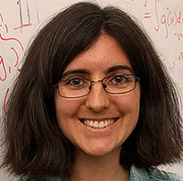
Tamara Broderick
VerifiedMassachusetts Institute of Technology · Electrical Engineering & Computer Science
Active 2004–2026
About
Tamara Broderick is an Associate Professor of Electrical Engineering and Computer Science (EECS) at MIT. Her research focuses on artificial intelligence and machine learning, particularly in developing techniques for the analysis and synthesis of systems that interact with the external world through perception, communication, and action. Her work involves systems that learn, make decisions, and adapt to changing environments, contributing to the advancement of AI methodologies and their applications. As part of her academic role, she engages in research that leverages computational, theoretical, and experimental tools to address shared human challenges through innovative AI solutions. Her expertise and contributions are integral to the department's efforts in exploring all research areas related to AI and decision-making, fostering advancements in intelligent systems and their societal impacts.
Research topics
- Computer science
- Mathematics
- Algorithm
- Artificial intelligence
- Applied mathematics
Selected publications
Navigating the Conceptual Multiverse
arXiv (Cornell University) · 2026-04-20
preprintOpen accessWhen language models answer open-ended problems, they implicitly make hidden decisions that shape their outputs, leaving users with uncontextualized answers rather than a working map of the problem; drawing on multiverse analysis from statistics, we build and evaluate the conceptual multiverse, an interactive system that represents conceptual decisions such as how to frame a question or what to value as a space users can transparently inspect, intervenably change, and check against principled domain reasoning; for this structure to be worth navigating rather than misleading, it must be rigorous and checkable against domain reasoning norms, so we develop a general verification framework that enforces properties of good decision structures like unambiguity and completeness calibrated by expert-level reasoning; across three domains, the conceptual multiverse helped participants develop a working map of the problem, with philosophy students rewriting essays with sharper framings and reversed theses, alignment annotators moving from surface preferences to reasoning about user intent and harm, and poets identifying compositional patterns that clarified their taste.
Navigating the Conceptual Multiverse
ArXiv.org · 2026-04-20
articleOpen accessWhen language models answer open-ended problems, they implicitly make hidden decisions that shape their outputs, leaving users with uncontextualized answers rather than a working map of the problem; drawing on multiverse analysis from statistics, we build and evaluate the conceptual multiverse, an interactive system that represents conceptual decisions such as how to frame a question or what to value as a space users can transparently inspect, intervenably change, and check against principled domain reasoning; for this structure to be worth navigating rather than misleading, it must be rigorous and checkable against domain reasoning norms, so we develop a general verification framework that enforces properties of good decision structures like unambiguity and completeness calibrated by expert-level reasoning; across three domains, the conceptual multiverse helped participants develop a working map of the problem, with philosophy students rewriting essays with sharper framings and reversed theses, alignment annotators moving from surface preferences to reasoning about user intent and harm, and poets identifying compositional patterns that clarified their taste.
arXiv (Cornell University) · 2026-03-31
preprintOpen accessSenior authorScientists often want to explain why an outcome is different in two groups. For instance, differences in patient mortality rates across two hospitals could be due to differences in the patients themselves (covariates) or differences in medical care (outcomes given covariates). The Oaxaca--Blinder decomposition (OBD) is a standard tool to tease apart these factors. It is well known that the OBD requires choosing one of the groups as a reference, and the numerical answer can vary with the reference. To the best of our knowledge, there has not been a systematic investigation into whether the choice of OBD reference can yield different substantive conclusions and how common this issue is. In the present paper, we give existence proofs in real and simulated data that the OBD references can yield substantively different conclusions and that these differences are not entirely driven by model misspecification or small data. We prove that substantively different conclusions occur in up to half of the parameter space, but find these discrepancies rare in the real-data analyses we study. We explain this empirical rarity by examining how realistic data-generating processes can be biased towards parameters that do not change conclusions under the OBD.
Do LLMs Benefit From Their Own Words?
Open MIND · 2026-02-27
preprintMulti-turn interactions with large language models typically retain the assistant's own past responses in the conversation history. In this work, we revisit this design choice by asking whether large language models benefit from conditioning on their own prior responses. Using in-the-wild, multi-turn conversations, we compare standard (full-context) prompting with a user-turn-only prompting approach that omits all previous assistant responses, across three open reasoning models and one state-of-the-art model. To our surprise, we find that removing prior assistant responses does not affect response quality on a large fraction of turns. Omitting assistant-side history can reduce cumulative context lengths by up to 10x. To explain this result, we find that multi-turn conversations consist of a substantial proportion (36.4%) of self-contained prompts, and that many follow-up prompts provide sufficient instruction to be answered using only the current user turn and prior user turns. When analyzing cases where user-turn-only prompting substantially outperforms full context, we identify instances of context pollution, in which models over-condition on their previous responses, introducing errors, hallucinations, or stylistic artifacts that propagate across turns. Motivated by these findings, we design a context-filtering approach that selectively omits assistant-side context. Our findings suggest that selectively omitting assistant history can improve response quality while reducing memory consumption.
Do LLMs Benefit From Their Own Words?
arXiv (Cornell University) · 2026-02-27
articleOpen accessMulti-turn interactions with large language models typically retain the assistant's own past responses in the conversation history. In this work, we revisit this design choice by asking whether large language models benefit from conditioning on their own prior responses. Using in-the-wild, multi-turn conversations, we compare standard (full-context) prompting with a user-turn-only prompting approach that omits all previous assistant responses, across three open reasoning models and one state-of-the-art model. To our surprise, we find that removing prior assistant responses does not affect response quality on a large fraction of turns. Omitting assistant-side history can reduce cumulative context lengths by up to 10x. To explain this result, we find that multi-turn conversations consist of a substantial proportion (36.4%) of self-contained prompts, and that many follow-up prompts provide sufficient instruction to be answered using only the current user turn and prior user turns. When analyzing cases where user-turn-only prompting substantially outperforms full context, we identify instances of context pollution, in which models over-condition on their previous responses, introducing errors, hallucinations, or stylistic artifacts that propagate across turns. Motivated by these findings, we design a context-filtering approach that selectively omits assistant-side context. Our findings suggest that selectively omitting assistant history can improve response quality while reducing memory consumption.
arXiv (Cornell University) · 2026-03-31
articleOpen accessSenior authorScientists often want to explain why an outcome is different in two groups. For instance, differences in patient mortality rates across two hospitals could be due to differences in the patients themselves (covariates) or differences in medical care (outcomes given covariates). The Oaxaca--Blinder decomposition (OBD) is a standard tool to tease apart these factors. It is well known that the OBD requires choosing one of the groups as a reference, and the numerical answer can vary with the reference. To the best of our knowledge, there has not been a systematic investigation into whether the choice of OBD reference can yield different substantive conclusions and how common this issue is. In the present paper, we give existence proofs in real and simulated data that the OBD references can yield substantively different conclusions and that these differences are not entirely driven by model misspecification or small data. We prove that substantively different conclusions occur in up to half of the parameter space, but find these discrepancies rare in the real-data analyses we study. We explain this empirical rarity by examining how realistic data-generating processes can be biased towards parameters that do not change conclusions under the OBD.
Network and Risk Analysis of Surety Bonds
ArXiv.org · 2025-11-07
preprintOpen access1st authorCorrespondingSurety bonds are financial agreements between a contractor (principal) and obligee (project owner) to complete a project. However, most large-scale projects involve multiple contractors, creating a network and introducing the possibility of incomplete obligations to propagate and result in project failures. Typical models for risk assessment assume independent failure probabilities within each contractor. However, we take a network approach, modeling the contractor network as a directed graph where nodes represent contractors and project owners and edges represent contractual obligations with associated financial records. To understand risk propagation throughout the contractor network, we extend the celebrated Friedkin-Johnsen model and introduce a stochastic process to simulate principal failures across the network. From a theoretical perspective, we show that under natural monotonicity conditions on the contractor network, incorporating network effects leads to increases in the average risk for the surety organization. We further use data from a partnering insurance company to validate our findings, estimating an approximately 2% higher exposure when accounting for network effects.
Smooth Sailing: Lipschitz-Driven Uncertainty Quantification for Spatial Association
ArXiv.org · 2025-02-09
preprintOpen accessSenior authorEstimating associations between spatial covariates and responses - rather than merely predicting responses - is central to environmental science, epidemiology, and economics. For instance, public health officials might be interested in whether air pollution has a strictly positive association with a health outcome, and the magnitude of any effect. Standard machine learning methods often provide accurate predictions but offer limited insight into covariate-response relationships. And we show that existing methods for constructing confidence (or credible) intervals for associations can fail to provide nominal coverage in the face of model misspecification and nonrandom locations - despite both being essentially always present in spatial problems. We introduce a method that constructs valid frequentist confidence intervals for associations in spatial settings. Our method requires minimal assumptions beyond a form of spatial smoothness and a homoskedastic Gaussian error assumption. In particular, we do not require model correctness or covariate overlap between training and target locations. Our approach is the first to guarantee nominal coverage in this setting and outperforms existing techniques in both real and simulated experiments. Our confidence intervals are valid in finite samples when the noise of the Gaussian error is known, and we provide an asymptotically consistent estimation procedure for this noise variance when it is unknown.
Common Functional Decompositions Can Mis-attribute Differences in Outcomes Between Populations
ArXiv.org · 2025-04-23
preprintOpen accessSenior authorIn science and social science, we often wish to explain why an outcome is different in two populations. For instance, if a jobs program benefits members of one city more than another, is that due to differences in program participants (particular covariates) or the local labor markets (outcomes given covariates)? The Kitagawa-Oaxaca-Blinder (KOB) decomposition is a standard tool in econometrics that explains the difference in the mean outcome across two populations. However, the KOB decomposition assumes a linear relationship between covariates and outcomes, while the true relationship may be meaningfully nonlinear. Modern machine learning boasts a variety of nonlinear functional decompositions for the relationship between outcomes and covariates in one population. It seems natural to extend the KOB decomposition using these functional decompositions. We observe that a successful extension should not attribute the differences to covariates -- or, respectively, to outcomes given covariates -- if those are the same in the two populations. Unfortunately, we demonstrate that, even in simple examples, two common decompositions -- functional ANOVA and Accumulated Local Effects -- can attribute differences to outcomes given covariates, even when they are identical in two populations. We provide a characterization of when functional ANOVA misattributes, as well as a general property that any discrete decomposition must satisfy to avoid misattribution. We show that if the decomposition is independent of its input distribution, it does not misattribute. We further conjecture that misattribution arises in any reasonable additive decomposition that depends on the distribution of the covariates.
Wrong Model, Right Uncertainty: Spatial Associations for Discrete Data with Misspecification
ArXiv.org · 2025-09-01
preprintOpen accessSenior authorScientists are often interested in estimating an association between a covariate and a binary- or count-valued response. For instance, public health officials are interested in how much disease presence (a binary response per individual) varies as temperature or pollution (covariates) increases. Many existing methods can be used to estimate associations, and corresponding uncertainty intervals, but make unrealistic assumptions in the spatial domain. For instance, they incorrectly assume models are well-specified. Or they assume the training and target locations are i.i.d. -- whereas in practice, these locations are often not even randomly sampled. Some recent work avoids these assumptions but works only for continuous responses with spatially constant noise. In the present work, we provide the first confidence intervals with guaranteed asymptotic nominal coverage for spatial associations given discrete responses, even under simultaneous model misspecification and nonrandom sampling of spatial locations. To do so, we demonstrate how to handle spatially varying noise, provide a novel proof of consistency for our proposed estimator, and use a delta method argument with a Lyapunov central limit theorem. We show empirically that standard approaches can produce unreliable confidence intervals and can even get the sign of an association wrong, while our method reliably provides correct coverage.
Recent grants
CAREER: Robust, scalable, reliable machine learning
NSF · $550k · 2018–2024
Frequent coauthors
- 51 shared
Michael I. Jordan
- 36 shared
Ryan Giordano
- 34 shared
Trevor Campbell
- 30 shared
Jonathan H. Huggins
Dow Chemical (United States)
- 16 shared
William Stephenson
Genomic Health (United States)
- 15 shared
Brian L. Trippe
- 12 shared
Raj Agrawal
- 12 shared
Tin D. Nguyen
Labs
MIT EECS Artificial Intelligence + Decision-making LabPI
Awards & honors
- Eleven MIT faculty receive Presidential Early Career Awards
- Resume-aware match score
- Save to shortlist
- AI-drafted outreach
See your match with Tamara Broderick
PhdFit ranks faculty by your research interests, methods, and publications — grounded in their actual work, not templates.
- Free to start
- No credit card
- 30-second signup