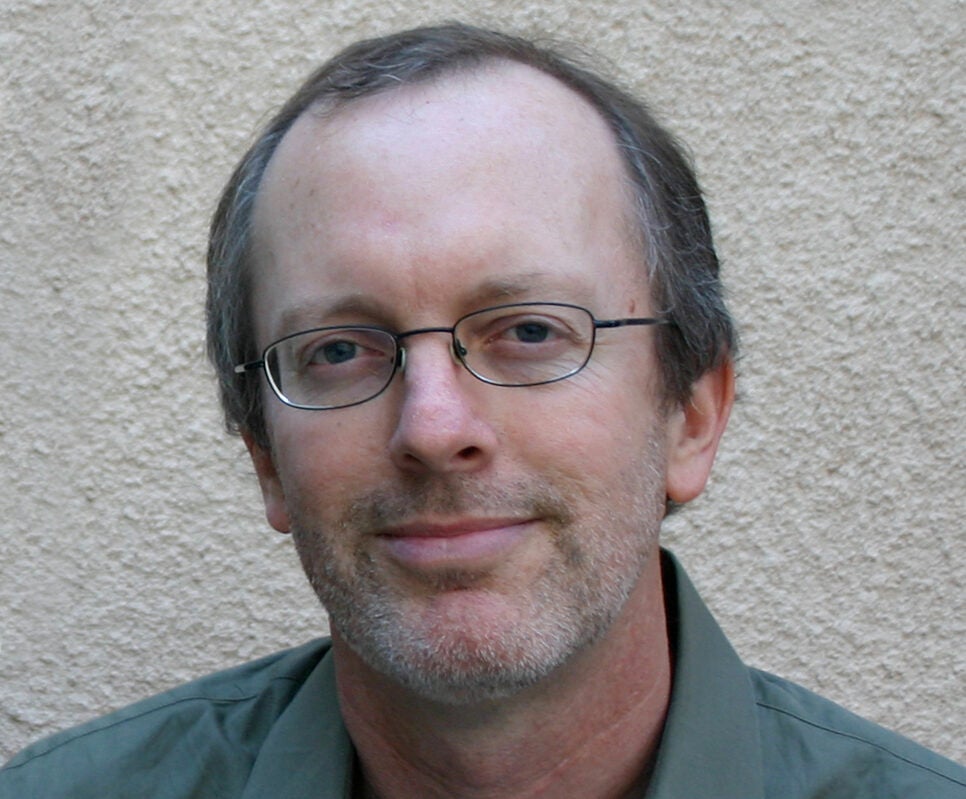
Steve Anderson
· Professor Associate Dean, Academic Affairs, School of the Arts and ArchitectureUniversity of California, Los Angeles · Film, Television and Digital Media
Active 1970–2024
About
Steve Anderson is a scholar and creative practitioner whose work spans digital media, film, and art. His research and creative projects include the development of immersive and interactive media, such as Machine Visions: Mojave, which explores aerial and subterranean landscapes through innovative visualization techniques. Anderson has presented his work at numerous festivals and venues worldwide, including the Flux Festival, FIVARS, and the Portland Festival of Cinema, Animation & Technology. His video essay Reality Frictions has been screened internationally and awarded at the Interrobang Film Festival, and he has engaged audiences through campus screenings at institutions like Middlebury College, Dartmouth College, and NYU Shanghai. Anderson's scholarly contributions include published essays such as 'Shadows in the Valley,' which critically examines the iconography and environmental impact of computation in popular culture. He has also delivered keynote addresses, notably on Generative AI and art at Shanghai University, where he discussed the historical context of AI-generated art and the evolving relationship between human and machine vision. His work emphasizes the intersection of media theory, digital visualization, and experimental media art, contributing to the understanding of technological literacy, media signification, and the cultural implications of digital media.
Research topics
- Physics
- Atomic physics
- Nuclear physics
- Optics
- Materials science
- Statistics
- Medical physics
- Mathematics
- Chemistry
- Radiochemistry
Selected publications
$^{11}$B states above the $α$-decay threshold studied via $^{10}$B$(d,p){}^{11}$B
arXiv (Cornell University) · 2024
- Physics
- Atomic physics
- Mathematics
The resonance region of $^{11}$B covering excitation energies from 8.4 MeV to 13.6 MeV was investigated with the $(d,p)$ reaction performed on an enriched $^{10}$B target at the Florida State University Super-Enge Split-Pole Spectrograph of the John D. Fox Superconducting Linear Accelerator Laboratory. Complementary measurements were performed with a target enriched in $^{11}$B to identify possible $^{12}$B contaminants in the $(d,p)$ reaction. Four strongly populated $^{11}$B states were observed above the $α$-decay threshold. Angular distributions were measured and compared to DWBA calculations to extract angular momentum transfers and $^{10}\mathrm{B}\left(3^+\right)+n$ spectroscopic factors. The recently observed and heavily discussed resonance at 11.4 MeV in $^{11}$B was not observed in this work. This result is consistent with the interpretation that it is predominantly a $^{10}\mathrm{Be}\left(0^+\right)+p$ resonance with a possible additional $^{7}\mathrm{Li}+α$ contribution. The predicted $^{10}\mathrm{B}\left(3^+\right)+n$ resonance at 11.6 MeV, analogous to the 11.4-MeV proton resonance, was not observed either. Upper limits for the $^{10}\mathrm{B}\left(3^+\right)+n$ spectroscopic factors of the 11.4-MeV and 11.6-MeV states were determined. In addition, supporting configuration interaction shell model calculations with the effective WBP interaction are presented.
Diagnostic development and needs for laser driven MeV x-ray radiography
Review of Scientific Instruments · 2024 · 2 citations
- Physics
- Optics
- Medical physics
Laser-driven MeV x-ray radiography of dynamic, dense objects demands a small, high flux source of energetic x-rays to generate an image with sufficient quality. Understanding the multi-MeV x-ray spectrum underscores the ability to extrapolate from the current laser sources to new future lasers that might deploy this radiography modality. Here, we present a small study of the existing x-ray diagnostics and techniques. We also present work from National Ignition Facility-Advanced Radiographic Capability, where we deploy three diagnostics to measure the x-ray spectrum up to 30 MeV. Finally, we also discuss the needs and developments of two new diagnostics: a single crystal scintillator spectrometer and a fast decay activation.
The 40Ar(d,p)41Ar cross section between 3–7 MeV
Applied Radiation and Isotopes · 2022
- Nuclear physics
- Atomic physics
- Materials science
Frequent coauthors
- 58 shared
David J. Gibson
Southern Illinois University Carbondale
- 50 shared
A. Tremaine
Lawrence Livermore National Laboratory
- 44 shared
J. B. Rosenzweig
University of California, Los Angeles
- 41 shared
C. W. Siders
Lawrence Livermore National Laboratory
- 38 shared
F. V. Hartemann
Lawrence Livermore National Laboratory
- 36 shared
Roark Marsh
University of California, Irvine
- 32 shared
F. Albert
Lawrence Livermore National Laboratory
- 32 shared
M. Y. Shverdin
Lawrence Livermore National Laboratory
Awards & honors
- Best Edited Collection from the Popular Culture Association…
- Digital Innovation Fellowship from the American Council of L…
- Best Mixed Reality at the New Media Film Festival for Live-V…
- Award of Merit from the Impact Docs Awards for Reality Frict…
Similar researchers at University of California, Los Angeles
- Resume-aware match score
- Save to shortlist
- AI-drafted outreach
See your match with Steve Anderson
PhdFit ranks faculty by your research interests, methods, and publications — grounded in their actual work, not templates.
- Free to start
- No credit card
- 30-second signup