
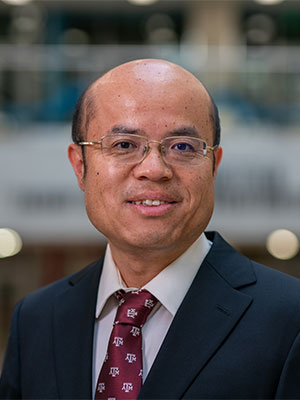
Shuiwang Ji
· Professor, Computer Science & Engineering, Truchard Family Endowed Chair, Presidential Impact FellowVerifiedTexas A&M University · Computer Science & Engineering
Active 2007–2026
About
Shuiwang Ji is a Professor in the Department of Computer Science & Engineering at Texas A&M University. He holds the Truchard Family Endowed Chair, is a Presidential Impact Fellow, and an EDGES Fellow. His educational background includes a Ph.D. in Computer Science from Arizona State University, obtained in 2010. His research interests focus on machine learning and artificial intelligence (AI) for science and engineering, with particular emphasis on language models and agents. He is a Fellow of the Institute of Electrical and Electronics Engineers (IEEE) since 2023 and a Fellow of the American Institute for Medical and Biological Engineering (AIMBE) since 2022. His contributions to the field have been recognized through numerous awards, including the Distinguished Achievement Award from Texas A&M University and The Association of Former Students in 2026, the Dean of Engineering Excellence Award in 2024, and the NSF CAREER Award in 2014. His work involves advancing AI methodologies for scientific applications, contributing to the development of tensor decomposition networks, geometry-informed tokenization of molecules, and invariant tokenization of crystalline materials, among other areas.
Research topics
- Artificial Intelligence
- Computer Science
- Machine Learning
- Theoretical computer science
Selected publications
ChemRxiv · 2026-02-09
articleOpen accessSenior authorGenerative Artificial Intelligence for Biology: Toward Unifying Models, Algorithms, and Modalities
ChemRxiv · 2026-02-12
articleOpen accessSenior authorRapid advances in generative artificial intelligence have revolutionized biological modeling across domains such as protein, genetics, and single-cell. However, existing works often organize applications by molecule types or specific research tasks, overlooking the methodological convergence and cross-modal innovations. This paper aims to present a unified methodological perspective that highlights the fundamental technical commonalities across biological modalities. We systematically organize recent advances in generative modeling for biology through the lens of core machine learning paradigms, from language models (LMs) and diffusion models to their emerging hybrid architectures. Our work reveals how techniques initially developed for one molecular type (e.g., protein design) can be effectively transferred to others (e.g., RNA engineering), and identifies the convergence trend where discrete diffusion models and iterative language models represent different facets of a unified generative framework. We cover the evolution from domain-specific models to multi-modal biological foundation models and agent-based systems. By emphasizing methodological connections rather than applications, this paper aims to accelerate cross-domain innovation and make the field more accessible to the broader machine learning community. We conclude by identifying promising research directions where successful techniques in one biological domain remain unexplored in others, offering a roadmap for future advances in generative biology.
A Physics-Regularized Graph Neural Surrogate for Geometry-Generalizable Fluid Flow Prediction
SSRN Electronic Journal · 2026-01-01
preprintOpen accessSenior authorGenerative Artificial Intelligence for Biology: Toward Unifying Models, Algorithms, and Modalities
ChemRxiv · 2026-04-06
articleSenior authorRapid advances in generative artificial intelligence have revolutionized biological modeling across domains such as protein, genetics, and single-cell. However, existing works often organize applications by molecule types or specific research tasks, overlooking the methodological convergence and cross-modal innovations. This paper aims to present a unified methodological perspective that highlights the fundamental technical commonalities across biological modalities. We systematically organize recent advances in generative modeling for biology through the lens of core machine learning paradigms, from language models (LMs) and diffusion models to their emerging hybrid architectures. Our work reveals how techniques initially developed for one molecular type (e.g., protein design) can be effectively transferred to others (e.g., RNA engineering), and identifies the convergence trend where discrete diffusion models and iterative language models represent different facets of a unified generative framework. We cover the evolution from domain-specific models to multi-modal biological foundation models and agent-based systems. By emphasizing methodological connections rather than applications, this paper aims to accelerate cross-domain innovation and make the field more accessible to the broader machine learning community. We conclude by identifying promising research directions where successful techniques in one biological domain remain unexplored in others, offering a roadmap for future advances in generative biology.
Tensor Decomposition Networks for Fast Machine Learning Interatomic Potential Computations
ArXiv.org · 2025-07-01
preprintOpen accessSenior author$\rm{SO}(3)$-equivariant networks are the dominant models for machine learning interatomic potentials (MLIPs). The key operation of such networks is the Clebsch-Gordan (CG) tensor product, which is computationally expensive. To accelerate the computation, we develop tensor decomposition networks (TDNs) as a class of approximately equivariant networks in which CG tensor products are replaced by low-rank tensor decompositions, such as the CANDECOMP/PARAFAC (CP) decomposition. With the CP decomposition, we prove (i) a uniform bound on the induced error of $\rm{SO}(3)$-equivariance, and (ii) the universality of approximating any equivariant bilinear map. To further reduce the number of parameters, we propose path-weight sharing that ties all multiplicity-space weights across the $\mathcal{O}(L^3)$ CG paths into a single shared parameter set without compromising equivariance, where $L$ is the maximum angular degree. The resulting layer acts as a plug-and-play replacement for tensor products in existing networks, and the computational complexity of tensor products is reduced from $\mathcal{O}(L^6)$ to $\mathcal{O}(L^4)$. We evaluate TDNs on PubChemQCR, a newly curated molecular relaxation dataset containing 105 million DFT-calculated snapshots. We also use existing datasets, including OC20, and OC22. Results show that TDNs achieve competitive performance with dramatic speedup in computations. Our code is publicly available as part of the AIRS library (\href{https://github.com/divelab/AIRS/tree/main/OpenMol/TDN}{https://github.com/divelab/AIRS/}).
Toward Greater Autonomy in Materials Discovery Agents: Unifying Planning, Physics, and Scientists
ArXiv.org · 2025-06-05 · 1 citations
preprintOpen accessSenior authorWe aim at designing language agents with greater autonomy for crystal materials discovery. While most of existing studies restrict the agents to perform specific tasks within predefined workflows, we aim to automate workflow planning given high-level goals and scientist intuition. To this end, we propose Materials Agent unifying Planning, Physics, and Scientists, known as MAPPS. MAPPS consists of a Workflow Planner, a Tool Code Generator, and a Scientific Mediator. The Workflow Planner uses large language models (LLMs) to generate structured and multi-step workflows. The Tool Code Generator synthesizes executable Python code for various tasks, including invoking a force field foundation model that encodes physics. The Scientific Mediator coordinates communications, facilitates scientist feedback, and ensures robustness through error reflection and recovery. By unifying planning, physics, and scientists, MAPPS enables flexible and reliable materials discovery with greater autonomy, achieving a five-fold improvement in stability, uniqueness, and novelty rates compared with prior generative models when evaluated on the MP-20 data. We provide extensive experiments across diverse tasks to show that MAPPS is a promising framework for autonomous materials discovery.
Staleness-Based Subgraph Sampling for Training GNNs on Large-Scale Graphs
2025-12-08
articleSenior authorGenerative AI for Autonomous Driving: Frontiers and Opportunities
ArXiv.org · 2025-05-13 · 1 citations
preprintOpen accessGenerative Artificial Intelligence (GenAI) constitutes a transformative technological wave that reconfigures industries through its unparalleled capabilities for content creation, reasoning, planning, and multimodal understanding. This revolutionary force offers the most promising path yet toward solving one of engineering's grandest challenges: achieving reliable, fully autonomous driving, particularly the pursuit of Level 5 autonomy. This survey delivers a comprehensive and critical synthesis of the emerging role of GenAI across the autonomous driving stack. We begin by distilling the principles and trade-offs of modern generative modeling, encompassing VAEs, GANs, Diffusion Models, and Large Language Models (LLMs). We then map their frontier applications in image, LiDAR, trajectory, occupancy, video generation as well as LLM-guided reasoning and decision making. We categorize practical applications, such as synthetic data workflows, end-to-end driving strategies, high-fidelity digital twin systems, smart transportation networks, and cross-domain transfer to embodied AI. We identify key obstacles and possibilities such as comprehensive generalization across rare cases, evaluation and safety checks, budget-limited implementation, regulatory compliance, ethical concerns, and environmental effects, while proposing research plans across theoretical assurances, trust metrics, transport integration, and socio-technical influence. By unifying these threads, the survey provides a forward-looking reference for researchers, engineers, and policymakers navigating the convergence of generative AI and advanced autonomous mobility. An actively maintained repository of cited works is available at https://github.com/taco-group/GenAI4AD.
ArXiv.org · 2025-02-20
preprintOpen accessTo fully leverage the capabilities of diffusion models, we are often interested in optimizing downstream reward functions during inference. While numerous algorithms for reward-guided generation have been recently proposed due to their significance, current approaches predominantly focus on single-shot generation, transitioning from fully noised to denoised states. We propose a novel framework for inference-time reward optimization with diffusion models inspired by evolutionary algorithms. Our approach employs an iterative refinement process consisting of two steps in each iteration: noising and reward-guided denoising. This sequential refinement allows for the gradual correction of errors introduced during reward optimization. Besides, we provide a theoretical guarantee for our framework. Finally, we demonstrate its superior empirical performance in protein and cell-type-specific regulatory DNA design. The code is available at \href{https://github.com/masa-ue/ProDifEvo-Refinement}{https://github.com/masa-ue/ProDifEvo-Refinement}.
NeurIPS 2024 ML4CFD Competition: Results and Retrospective Analysis
ArXiv.org · 2025-06-10
preprintOpen accessSenior authorThe integration of machine learning (ML) into the physical sciences is reshaping computational paradigms, offering the potential to accelerate demanding simulations such as computational fluid dynamics (CFD). Yet, persistent challenges in accuracy, generalization, and physical consistency hinder the practical deployment of ML models in scientific domains. To address these limitations and systematically benchmark progress, we organized the ML4CFD competition, centered on surrogate modeling for aerodynamic simulations over two-dimensional airfoils. The competition attracted over 240 teams, who were provided with a curated dataset generated via OpenFOAM and evaluated through a multi-criteria framework encompassing predictive accuracy, physical fidelity, computational efficiency, and out-of-distribution generalization. This retrospective analysis reviews the competition outcomes, highlighting several approaches that outperformed baselines under our global evaluation score. Notably, the top entry exceeded the performance of the original OpenFOAM solver on aggregate metrics, illustrating the promise of ML-based surrogates to outperform traditional solvers under tailored criteria. Drawing from these results, we analyze the key design principles of top submissions, assess the robustness of our evaluation framework, and offer guidance for future scientific ML challenges.
Recent grants
III: Medium: Collaborative Research: Towards Scalable and Interpretable Graph Neural Networks
NSF · $100k · 2020–2022
NSF · $296k · 2017–2020
NSF · $263k · 2020–2024
III: Small: Collaborative Research: Structured Methods for Multi-Task Learning
NSF · $247k · 2016–2019
Deep Learning for Connectomics
NIH · $406k · 2017–2021
Frequent coauthors
- 66 shared
Jieping Ye
- 42 shared
Zhengyang Wang
- 40 shared
Sudhir Kumar
Malaviya National Institute of Technology Jaipur
- 31 shared
Hongyang Gao
- 28 shared
Yaochen Xie
Texas A&M University
- 27 shared
Stuart J. Newfeld
Arizona State University
- 25 shared
Youzhi Luo
Texas A&M University
- 25 shared
Michael McCutchan
Arizona State University
Education
PhD, Computer Science and Engineering
Arizona State University
Awards & honors
- Distinguished Achievement Award for research, Texas A&M Univ…
- Dean of Engineering Excellence Award, Texas A&M University (…
- Computer Science & Engineering Graduate Faculty Teaching Exc…
- IEEE Transactions on Pattern Analysis and Machine Intelligen…
- Faculty Early Career Development (CAREER) Award, National Sc…
- Resume-aware match score
- Save to shortlist
- AI-drafted outreach
See your match with Shuiwang Ji
PhdFit ranks faculty by your research interests, methods, and publications — grounded in their actual work, not templates.
- Free to start
- No credit card
- 30-second signup