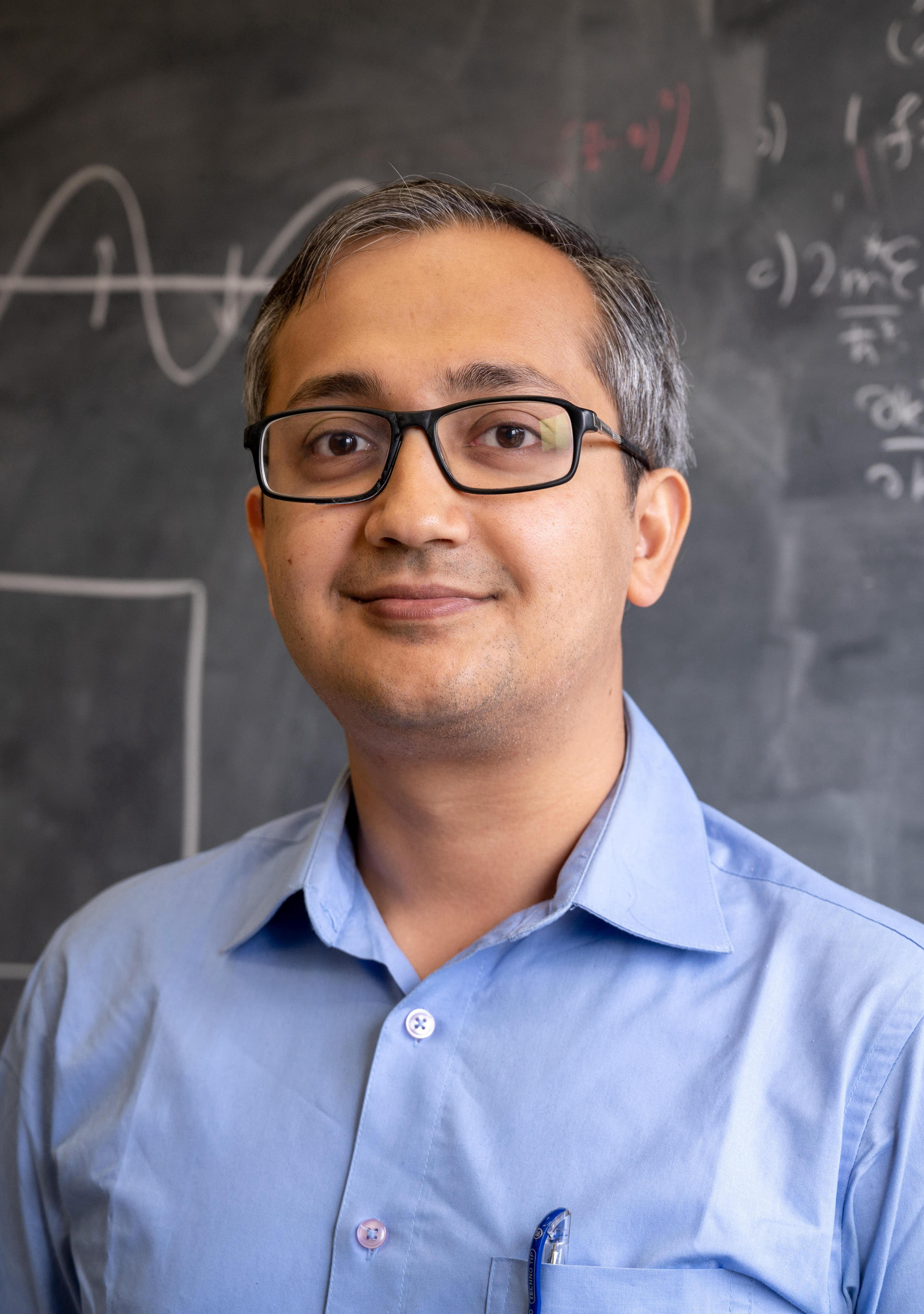
Shubhayu Chatterjee
· Assistant ProfessorVerifiedCarnegie Mellon University · Physics
Active 2012–2026
About
Shubhayu Chatterjee is an Assistant Professor in the Department of Physics at Carnegie Mellon University, affiliated with the Mellon College of Science. He earned his PhD in Physics from Harvard University in 2018 and holds an integrated MSc in Physics from the Indian Institute of Technology Kanpur, obtained in 2012. His research interests focus on quantum many-body physics in strongly correlated electronic systems, as well as quantum simulators and quantum sensing. Prior to his current position, he was a Postdoctoral Fellow in Physics at UC Berkeley from 2018 to 2022. He has received several honors and awards, including the PQI Community Collaboration Award in 2023, the Harvard GSAS Merit Research Fellowship during 2016-17, and the President's Gold Medal at IIT Kanpur in 2012. His work involves exploring complex quantum phenomena, contributing to the understanding of topological states, quantum order, and superconductivity in various condensed matter systems.
Research topics
- Condensed matter physics
- Physics
- Quantum mechanics
- Nanotechnology
- Optics
- Materials science
- Chemical physics
- Theoretical physics
Selected publications
Spin-orbital magnetism in moiré Wigner molecules
SciPost Physics · 2026-03-24
preprintOpen accessSenior authorThe interplay of spin and orbital degrees of freedom offers a versatile playground for the realization of a variety of correlated phases of matter. However, the types of spin-orbital interactions are often limited and challenging to tune. Here, we propose and analyze a new platform for spin-orbital interactions based upon a lattice of Wigner molecules in moiré transition metal dichalcogenides (TMDs). Leveraging the spin-orbital degeneracy of the low-energy Hilbert space of each Wigner molecule, we demonstrate that TMD materials can host a general spin-orbital Hamiltonian that is tunable via the moiré superlattice spacing and dielectric environments. We study the phase diagram for this model, revealing a rich landscape of phases driven by spin-orbital interactions, ranging from ferri-electric valence bond solids to a helical spin liquid. Our work establishes moiré Wigner molecules in TMD materials as a prominent platform for correlated spin-orbital phenomena.
Fluctuation-driven chiral ferromagnetism
ArXiv.org · 2026-05-07
articleOpen accessSenior authorIn general, quantum fluctuations are suppressed in ferromagnetic materials because they admit a simple unfrustrated ground state, greatly limiting the scope of phenomena that can be observed in these materials. In this work, we show how magnetization-non-conserving couplings fundamentally alter this paradigm by demonstrating the existence of a chiral ferromagnet that is stabilized by quantum fluctuations. More specifically, we show how these spin-orbit interactions modify the classical phase diagram; whereas a classical analysis predicts only collinear states, we observe fluctuation-stabilized phases, including a ferromagnet with large orbital chirality and a chiral stripe regime. We elucidate how such couplings spontaneously generate a scalar orbital chirality, in contrast to conventional mechanisms which rely upon a field-induced canting of vector chiral order. The resultant chiral states exhibit distinct transport signatures, namely an enhanced thermal Hall effect, and are of direct relevance to moiré heterostructures, Rydberg-atom arrays, and solid-state materials featuring non-Kramers spins.
Qubit Noise Spectroscopy of Superconducting Dynamics in a Magnetic Field
Open MIND · 2026-02-23
preprintSenior authorAn applied magnetic field affects a superconductor in two ways -- by promoting pairing fluctuations, and by inducing topological defects called vortices that carry quantized magnetic flux. A quantitative characterization of the resultant field-induced superconducting dynamics with spatio-temporal resolution remains challenging, particularly in two-dimensional materials. In this work, we analyze magnetic noise measured by the depolarization rate of a proximate single spin qubit as a non-invasive probe of such dynamical fluctuations. We demonstrate that the temperature dependence of the magnetic noise spectrum near $T_c$ deviates from predictions based on quasiparticle excitations due to critical superconducting fluctuations, which in turn are enhanced by a weak applied field. By analyzing the magnetic noise due to vortex dynamics, we further show that noise spectroscopy is not only able to distinguish between different vortex phases, but also extract key physical quantities of interest, such as oscillation frequencies of pinned vortices, phonon dispersion of vortex lattices and vortex diffusivity in a vortex liquid. Complementing recent work on noise magnetometry of quasiparticle excitations and Berezinskii-Kosterlitz-Thouless transitions in two-dimensional superconductors without an applied field, our work highlights the ability of noise spectroscopy to reveal a wealth of superconducting dynamical phenomena in an applied field.
Ground states of quantum XY dipoles on the Archimedean lattices
ArXiv.org · 2026-05-08
articleOpen accessWe report numerical ground states for the dipolar XY spin model, which describes extended antiferromagnetic interactions in two-dimensional arrays of polar molecules and two-level Rydberg atoms. Carrying out large-scale density matrix renormalization group (DMRG) calculations, we compute ground state properties on nine of the eleven Archimedean lattices--tilings of the plane by regular polygons. Four of these host trivial paramagnets, while another four develop collinear Neel magnetic order, as was found previously for the square lattice. For the ordered states, we calculate the hydrodynamic parameters (magnetization, susceptibility, and stiffness) and compare to linear spin wave theory. We also investigate the triangular lattice, for which we find several competing phases including coplanar magnetism, stripe density wave order, and a possible spin liquid; their relative stability is sensitive to the long-range couplings present in our dipolar model. Finally, the Archimedean classification is completed by the kagome lattice, which we argue in a companion work is likely to be a Dirac spin liquid.
Fluctuation-driven chiral ferromagnetism
arXiv (Cornell University) · 2026-05-07
preprintOpen accessSenior authorIn general, quantum fluctuations are suppressed in ferromagnetic materials because they admit a simple unfrustrated ground state, greatly limiting the scope of phenomena that can be observed in these materials. In this work, we show how magnetization-non-conserving couplings fundamentally alter this paradigm by demonstrating the existence of a chiral ferromagnet that is stabilized by quantum fluctuations. More specifically, we show how these spin-orbit interactions modify the classical phase diagram; whereas a classical analysis predicts only collinear states, we observe fluctuation-stabilized phases, including a ferromagnet with large orbital chirality and a chiral stripe regime. We elucidate how such couplings spontaneously generate a scalar orbital chirality, in contrast to conventional mechanisms which rely upon a field-induced canting of vector chiral order. The resultant chiral states exhibit distinct transport signatures, namely an enhanced thermal Hall effect, and are of direct relevance to moiré heterostructures, Rydberg-atom arrays, and solid-state materials featuring non-Kramers spins.
Correction: Spin-orbital magnetism in moiré Wigner molecules
SciPost Physics · 2026-04-09
articleOpen accessSenior authorQubit Noise Spectroscopy of Superconducting Dynamics in a Magnetic Field
ArXiv.org · 2026-02-23
articleOpen accessSenior authorAn applied magnetic field affects a superconductor in two ways -- by promoting pairing fluctuations, and by inducing topological defects called vortices that carry quantized magnetic flux. A quantitative characterization of the resultant field-induced superconducting dynamics with spatio-temporal resolution remains challenging, particularly in two-dimensional materials. In this work, we analyze magnetic noise measured by the depolarization rate of a proximate single spin qubit as a non-invasive probe of such dynamical fluctuations. We demonstrate that the temperature dependence of the magnetic noise spectrum near $T_c$ deviates from predictions based on quasiparticle excitations due to critical superconducting fluctuations, which in turn are enhanced by a weak applied field. By analyzing the magnetic noise due to vortex dynamics, we further show that noise spectroscopy is not only able to distinguish between different vortex phases, but also extract key physical quantities of interest, such as oscillation frequencies of pinned vortices, phonon dispersion of vortex lattices and vortex diffusivity in a vortex liquid. Complementing recent work on noise magnetometry of quasiparticle excitations and Berezinskii-Kosterlitz-Thouless transitions in two-dimensional superconductors without an applied field, our work highlights the ability of noise spectroscopy to reveal a wealth of superconducting dynamical phenomena in an applied field.
Ground states of quantum XY dipoles on the Archimedean lattices
arXiv (Cornell University) · 2026-05-08
preprintOpen accessWe report numerical ground states for the dipolar XY spin model, which describes extended antiferromagnetic interactions in two-dimensional arrays of polar molecules and two-level Rydberg atoms. Carrying out large-scale density matrix renormalization group (DMRG) calculations, we compute ground state properties on nine of the eleven Archimedean lattices--tilings of the plane by regular polygons. Four of these host trivial paramagnets, while another four develop collinear Neel magnetic order, as was found previously for the square lattice. For the ordered states, we calculate the hydrodynamic parameters (magnetization, susceptibility, and stiffness) and compare to linear spin wave theory. We also investigate the triangular lattice, for which we find several competing phases including coplanar magnetism, stripe density wave order, and a possible spin liquid; their relative stability is sensitive to the long-range couplings present in our dipolar model. Finally, the Archimedean classification is completed by the kagome lattice, which we argue in a companion work is likely to be a Dirac spin liquid.
Report on reproducibility in condensed matter physics
Physical review. B./Physical review. B · 2026-03-20 · 2 citations
articleThis report from a diverse collaboration of experts addresses community concerns around reproducibility in condensed matter physics by establishing clear best practices for researchers, publishers, and institutions. It advocates for mandatory sharing of primary data, code, and full experimental parameters to enhance and safeguard the field's scientific integrity.
Tomonaga-Luttinger Liquid Behavior in a Rydberg-encoded Spin Chain
ArXiv.org · 2025-01-14
preprintOpen accessQuantum fluctuations can disrupt long-range order in one-dimensional systems, and replace it with the universal paradigm of the Tomonaga-Luttinger liquid (TLL), a critical phase of matter characterized by power-law decaying correlations and linearly dispersing excitations. Using a Rydberg quantum simulator, we study how TLL physics manifests in the low-energy properties of a spin chain, interacting under either the ferromagnetic or the antiferromagnetic dipolar XY Hamiltonian. Following quasi-adiabatic preparation, we directly observe the power-law decay of spin-spin correlations in real-space, allowing us to extract the Luttinger parameter. In the presence of an impurity, the chain exhibits tunable Friedel oscillations of the local magnetization. Moreover, by utilizing a quantum quench, we directly probe the propagation of correlations, which exhibit a light-cone structure related to the linear sound mode of the underlying TLL. Our measurements demonstrate the influence of the long-range dipolar interactions, renormalizing the parameters of TLL with respect to the case of nearest-neighbor interactions. Finally, comparison to numerical simulations exposes the high sensitivity of TLLs to doping and finite-size effects.
Frequent coauthors
- 41 shared
Norman Y. Yao
- 39 shared
Subir Sachdev
- 31 shared
Michael P. Zaletel
- 20 shared
Antoine Georges
Centre National de la Recherche Scientifique
- 15 shared
Mathias S. Scheurer
- 15 shared
Michel Ferrero
École Polytechnique
- 14 shared
Wéi Wú
Sun Yat-sen University
- 12 shared
Ahmed Abouelkomsan
Education
- 2018
Ph.D.
Harvard University
- 2012
Other
Indian Institute of Technology Kanpur
Awards & honors
- PQI Community Collaboration Award (2023)
- Harvard GSAS Merit Research Fellowship (2016-17)
- President's Gold Medal (2012), IIT Kanpur
- Resume-aware match score
- Save to shortlist
- AI-drafted outreach
See your match with Shubhayu Chatterjee
PhdFit ranks faculty by your research interests, methods, and publications — grounded in their actual work, not templates.
- Free to start
- No credit card
- 30-second signup