
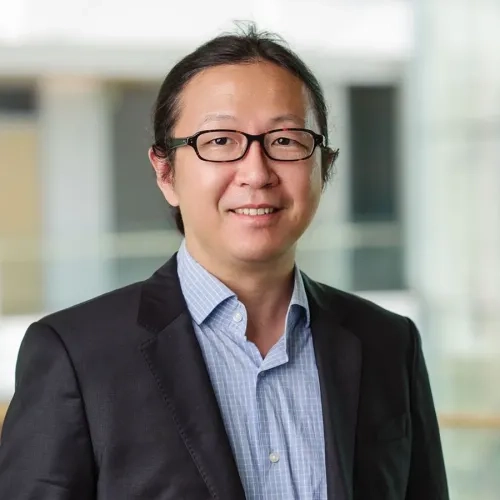
Shengxing Zhang
· Associate Professor of EconomicsCarnegie Mellon University · Economics
Active 1991–2026
Academic metrics are sourced from OpenAlex and public funding records; values may differ from Google Scholar.
About
Shengxing Zhang is an Associate Professor of Economics at the Tepper School of Business, Carnegie Mellon University. His academic role involves research and teaching within the field of economics, with a focus on areas related to business, management science, and organizational behavior. As part of the Tepper School's faculty, he contributes to the school's strategic vision of integrating business, technology, and analytics, supporting the school's mission to lead in these interdisciplinary areas.
Research topics
- Computer Science
- Artificial Intelligence
- Natural Language Processing
- Information Retrieval
- Data Mining
- Theoretical computer science
- Machine Learning
- Programming language
Selected publications
Supportiveness-based Knowledge Rewriting for Retrieval-augmented Language Modeling
2025-01-01 · 2 citations
articleOpen accessSenior authorRetrieval-augmented language models (RALMs) have recently shown great potential in mitigating the limitations of implicit knowledge in LLMs, such as untimely updating of the latest expertise and unreliable retention of long-tail knowledge.However, since the external knowledge base, as well as the retriever, can not guarantee reliability, potentially leading to the knowledge retrieved not being helpful or even misleading for LLM generation.In this paper, we introduce Supportiveness-based Knowledg…
RewardAnything: Generalizable Principle-Following Reward Models
ArXiv.org · 2025-06-04 · 1 citations
preprintOpen accessReward Models, essential for guiding Large Language Model optimization, are typically trained on fixed preference datasets, resulting in rigid alignment to single, implicit preference distributions. This prevents adaptation to diverse real-world needs-from conciseness in one task to detailed explanations in another. The standard practice of collecting task-specific preference data and retraining reward models is resource-intensive, often producing biased rewards, and limits practical application…
ArXiv.org · 2025-03-03
preprintOpen accessExisting pretraining data mixing methods for large language models (LLMs) typically follow a domain-wise methodology, a top-down process that first determines domain weights and then performs uniform data sampling across each domain. However, these approaches neglect significant inter-domain overlaps and commonalities, failing to control the global diversity of the constructed training dataset. Further, uniform sampling within domains ignores fine-grained sample-specific features, potentially le…
3D Surface Reconstruction with Enhanced High-Frequency Details
ArXiv.org · 2025-05-06
preprintOpen access1st authorCorrespondingNeural implicit 3D reconstruction can reproduce shapes without 3D supervision, and it learns the 3D scene through volume rendering methods and neural implicit representations. Current neural surface reconstruction methods tend to randomly sample the entire image, making it difficult to learn high-frequency details on the surface, and thus the reconstruction results tend to be too smooth. We designed a method (FreNeuS) based on high-frequency information to solve the problem of insufficient surfa…
AutoRed: A Free-form Adversarial Prompt Generation Framework for Automated Red Teaming
ArXiv.org · 2025-10-09
preprintOpen accessThe safety of Large Language Models (LLMs) is crucial for the development of trustworthy AI applications. Existing red teaming methods often rely on seed instructions, which limits the semantic diversity of the synthesized adversarial prompts. We propose AutoRed, a free-form adversarial prompt generation framework that removes the need for seed instructions. AutoRed operates in two stages: (1) persona-guided adversarial instruction generation, and (2) a reflection loop to iteratively refine low-…
Frequent coauthors
- 46 shared
Wei Ye
Peking University
- 21 shared
Rui Xie
Peking University
- 20 shared
Jinan Sun
Peking University
- 19 shared
Wei Ye
- 17 shared
Lifu Wang
Mianyang Third People's Hospital
- 15 shared
Wen Zhao
- 14 shared
Wei Ye
- 14 shared
Wei Ye
Similar researchers at Carnegie Mellon University
- Resume-aware match score
- Save to shortlist
- AI-drafted outreach
See your match with Shengxing Zhang
PhdFit ranks faculty by your research interests, methods, and publications — grounded in their actual work, not templates.
- Free to start
- No credit card
- 30-second signup