
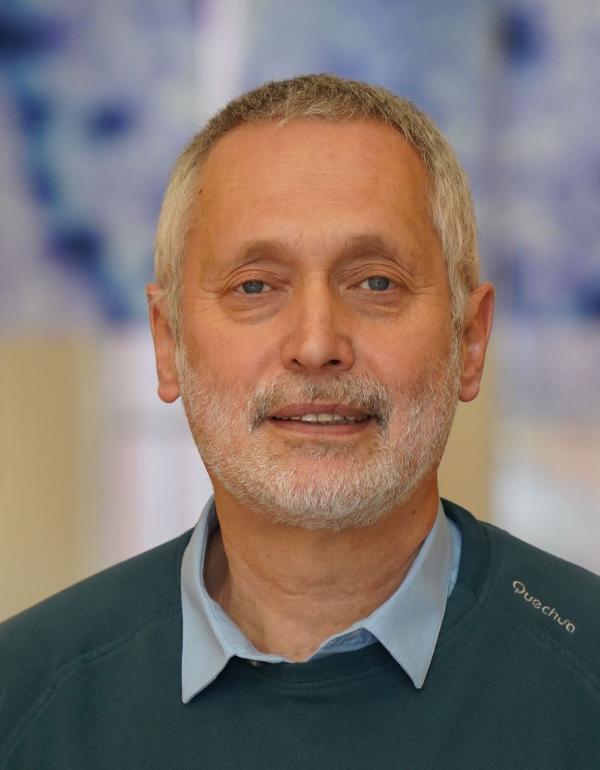
Sergei Sukharev
University of Maryland, College Park · Biology
Active 1982–2026
Academic metrics are sourced from OpenAlex and public funding records; values may differ from Google Scholar.
About
Sergei Sukharev is a Professor in the Department of Biology at the University of Maryland, with affiliate positions in Chemistry and Biochemistry Graduate Program. He earned his Ph.D. from Moscow State University in 1987, focusing on molecular mechanisms of mechanosensation and mechano-activated ion channels, their structure, and mechanisms of gating by membrane stretch. His research investigates the principles and molecules that cells use to detect mechanical force and pressure, encompassing phenomena from bacterial adaptation to osmotic changes to complex processes such as hearing, balance, and gravitropism in animals and plants. Dr. Sukharev has made significant contributions to the field, notably in the isolation and cloning of the Mechanosensitive Channel of Large conductance of Escherichia coli (MscL), the first identified channel of this class. His work involves interdisciplinary approaches including molecular modeling, genetic modifications, biochemical purification, reconstitution into membranes, single-channel recording, and video imaging. His research addresses the structure and gating mechanisms of mechanosensitive channels, with a focus on understanding how interactions within these proteins keep channels closed at rest and allow them to open under tension. He has received awards such as the J. W. Ritter Award in 1988 and the University of Maryland College of Life Sciences Junior Faculty Award in 2000.
Research topics
- Chemistry
- Biophysics
- Biology
- Materials science
- Cell biology
Selected publications
Mechanism of Catalysis by <scp>l</scp>-Asparaginase
Biochemistry · 2020-05-04 · 59 citations
articleOpen accessTwo bacterial type II l-asparaginases, from Escherichia coli and Dickeya chrysanthemi, have played a critical role for more than 40 years as therapeutic agents against juvenile leukemias and lymphomas. Despite a long history of successful pharmacological applications and the apparent simplicity of the catalytic reaction, controversies still exist regarding major steps of the mechanism. In this report, we provide a detailed description of the reaction catalyzed by E. coli type II l-asparaginase (…
Langmuir · 2021-01-15 · 35 citations
articleOpen accessSenior authorCorrespondingThe outer membrane (OM) of Gram-negative (G−) bacteria presents a barrier for many classes of antibacterial agents. Lipopolysaccharide (LPS), present in the outer leaflet of the OM, is stabilized by divalent cations and is considered to be the major impediment for antibacterial agent permeation. However, the actual affinities of major antibiotic classes toward LPS have not yet been determined. In the present work, we use Langmuir monolayers formed from E. coli Re and Rd types of LPS to record pr…
eLife · 2021-07-02 · 30 citations
articleOpen accessThe causative agent of Chagas disease undergoes drastic morphological and biochemical modifications as it passes between hosts and transitions from extracellular to intracellular stages. The osmotic and mechanical aspects of these cellular transformations are not understood. Here we identify and characterize a novel mechanosensitive channel in T rypanosoma cruzi (TcMscS) belonging to the superfamily of small-conductance mechanosensitive channels (MscS). TcMscS is activated by membrane tension an…
Biophysical Journal · 2023-12-13 · 9 citations
articleOpen accessSenior authorCorrespondingThe lipid-mediated mechanism of mechanosensitive channel MscS inactivation
bioRxiv (Cold Spring Harbor Laboratory) · 2024-01-25 · 6 citations
preprintOpen accessCorrespondingMscS is an adaptive osmolyte release valve that regulates turgor in osmotically stressed cells. MscS promptly opens under abrupt super-threshold tensions in the membrane, but at lower and more gradually applied tensions, it silently inactivates from the closed state. A central question has been whether to assign the commonly observed non-conductive conformation with splayed peripheral helices to a closed or inactivated state. We present a 3-Å MscS cryo-EM structure obtained in Glyco-DIBMA polyme…
Recent grants
The bacterial mechanosentitive channel as a multimodal sensor device
NIH · $1.1M · 2013–2018
A Comprehensive approach to bacterial osmotolerance
NIH · $2.2M · 2018–2025
NIH · $2.3M · 2011
Frequent coauthors
- 83 shared
Andriy Anishkin
University of Maryland, College Park
- 23 shared
Leonid Chernomordik
Institute of Neuroimmunology of the Slovak Academy of Sciences
- 22 shared
Madolyn Britt
University of Maryland, College Park
- 20 shared
Elissa Moller
- 18 shared
Vadim A. Klenchin
University of Wisconsin–Madison
- 18 shared
Uğur Çetiner
- 17 shared
Kishore Kamaraju
University of Maryland, College Park
- 17 shared
Ian Rowe
University of Maryland, College Park
Education
Ph.D., Biology
Moscow State University
Awards & honors
- J. W. Ritter Award (1988)
- University of Maryland, College of Life Sciences Junior Facu…
Similar researchers at University of Maryland, College Park
- Resume-aware match score
- Save to shortlist
- AI-drafted outreach
See your match with Sergei Sukharev
PhdFit ranks faculty by your research interests, methods, and publications — grounded in their actual work, not templates.
- Free to start
- No credit card
- 30-second signup