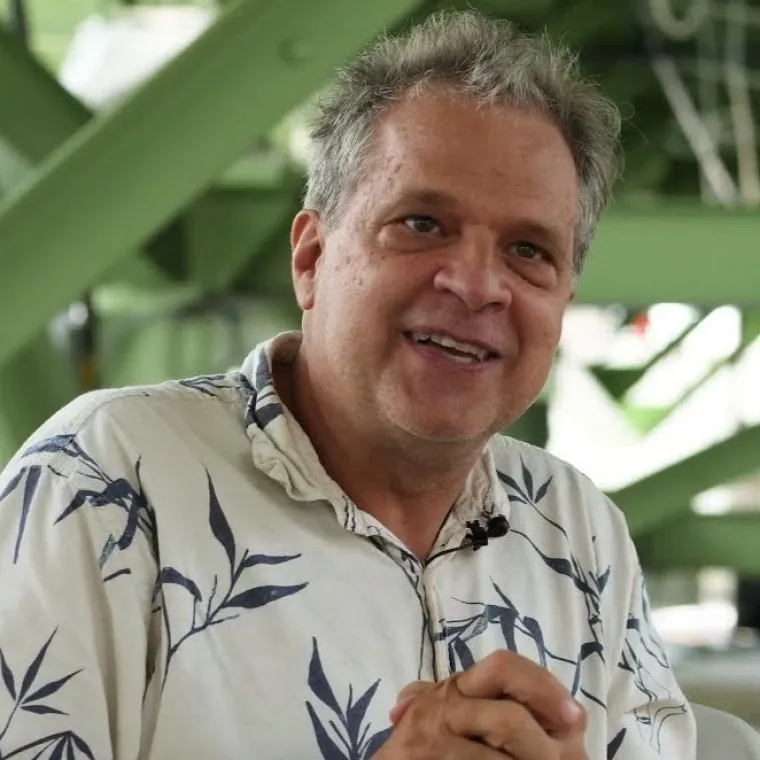
Scott Saleska
· ProfessorUniversity of Arizona · Ecology and Evolutionary Biology
Active 1989–2025
Academic metrics are sourced from OpenAlex and public funding records; values may differ from Google Scholar.
About
Scott Saleska is a Professor of Ecology & Evolutionary Biology at the University of Arizona, holding a position since 2017. He also has a joint appointment with UA Soil Water and Environmental Sciences and is a faculty affiliate of the UA Institute of Environment. His research focuses on understanding how the structure and function of terrestrial vegetation and microbial communities regulate large-scale biogeochemical processes. As a global change ecologist, he investigates how ecological communities influence land surface interactions with the atmosphere and climate, from local to global scales. His work addresses the significant challenge of scaling biological information from individual organs or organisms to landscapes and ecosystems, utilizing tools from ecophysiology, ecosystem ecology, micrometeorology, atmospheric science, remote sensing, process-based modeling, and microbial meta-omics. His contributions aim to improve predictions of climate change impacts by elucidating the role of ecological communities in climate regulation.
Research topics
- Computer Science
- Biology
- Environmental science
- Ecology
- Geography
- Computational biology
- Genetics
- World Wide Web
- Atmospheric sciences
- Information Retrieval
Selected publications
The FLUXNET2015 dataset and the ONEFlux processing pipeline for eddy covariance data
Scientific Data · 2020 · 1726 citations
, water, and energy exchange between the biosphere and the atmosphere, and other meteorological and biological measurements, from 212 sites around the globe (over 1500 site-years, up to and including year 2014). These sites, independently managed and operated, voluntarily contributed their data to create global datasets. Data were quality controlled and processed using uniform methods, to improve consistency and intercomparability across sites. The dataset is already being used in a number of ap…
A genomic catalog of Earth’s microbiomes
Nature Biotechnology · 2020 · 963 citations
The reconstruction of bacterial and archaeal genomes from shotgun metagenomes has enabled insights into the ecology and evolution of environmental and host-associated microbiomes. Here we applied this approach to >10,000 metagenomes collected from diverse habitats covering all of Earth's continents and oceans, including metagenomes from human and animal hosts, engineered environments, and natural and agricultural soils, to capture extant microbial, metabolic and functional potential. This compre…
How deregulation, drought and increasing fire impact Amazonian biodiversity
Nature · 2021 · 179 citations
Empirical evidence for resilience of tropical forest photosynthesis in a warmer world
Nature Plants · 2020 · 128 citations
Senior authorCorrespondingScientific Data · 2021 · 109 citations
A Correction to this paper has been published: https://doi.org/10.1038/s41597-021-00851-9.
Recent grants
NSF · $1.2M · 2018–2023
NSF · $309k · 2007–2010
PIRE: Carbon, Water and Vegetation Dynamics of Amazon Forests Under Climatic Variability and Change
NSF · $2.6M · 2007–2015
Frequent coauthors
- 154 shared
P. M. Crill
Stockholm University
- 101 shared
Natalia Restrepo‐Coupé
University of Arizona
- 95 shared
Steven C. Wofsy
- 93 shared
Virginia I. Rich
The Ohio State University
- 83 shared
Plínio Barbosa de Camargo
Universidade de São Paulo
- 79 shared
Lucy R. Hutyra
Boston University
- 76 shared
J. William Munger
Harvard University Press
- 63 shared
W. J. Riley
Lawrence Berkeley National Laboratory
Awards & honors
- Elected Fellow of the Ecological Society of America (2019)
- Agnese Nelms Haury Faculty Fellow in Environment and Social…
- NSF Doctoral Dissertation Grantee (1996-1998)
- NASA Global Change Fellow (1994-1997)
Similar researchers at University of Arizona
- Resume-aware match score
- Save to shortlist
- AI-drafted outreach
See your match with Scott Saleska
PhdFit ranks faculty by your research interests, methods, and publications — grounded in their actual work, not templates.
- Free to start
- No credit card
- 30-second signup