
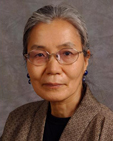
Sachiko Murata
· ProfessorStony Brook University · Asian and Asian American Studies
Active 1992–2024
Academic metrics are sourced from OpenAlex and public funding records; values may differ from Google Scholar.
About
Sachiko Murata is a professor in the Department of Asian & Asian American Studies at Stony Brook University. Her research investigates the interrelationships between Islamic and Far Eastern thought, with a particular focus on the writings of the Huiru, known as the Muslim Confucianists, who authored numerous tracts in Chinese from the seventeenth through the nineteenth centuries. Murata completed her undergraduate studies in family law at Chiba University in Japan, worked for a year in a law firm in Tokyo, and then pursued advanced studies in Iran, where she studied Islamic law. She earned her PhD in Persian literature from Tehran University in 1971 and was the first woman and the first non-Muslim enrolled in the faculty of theology there. She also completed an MA in Islamic jurisprudence in 1975. Her academic journey included work as a research associate at the Imperial Iranian Academy of Philosophy, and she has been teaching religious studies at Stony Brook University since 1983. Murata has published numerous scholarly articles and books, including translations and sourcebooks on Islamic jurisprudence, gender relationships in Islamic thought, and the intersection of Islamic and Confucian ideas. She has served as the director of Japanese Studies since its founding in 1990 and teaches courses on Japanese Studies, Buddhism, Feminine Spirituality in World Religions, and Islam and Confucianism.
Research topics
- Epistemology
- Literature
- Philosophy
- Theology
- Art
- Religious studies
Selected publications
Muslim Approaches to Religious Diversity in China
Palgrave Macmillan eBooks · 2013-10-04 · 2 citations
book-chapter1st authorCorrespondingMuslim Approaches to Religious Diversity in China
Palgrave Macmillan US eBooks · 2013-01-01 · 1 citations
book-chapter1st authorCorrespondingMuslims entered China in the seventh century and established communities within a century or two, but it took almost 1,000 years for them to begin writing about Islam in the Chinese language. In 1642, Wang Daiyu 王岱輿 (ca. 1592-ca. 1658) published the first known Chinese book on Islamic teachings, and many others joined him over the next two centuries. These scholars have often been called the Huiru 回儒, the Muslim Confucians, and their writings the Han Kitab, a Chinese-Arabic hybrid word meaning "…
Üsküdar Üniversitesi Tasavvuf Araştırmaları Enstitüsü Dergisi · 2024
1st authorCorrespondingThere are only four Islamic texts on theology and philosophy which are known to have been translated into Chinese before the twentieth century. One of them, Ashiʿʿat al-lamaʿāt, Jāmī’s commentary on Fakhr al-Dīn ʿIrāqī’s Lamaʿāt, was translated by She Yunshan. He was one of the earliest members of the school of thought known as “the Muslim Confucianists.” In this article, I will present a few examples from Yunshan’s translation, who is also known by the penname Ponachi, in order to illustrate th…
Harvard University Asia Center eBooks · 2017-09-07
book-chapter1st authorCorrespondingThe Implicit Dialogue of Confucian Muslims
2013-04-02
otherSenior authorMuslims have lived in China for well over a thousand years, tracing their lineage back to an emissary sent by Muhammad to the emperor. Historians have found no concrete evidence of dialogue between Muslims and Confucians before the seventeenth century, when Muslims began writing about their religion in Chinese. Having understood that Muslims were becoming ever more ignorant of their own religion, Hu Dengzhou saw no other way for the ulama to transmit Islamic learning to monolingual Chinese. Chin…
Frequent coauthors
- 27 shared
William C. Chittick
- 22 shared
Tu Weiming
Peking University
- 4 shared
Mutsumi Kitahashi
Women's Hospital
- 4 shared
Takako Mori
Tokyo Women's Medical University Adachi Medical Center
- 2 shared
Miho Kurisu
Women's Hospital
- 1 shared
Pierre Lory
- 1 shared
Li Guo
- 1 shared
Jāmī
Similar researchers at Stony Brook University
- Resume-aware match score
- Save to shortlist
- AI-drafted outreach
See your match with Sachiko Murata
PhdFit ranks faculty by your research interests, methods, and publications — grounded in their actual work, not templates.
- Free to start
- No credit card
- 30-second signup