
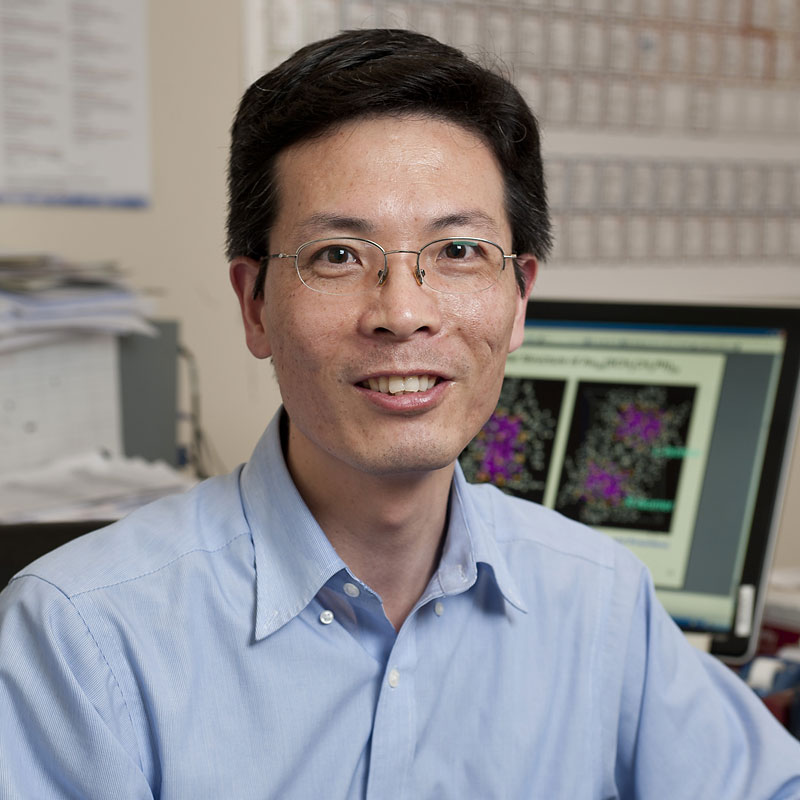
Rongchao Jin
· ProfessorCarnegie Mellon University · Chemistry
Active 1988–2026
Academic metrics are sourced from OpenAlex and public funding records; values may differ from Google Scholar.
About
Professor Rongchao Jin is a faculty member in the Department of Chemistry at Carnegie Mellon University, where he has served as Professor of Chemistry since 2015, following appointments as Associate Professor and Assistant Professor. He earned his Ph.D. in Chemistry from Northwestern University in 2003 and completed postdoctoral research at the James Franck Institute at the University of Chicago. His earlier education includes an M.S. in Catalysis from the Chinese Academy of Sciences and a B.S. in Chemical Physics from the University of Science and Technology of China. Professor Jin has been recognized with several awards, including the International Precious Metals Institute Advisor Award, the Asian Rising Star Award from the Federation of Asian Chemical Societies, and the Camille Dreyfus Teacher-Scholar Award. His research focuses on fundamental science and engineering challenges related to the creation and application of nanomaterials, particularly nanoparticles ranging from 1 to 100 nanometers in size. He develops chemical methods to synthesize new types of inorganic nanoclusters and nanocrystals, hybrid nano-architectures, and inorganic/polymer nanocomposites, employing advanced microscopy and spectroscopy techniques for characterization. His work aims to understand and control the size, shape, structure, and composition of nanoparticles to tailor their physical and chemical properties for applications in catalysis, optics, sensing, and energy conversion. A central…
Research topics
- Materials science
- Chemistry
- Nanotechnology
- Optoelectronics
- Organic chemistry
- Crystallography
- Physics
- Metallurgy
- Atomic physics
- Biology
Selected publications
Chemical Reviews · 2020 · 736 citations
1st authorCorrespondingHeterogeneous catalysis involves solid-state catalysts, among which metal nanoparticles occupy an important position. Unfortunately, no two nanoparticles from conventional synthesis are the same at the atomic level, though such regular nanoparticles can be highly uniform at the nanometer level (e.g., size distribution ∼5%). In the long pursuit of well-defined nanocatalysts, a recent success is the synthesis of atomically precise metal nanoclusters protected by ligands in the size range from tens…
Atomically precise alloy nanoclusters: syntheses, structures, and properties
Chemical Society Reviews · 2020 · 685 citations
Senior authorCorrespondingMetal nanoclusters fill the gap between discrete atoms and plasmonic nanoparticles, providing unique opportunities for investigating the quantum effects and precise structure-property correlations at the atomic level. As a versatile strategy, alloying can largely improve the physicochemical performances compared to the corresponding homo-metal nanoclusters, and thus benefit the applications of such nanomaterials. In this review, we highlight the achievements of atomically precise alloy nanoclust…
Double-helical assembly of heterodimeric nanoclusters into supercrystals
Nature · 2021 · 272 citations
Senior authorCorrespondingJournal of the American Chemical Society · 2023 · 110 citations
Senior authorCorrespondingnanocluster and the revealed mechanisms are expected to find future applications.
Structural distortion and electron redistribution in dual-emitting gold nanoclusters
Nature Communications · 2020 · 94 citations
Senior authorCorrespondingDeciphering the complicated excited-state process is critical for the development of luminescent materials with controllable emissions in different applications. Here we report the emergence of a photo-induced structural distortion accompanied by an electron redistribution in a series of gold nanoclusters. Such unexpected slow process of excited-state transformation results in near-infrared dual emission with extended photoluminescent lifetime. We demonstrate that this dual emission exhibits hig…
Recent grants
DMREF/Collaborative Research: Designing Tunable Au-Based Bimetallic Nanocatalysts
NSF · $287k · 2014–2017
On the origin of plasmons in metal nanoparticles
NSF · $800k · 2018–2023
Frequent coauthors
- 91 shared
Huifeng Qian
Shaoxing Second Hospital
- 90 shared
Manzhou Zhu
Anhui University
- 85 shared
Chenjie Zeng
University of Florida
- 79 shared
Nathaniel L. Rosi
University of Pittsburgh
- 73 shared
Zhikun Wu
Chinese Academy of Sciences
- 63 shared
Yongbo Song
- 62 shared
Meng Zhou
- 60 shared
Gao Li
Dalian Institute of Chemical Physics
Education
- 2003
Ph.D.
Northwestern University
Awards & honors
- 2020 US National Science Foundation Creativity Award
- 2019 International Precious Metals Institute (IPMI) Student…
- 2013 Asian Rising Star Award, Federation of Asian Chemical S…
- 2011 Camille Dreyfus Teacher-Scholar Award
Similar researchers at Carnegie Mellon University
- Resume-aware match score
- Save to shortlist
- AI-drafted outreach
See your match with Rongchao Jin
PhdFit ranks faculty by your research interests, methods, and publications — grounded in their actual work, not templates.
- Free to start
- No credit card
- 30-second signup