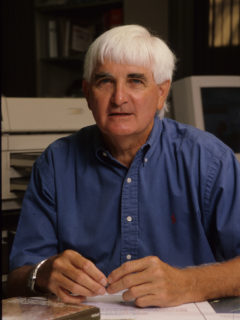
Robert Coulson
· Professor, Director - Knowledge Engineering LaboratoryTexas A&M University · Entomology
Active 1968–2026
About
Robert Coulson, Ph.D., is a professor in the Department of Entomology at Texas A&M University. His research has been transdisciplinary, focusing on the activities and impacts of insects and other taxa in various landscapes including forest, prairie, savanna, agricultural, and urban environments. His work addresses issues of ecological science and landscape-use management. Coulson co-founded the Knowledge Engineering Laboratory (KEL) in 1984 to develop computer applications for planning, problem-solving, and decision-making in environmental science and management, emphasizing the integration of qualitative expert knowledge with quantitative scientific data. He has received recognition for his research at multiple levels, including awards from Texas A&M University, the Texas Forestry Association, the Southern Forest Insect Work Conference, and the Entomological Society of America. Coulson teaches undergraduate and graduate courses in forest protection and landscape ecology, and has co-authored textbooks on these subjects. His research has been extensively funded, with over $10 million in total research funding during his tenure at Texas A&M. Coulson is a member of several professional societies, including the Entomological Society of America and the International Association for Landscape Ecology, and actively contributes to their scientific agendas.
Research topics
- Biology
- Ecology
- Agronomy
- Agroforestry
- Botany
- Horticulture
Selected publications
Research Square · 2026-02-09
preprintOpen accessSenior authorBiodiversity and Conservation · 2024-04-22 · 3 citations
articleSenior authorResearch Square · 2023-05-05 · 1 citations
preprintOpen accessSenior authorPLoS ONE · 2023-12-06 · 2 citations
articleOpen accessSenior authorCorrespondingTexas Rio Grande Valley Red-crowned Parrots (Psittaciformes: Amazona viridigenalis [Cassin, 1853]) primarily occupy vegetated urban rather than natural areas. We investigated the utility of raw vegetation indices and their derivatives as well as elevation in modelling the Red-crowned parrot's general use, nest site, and roost site habitat distributions. A feature selection algorithm was employed to create and select an ensemble of fine-scale, top-ranked MaxEnt models from optimally-sized, decorrelated subsets of four to seven of 199 potential variables. Variables were ranked post hoc by frequency of appearance and mean permutation importance in top-ranked models. Our ensemble models accurately predicted the three distributions of interest ([Formula: see text] Area Under the Curve [AUC] = 0.904-0.969). Top-ranked variables for different habitat distribution models included: (a) general use-percent cover of preferred ranges of entropy texture of Normalized Difference Vegetation Index (NDVI) values, entropy and contrast textures of NDVI, and elevation; (b) nest site-entropy textures of NDVI and Green-Blue NDVI, and percent cover of preferred range of entropy texture of NDVI values; (c) roost site-percent cover of preferred ranges of entropy texture of NDVI values, contrast texture of NDVI, and entropy texture of Green-Red Normalized Difference Index. Texas Rio Grande Valley Red-crowned Parrot presence was associated with urban areas with high heterogeneity and randomness in the distribution of vegetation and/or its characteristics (e.g., arrangement, type, structure). Maintaining existing preferred vegetation types and incorporating them into new developments should support the persistence of Red-crowned Parrots in southern Texas.
Research Square · 2022-01-06 · 2 citations
preprintOpen accessSenior authorBiodiversity and Conservation · 2022 · 9 citations
Senior authorCorresponding- Biology
- Ecology
The journal of cotton science/Journal of cotton science · 2021-01-01 · 1 citations
articleOpen accessSenior authorThe use of unmanned aircraft systems (UAS) delivering imaging technologies in agricultural settings has become more prevalent over the past five years and is growing in pest management programs. Here, spectral data from a three-band consumer-grade camera with a filter to obtain Near Infrared (NIR) data, mounted on a fixed-winged UAS, was used to assess the ability to detect cotton fleahopper, Pseudatomoscelis seriatus (Reuter) (Hemiptera: Miridae), injury to immature fruiting bodies on cotton. In a small plot experiment conducted two years and two planting periods each year, cotton fleahopper densities were manipulated with insecticide. Variable populations of cotton fleahopper across the plots were achieved in 2015, ranging between 0 and 3.5 cotton fleahopper-days over a five-week period when squares were forming. Derived from spectral data of multiple UAS flights, unexpected but inconsistent trends (by regression analysis) of increasing Normalized Difference Vegetation Index (NDVI), values with increasing cotton fleahopper days were detected in both plantings and years (five of 12 regressions were significant). Our preliminary data suggest that differences in cotton fleahopper activity on cotton may be reflected in NDVI values using a modified consumer-grade camera in-season. But the interpretation of NDVI may be complicated by the feeding site of cotton fleahopper, leading to unexpected and inconsistent regressions. Exploration of image resolution and bandwidth to define optical sensor needs appears important for cotton fleahopper, given its feeding habitat and injury to cotton. The application of UAS-derived remotely sensed data to detect insect-induced plant stress continues to have merit, but a merging of best suited UAS technology to the needs of detecting insect-induced cotton stress will be a research-intensive endeavor.
Applications of Artificial Intelligence to Animal Behavior
2021-10-07 · 4 citations
book-chapterSenior authorThe conceptual tools used to investigate animal behavior not only limit our abilities to explain reality, they also reflect the ways in which human thought processes are structured by biological organs and cultural legacy. Miscommunication regarding interpretation and explanation of animal behavior has occurred when researchers differed in their definition of and style of addressing a problem. This chapter defines a basic integrative structure used by ethologists in analyzing behavior and identifies some of the limitations of linear approaches to modeling behavior in heterogeneous environments. It illustrate some ways that Al concepts can be used to overcome such limitations. This is quite a different approach from the usual discussion of how artificial intelligence relates to the cognitive capacities demonstrated by human and nonhuman animals. The chapter provides some background so readers have a better perspective on the experiences that have shaped our view of the question "how have conceptual tools influenced the interpretation and explanation of behavior".
Insects · 2021 · 7 citations
- Biology
- Ecology
- Agroforestry
) and thrive in this large-field cotton system where cotton-crop interfaces are key local landscape features. These data have implications for potential pollination benefits to cotton production. The findings also contribute to a discussion regarding the role of large-field commercial cotton growing systems in conserving native bees.
Research Square · 2021-07-28 · 1 citations
preprintOpen accessSenior authorAbstract South-Central US milkweeds ( Asclepias spp.) are critical adult nectar and larval food resources for producing the first spring and last summer/fall generations of declining eastern migratory monarch butterflies ( Danaus plexippus ). MaxEnt niche models were developed for North American ranges of four important South-Central US milkweeds: Asclepias asperula ssp. capricornu , A. viridis , A. oenotheroides , and A. latifolia . Twelve models per species utilized subsets of six to eight of 95 edapho-topo-climatic variables chosen by a random subset feature selection algorithm. Milkweed weekly phenology was compared between early and late season periods of monarch activity. Novel land cover preference risk assessments were developed for milkweeds through land cover utilization-availability analyses, incorporating a novel sample bias reduction method for citizen science data before calculation of relativized electivity index ( E* ) land cover preference. Asclepias a. ssp. capricornu and A. viridis occurred more frequently during early season monarch activity, while A. oenotheroides and A. latifolia occurred more frequently during late season monarch activity. Milkweed utilization of roadsides varied from 6–31%. Developed-Open Space and Grassland Herbaceous land classes generally had highest benefit among milkweeds. Cultivated Crops and Shrub/Scrub had high risk. Combined milkweed high E i * kernel density estimation surfaces resolved interior and coastal corridors of milkweed land cover preference providing functional connectivity for the monarch spring and fall migrations. A potentially critical gap in milkweed land cover benefit connectivity was identified in South Texas. Milkweed land cover preference risk assessments can be used to prioritize milkweed habitat conservation for enhancing monarch migration connectivity across the South-Central US.
Frequent coauthors
- 40 shared
Maria D. Tchakerian
Texas A&M University
- 38 shared
Paul E. Pulley
Texas A&M University
- 34 shared
Terence L. Wagner
Pennsylvania State University
- 29 shared
Richard O. Flamm
Florida Fish and Wildlife Conservation Commission
- 28 shared
John L. Foltz
University of Florida
- 27 shared
Andrew Birt
Texas Department of Transportation
- 25 shared
Kristen A. Baum
Oklahoma State University
- 23 shared
W. S. Fargo
Education
- 1990
Ph.D., Entomology
Texas A&M University
- 1985
M.S., Entomology
University of California, Davis
- 1983
B.S., Entomology
University of California, Davis
Awards & honors
- Former Student Association Faculty Achievement Award for Res…
- Award of Merit in Recognition of Outstanding Achievements in…
- A. D. Hopkins Award, Southern Forest Insect Work Conference
- J. E. Bussart Award
- Fellow of Entomological Society of America
- Resume-aware match score
- Save to shortlist
- AI-drafted outreach
See your match with Robert Coulson
PhdFit ranks faculty by your research interests, methods, and publications — grounded in their actual work, not templates.
- Free to start
- No credit card
- 30-second signup