Resume-aware faculty matching

Find professors who actually fit you

Upload your resume. Four AI agents analyze your background, rank the faculty who fit, inspect their recent research, and help you draft outreach — grounded in their actual work, not templates.

Free to startNo credit cardCancel anytime
Top matches Balanced preset
Dr. Sarah Chen
Stanford · Interpretability · NLP
91
Dr. Marcus Holloway
MIT · Robotics · RL
84
Dr. Aisha Okonkwo
CMU · Fairness · HCI
82
Nova · Professor Researcher · re-ranking top 20…
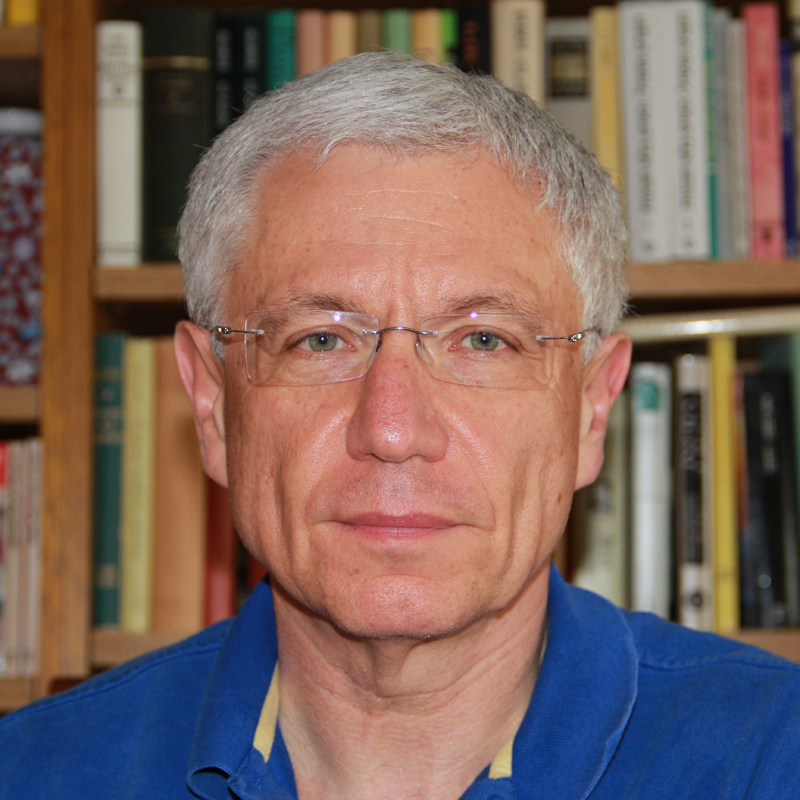
Rami Grossberg

Rami Grossberg

· ProfessorVerified

Carnegie Mellon University · Mathematical Sciences

Active 1983–2021

h-index19
Citations897
Papers683 last 5y
Funding
See your match with Rami Grossberg — sign in to PhdFit.Sign in

About

Rami Grossberg is a professor in the Department of Mathematical Sciences at Carnegie Mellon University. He earned his Ph.D. from Hebrew University of Jerusalem in 1986 under the advisement of Saharon Shelah. His research interests lie in model theory, a branch of logic, with a particular focus on the classification theory of non-elementary classes, infinitary logics, extensions of first-order logic, combinatorial set theory, and the applications of these areas to algebra. Grossberg's work is closely connected to the ideas of Saharon Shelah, and he references Shelah's perspectives on model theory. He has also compiled a survey of results and problems in the field, reflecting his active engagement with ongoing research challenges. Additionally, Grossberg has mentored several graduate students and postdoctoral researchers who have gone on to hold academic positions at various universities. His academic lineage and contributions highlight his role in advancing the understanding of abstract elementary classes and classification theory within mathematical logic.

Research topics

  • Computer Science
  • Statistics
  • Epistemology
  • Discrete mathematics
  • Combinatorics
  • Mathematics
  • Philosophy
  • Geography

Selected publications

  • Simple-like independence relations in abstract elementary classes

    arXiv (Cornell University) · 2021

    1st authorCorresponding
    • Computer Science
    • Mathematics
    • Discrete mathematics

    We introduce and study simple and supersimple independence relations in the context of AECs with a monster model. Theorem 0.1Let K be an AEC with a monster model.•If K has a simple independence relation, then K does not have the 2-tree property.•If K has a simple independence relation with the (<ℵ0)-witness property for singletons, then K does not have the tree property. Theorem 0.1 Let K be an AEC with a monster model. If K has a simple independence relation, then K does not have the 2-tree property. If K has a simple independence relation with the (<ℵ0)-witness property for singletons, then K does not have the tree property. The proof of both facts is done by finding cardinal bounds to classes of small Galois-types over a fixed model that are inconsistent for large subsets. We think that this finer way of counting types is an interesting notion in itself. We characterize supersimple independence relations by finiteness of the Lascar rank under locality assumptions on the independence relation.

  • Characterizing stability and superstability by unions of chains and saturated models

    Research Showcase @ Carnegie Mellon University (Carnegie Mellon University) · 2018-06-29

    articleOpen accessSenior author

    Mathematics Technical Report

  • Characterizations of the finite cover property and stability

    Research Showcase @ Carnegie Mellon University (Carnegie Mellon University) · 2018-06-29

    articleOpen access

    Mathematics Technical Report

  • Superstability in abstract elementary classes

    arXiv (Cornell University) · 2018-06-29 · 10 citations

    preprintOpen access1st authorCorresponding

    We prove that several definitions of superstability in abstract elementary classes (AECs) are equivalent under the assumption that the class is stable, tame, has amalgamation, joint embedding, and arbitrarily large models. This partially answers questions of Shelah. <strong>Theorem 0.1</strong>. Let K be a tame AEC with amalgamation, joint embedding, and arbitrarily large models. Assume K is stable. Then the following are equivalent: (1) For all high-enough λ, there exists κ ≤ λ such that there is a good λ-frame on the class of κ-saturated models in Kλ. (2) For all high-enough λ, K has a unique limit model of cardinality λ. (3) For all high-enough λ, K has a superlimit model of cardinality λ. (4) For all high-enough λ, the union of a chain of λ-saturated models is λ-saturated. (5) There exists θ such that for all high-enough λ, K is (λ, θ)- solvable.

  • Forking in pregeometries.

    Research Showcase @ Carnegie Mellon University (Carnegie Mellon University) · 2018-06-29

    articleOpen access1st authorCorresponding

    Abstract: "The aim of this paper is to set the foundation to separate geometric model theory from model theory. Our thesis is that it is possible to lift results from geometric model theory to non first order logic (e.g. L[subscript omegaΓéü, omega]). We introduce a relation between subsets of a pregeometry and show that it satisfies all the formal properties that forking satisfies in simple first order theories. This is important when one is trying to lift forking to nonelementary classes, in contexts where there exists pregeometries but not necessarily a well-behaved dependence relation (see for example [HySh]). We use these to reproduce S. Buechler's characterization of local modularity in general. These results are used by Lessmann to prove an abstract group configuration theorem in [Le2]."

  • Remarks on local stability and the local order property

    Research Showcase @ Carnegie Mellon University (Carnegie Mellon University) · 2018-06-29 · 2 citations

    articleOpen access1st authorCorresponding

    Abstract: "We continue the study of stability of a type in several directions: (1) Inside a fixed model, (2) for classes of models where the compactness theorem fails and (3) for the first order case. Appropriate localizations of the order property, the independence property, and the strict order property are introduced. We are able to generalize some of the results that were known in the case of local stability for the first order theories, and for stability for nonelementary classes (existence of indiscernibles, existence of averages, stability spectrum, equivalence between order and instability). In the first order case, we also prove the local version of Shelah's Trichotomy Theorem. Finally as an application, we give a new characterization of stable types when the ambient first order theory is simple."

  • On cardinalities in quotients of inverse limits of groups

    Research Showcase @ Carnegie Mellon University (Carnegie Mellon University) · 2018-06-29 · 10 citations

    articleOpen accessSenior author

    Mathematics Technical Report

  • Indiscernible sequences in stable models

    Research Showcase @ Carnegie Mellon University (Carnegie Mellon University) · 2018-06-29

    articleOpen access1st authorCorresponding

    Mathematics Technical Report

  • On chains of relatively saturated submodels of a stable model

    Research Showcase @ Carnegie Mellon University (Carnegie Mellon University) · 2018-06-29

    articleOpen access1st authorCorresponding

    Mathematics Technical Report

  • The D-rank is equal to the R-rank

    Research Showcase @ Carnegie Mellon University (Carnegie Mellon University) · 2018-06-29

    articleOpen access1st authorCorresponding

    Mathematics Technical Report

Frequent coauthors

  • Saharon Shelah

    Rutgers, The State University of New Jersey

    29 shared
  • Monica VanDieren

    Nvidia (United States)

    11 shared
  • Bradd Hart

    8 shared
  • Sebastien Vasey

    7 shared
  • Olivier Lessmann

    UCLA Health

    7 shared
  • Will Boney

    7 shared
  • Martin Goldstern

    TU Wien

    4 shared
  • Marcos Mazari‐Armida

    3 shared

Labs

Education

  • Ph.D.

    The Hebrew University of Jerusalem

  • Resume-aware match score
  • Save to shortlist
  • AI-drafted outreach

See your match with Rami Grossberg

PhdFit ranks faculty by your research interests, methods, and publications — grounded in their actual work, not templates.

  • Free to start
  • No credit card
  • 30-second signup