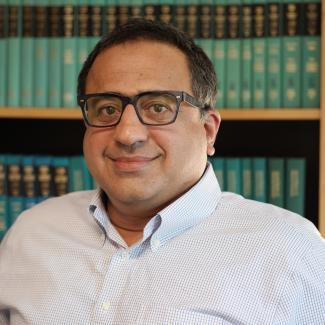
Ram Seshadri
University of California, Santa Barbara · Chemistry and Biochemistry
Active 1988–2026
Academic metrics are sourced from OpenAlex and public funding records; values may differ from Google Scholar.
About
Ram Seshadri is a Distinguished Professor in the Department of Chemistry & Biochemistry and the Materials Department at the University of California, Santa Barbara. He specializes in Inorganic Materials Chemistry and Functional Inorganic Materials. Ram received his PhD in Solid State Chemistry from the Indian Institute of Science in 1995, working with Professor C. N. R. Rao FRS on carbon nanostructures. Following postdoctoral fellowships in Caen, France, with Professor Bernard Raveau, and in Mainz, Germany, with Professor Wolfgang Tremel, he returned to Bangalore as an Assistant Professor at the Indian Institute of Science. In 2002, he moved to UC Santa Barbara, where he has been a faculty member since 2008. His research group aims to develop a fundamental understanding of functional materials that impact everyday life, focusing on the compositional tuning of properties of extended solids through solid solution. His work includes preparing and characterizing new materials, understanding the theory behind functional materials, and developing tools to probe them. Ram serves on the Editorial Committee of the Annual Reviews of Materials Research and is an Associate Editor of the ACS Journal Chemistry of Materials.
Research topics
- Physics
- Computer Science
- Materials science
- Artificial Intelligence
- Machine Learning
- Organic chemistry
- Chemistry
- Optoelectronics
- Optics
- Inorganic chemistry
Selected publications
Physical Review Letters · 2020 · 938 citations
Recently discovered alongside its sister compounds KV_{3}Sb_{5} and RbV_{3}Sb_{5}, CsV_{3}Sb_{5} crystallizes with an ideal kagome network of vanadium and antimonene layers separated by alkali metal ions. This work presents the electronic properties of CsV_{3}Sb_{5}, demonstrating bulk superconductivity in single crystals with a T_{c}=2.5 K. The normal state electronic structure is studied via angle-resolved photoemission spectroscopy and density-functional theory, which categorize CsV_{3}Sb_{5}…
Design Principles for Enhancing Photoluminescence Quantum Yield in Hybrid Manganese Bromides
Journal of the American Chemical Society · 2020 · 377 citations
Senior authorCorresponding, where a PLQY of 70.8% for a powder sample and 98% for a large single crystal sample is achieved. Our study reveals a generalized method for improving PLQYs in hybrid manganese bromides and is readily extended to designing all varieties of highly emissive hybrid materials.
Physical Review X · 2021 · 243 citations
The recently discovered family of AV 3 Sb 5 (A: K, Rb Cs) kagome metals possess a unique combination of nontrivial band topology, superconducting ground states, and signatures of electron correlations manifest via competing charge density wave order. Little is understood regarding the nature of the charge density wave (CDW) instability inherent to these compounds and the potential correlation with the onset of a large anomalous Hall response. To understand the impact of the CDW order on the elec…
Physical review. B./Physical review. B · 2021 · 112 citations
The synthesis and characterization of vanadium-based kagome metals ${\mathrm{YV}}_{6}{\mathrm{Sn}}_{6}$ and ${\mathrm{GdV}}_{6}{\mathrm{Sn}}_{6}$ are presented. X-ray diffraction, magnetization, magnetotransport, and heat capacity measurements reveal an ideal kagome network of V ions coordinated by Sn and separated by triangular lattice planes of rare-earth ions. The onset of low-temperature magnetic order of Gd spins is detected in ${\mathrm{GdV}}_{6}{\mathrm{Sn}}_{6}$ and is suggested to be no…
ACS Nano · 2023 · 63 citations
-PorBTD were found to be 10 times and 2.5 times larger than that of Pt/C, respectively. These COFs also exhibit larger power density and recycling stability in Zn-air batteries compared with a Pt/C-based air cathode. A theoretical analysis demonstrates that the combination of Co-porphyrin with two different BTD ligands affords two crystalline porous electrocatalysts having different d-band center positions, which leads to reactivity differences toward alkaline ORR. The strategy, design, and elec…
Recent grants
Materials Research Science and Engineering Center at UCSB
NSF · $24.0M · 2017–2024
Magnetostructural Coupling in Itinerant Magnets
NSF · $450k · 2017–2020
Spin and positional disorder in complex oxides
NSF · $425k · 2011–2014
Frequent coauthors
- 182 shared
Anthony K. Cheetham
University of California, Santa Barbara
- 102 shared
Stephen D. Wilson
University of California, Santa Barbara
- 93 shared
Mercouri G. Kanatzidis
Northwestern University
- 72 shared
Guang Wu
University of California, Santa Barbara
- 64 shared
Lingling Mao
Southern University of Science and Technology
- 63 shared
Pratap Vishnoi
Jawaharlal Nehru Centre for Advanced Scientific Research
- 58 shared
Michael L. Chabinyc
University of California, Santa Barbara
- 57 shared
C. N. R. Rao
Jawaharlal Nehru Centre for Advanced Scientific Research
Education
PhD, Solid State and Structural Chemistry Unit
Indian Institute of Science
Similar researchers at University of California, Santa Barbara
- Resume-aware match score
- Save to shortlist
- AI-drafted outreach
See your match with Ram Seshadri
PhdFit ranks faculty by your research interests, methods, and publications — grounded in their actual work, not templates.
- Free to start
- No credit card
- 30-second signup