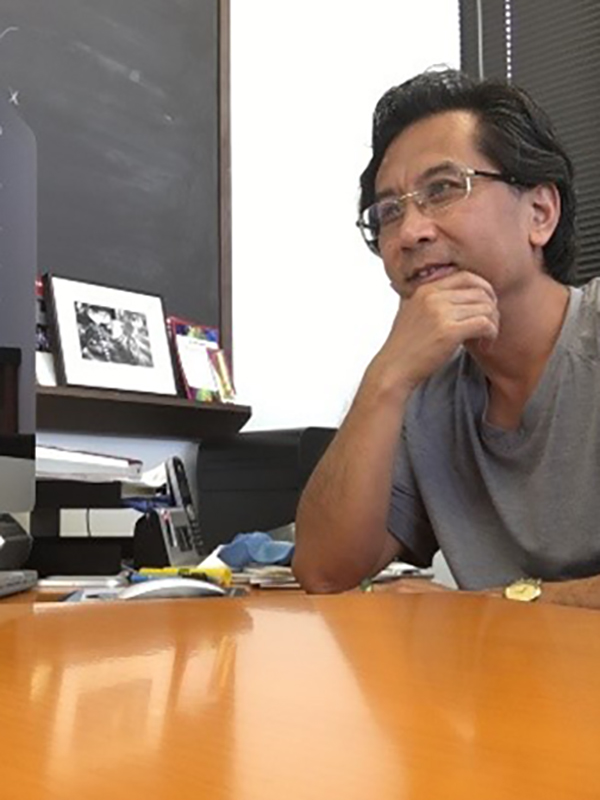
Ping Chang
· Professor, University Distinguished Professor, Texas A&M Systems Regents Professor, Louis & Elizabeth Scherck Chair in OceanographyVerifiedTexas A&M University · Oceanography
Active 1989–2026
About
Ping Chang is a University Distinguished Professor, Regents Professor, and holds the Louis & Elizabeth Scherck Chair in Oceanography at Texas A&M University. His research specializes in climate dynamics, climate prediction, and high-resolution global and regional climate modeling. Dr. Chang has made groundbreaking advances in these fields through his collaborative work and extensive publication record, which includes over 200 refereed journal articles and book chapters. He has contributed to significant scientific efforts such as co-chairing the International CLIVAR Atlantic Research Panel and participating in the Fifth Assessment Report of the Intergovernmental Panel on Climate Change (IPCC). Dr. Chang served as the Director of the International Laboratory for High-Resolution Earth System Prediction (iHESP) at Texas A&M University from 2019 to 2021. His professional recognition includes fellowships with the American Association for the Advancement of Science (AAAS), the American Geophysical Union (AGU), and the American Meteorological Society (AMS). His research projects focus on improving climate prediction and understanding climate variability, including sea-level changes in the Gulf of Mexico, mesoscale atmosphere-ocean interactions, and the role of high-resolution modeling in climate resilience.
Research topics
- Climatology
- Geology
- Oceanography
- Environmental science
- Geography
- Meteorology
- Atmospheric sciences
- Fishery
Selected publications
Sustainable Blue: A Participatory Spatial Decision Support System for Fishery Management
Annals of the American Association of Geographers · 2026-04-20
articleCancer Nursing · 2026-03-10
articleBACKGROUND: The treatment of gynecologic malignancies can cause direct damage to reproductive function. Fertility preservation decision-making is necessary and complex, which results in a heavy internal burden for patients with early-stage gynecologic malignancies. OBJECTIVE: To explore the real experiences of patients with early-stage gynecologic malignancies in fertility preservation decision-making. METHODS: A descriptive qualitative study was conducted. Semistructured interviews were performed with 12 patients with early-stage gynecologic malignancies and 12 healthcare professionals. Data were analyzed using NVivo 11 software. RESULTS: Three main themes were identified: decision-making dilemmas (anxiety, conflict, and avoidance), decision-making needs (the need for information support, emotional support, and decision support), and decision-making influencing factors (patients' cognitive levels, value preferences and family involvement, providers' professional competence and communication skills, and healthcare resource accessibility and policy support). CONCLUSION: Patients with early-stage gynecologic malignancies are prone to multiple dilemmas when faced with fertility preservation decisions, have multiple types of needs, and are affected by multiple factors that make decision-making difficult. These challenges can be addressed at multiple levels, including healthcare professionals, families, and society, to optimize the shared decision-making process between patients and healthcare professionals. IMPLICATIONS FOR PRACTICE: Healthcare professionals should understand the decision-making psychology and needs of patients with early-stage gynecologic malignancies facing fertility preservation decision-making and provide them with comprehensive, accurate decision support to help enhance patients' decision confidence and improve decision quality.
Climate Dynamics · 2026-02-20
articleOpen accessMulti‐Year Prediction of Accelerated Sea Level Rise Along the Gulf of Mexico Coast During 2010–2020
Geophysical Research Letters · 2025-10-08 · 1 citations
articleOpen accessAbstract The Gulf of Mexico (GoM) coast has experienced an acceleration of sea‐level rise between about 2010 and 2020, garnering notable attention from both the scientific and coastal communities. This study investigates the underlying causes of this acceleration by comparing high‐resolution (HR) and low‐resolution (LR) ensembles of multi‐year prediction simulations and historical climate simulations. The findings demonstrate that HR outperforms LR in predicting this acceleration, although they perform comparable prediction skill caused by external forcings. As the acceleration was driven by internal dynamics rather than external climate forcings, improved prediction skill in HR is attributed to its enhanced ability to capture internal variability. Further analysis reveals a strong link between GoM sea‐level variability and a dipole‐like wind stress curl anomaly straddling the region around Cuba, generating Ekman pumping and suction, and triggering remote changes in GoM sea‐level rise through Rossby wave propagation. HR effectively captures this process likely due to its improved prediction of the multi‐year Atlantic Meridional Mode.
Nature Geoscience · 2025-12-09
articleOpen accessConnecting Warming Patterns of the Paleo‐Ocean to Our Future
AGU Advances · 2025-09-11
articleOpen accessAbstract The evolution of the spatial pattern of ocean surface warming affects global radiative feedback, yet different climate models provide varying estimates of future patterns. Paleoclimate data, especially from past warm periods, can help constrain future equilibrium warming patterns. By analyzing marine temperature records spanning the past 10 million years with a regression‐based technique that removes temporal dimensions, we extract long‐term ocean warming patterns and quantify relative sea surface temperature changes across the global ocean. This analysis revealed a distinct pattern of amplified warming that aligns with equilibrated model simulations under high CO 2 conditions, yet differs from the transient warming pattern observed over the past 160 years. This paleodata‐model comparison allows us to identify models that better capture fundamental aspects of Earth's warming response, while suggesting how ocean heat uptake and circulation changes modify the development of warming patterns over time. By combining this paleo‐ocean warming pattern with equilibrated model simulations, we characterized the likely evolution of global ocean warming as the climate system approaches equilibrium.
Global Warming Amplifies Inland Compound Risks from Tropical Cyclones
Research Square · 2025-09-04
preprintOpen access2025-03-01
preprintOpen accessMesoscale sea surface temperature (SST) variability influences the marine atmosphere boundary layer (MABL), affecting near-surface winds and turbulent heat fluxes. This study examines precipitation response to mesoscale SST forcing using satellite observations, ERA5 reanalysis, and high- and low-resolution climate models. The results show that high-resolution models produce a precipitation response to mesoscale SST consistent with satellite observations and ERA5. However, partitioning ERA5 and model precipitation into resolved and parameterized convective components reveals that even in high-resolution models, the mesoscale SST-precipitation relationship remains highly dependent on convective parameterization. Further analysis of ERA5 and high-resolution simulations shows a vertical velocity response extending to 500 hPa, suggesting a potential remote influence of mesoscale SST on atmospheric circulation. However, the reliance on convective schemes introduces uncertainties about whether high-resolution models accurately capture these effects.
The Tropical Basin Interaction Model Intercomparison Project (TBIMIP)
Geoscientific model development · 2025-05-12 · 7 citations
articleOpen accessAbstract. Large-scale interaction between the three tropical ocean basins is an area of intense research that is often conducted through experimentation with numerical models. A common problem is that modeling groups use different experimental setups, which makes it difficult to compare results and delineate the role of model biases from differences in experimental setups. To address this issue, an experimental protocol for examining interaction between the tropical basins is introduced. The Tropical Basin Interaction Model Intercomparison Project (TBIMIP) consists of experiments in which sea surface temperatures (SSTs) are prescribed to follow observed values in selected basins. There are two types of experiments. One type, called standard pacemaker, consists of simulations in which SSTs are restored to observations in selected basins during a historical simulation. The other type, called pacemaker hindcast, consists of seasonal hindcast simulations in which SSTs are restored to observations during 12-month forecast periods. TBIMIP is coordinated by the Climate and Ocean – Variability, Predictability, and Change (CLIVAR) Research Focus on Tropical Basin Interaction. The datasets from the model simulations will be made available to the community to facilitate and stimulate research on tropical basin interaction and its role in seasonal-to-decadal variability and climate change.
Climate Dynamics · 2025-08-28
articleSenior author
Recent grants
NSF · $2.3M · 2023–2027
NSF · $397k · 2006–2010
NSF · $539k · 2011–2015
Collaborative research: The Tropical Pacific in Glacial-Interglacial Climate Dynamics
NSF · $34k · 2009–2013
Tropical Atlantic Variability and Its Predictability Using the Community Climate System Model
NSF · $619k · 2003–2009
Frequent coauthors
- 137 shared
R. Saravanan
- 134 shared
Lixin Wu
Laoshan Laboratory
- 101 shared
Christina M. Patricola
Iowa State University
- 83 shared
Gökhan Danabasoglu
NSF National Center for Atmospheric Research
- 83 shared
Qiuying Zhang
- 69 shared
Zhao Jing
Ocean University of China
- 69 shared
Stephen Yeager
NSF National Center for Atmospheric Research
- 66 shared
Hong Wang
Southern University of Science and Technology
Awards & honors
- National Science Foundation Presidential Young Investigator…
- Faculty Fellow, Texas A&M University (2000-2002)
- TAMU Association of Former Students Distinguished Achievemen…
- Follow of the Research Center for Advanced Science and Techn…
- Followship of Japan Society for the Promotion of Science (20…
- Resume-aware match score
- Save to shortlist
- AI-drafted outreach
See your match with Ping Chang
PhdFit ranks faculty by your research interests, methods, and publications — grounded in their actual work, not templates.
- Free to start
- No credit card
- 30-second signup