
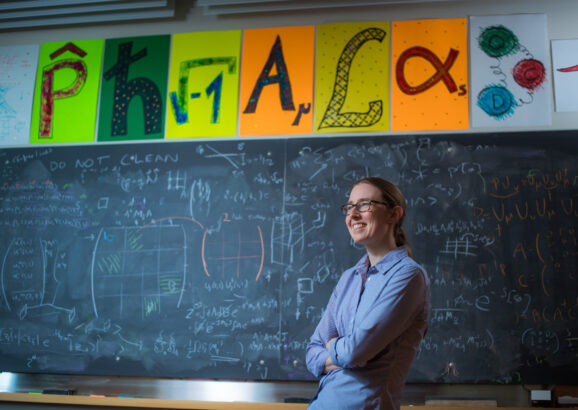
Phiala Shanahan
VerifiedMassachusetts Institute of Technology · Physics
Active 2011–2026
About
Phiala E. Shanahan is an Associate Professor of Physics at MIT, with research focused on particle and nuclear theory, particularly understanding the structure and interactions of hadrons and nuclei from the fundamental quark and gluon degrees of freedom encoded in the Standard Model of particle physics. Her recent work has concentrated on the role of gluons in hadron and nuclear structure, utilizing analytic tools and high-performance supercomputing to achieve the first calculation of the gluon structure of light nuclei, making predictions testable in upcoming experiments at Jefferson National Accelerator Facility and the Electron-Ion Collider. She has also extensively studied the role of strange quarks in the proton and light nuclei, sharpening theoretical predictions for dark matter cross-sections in direct detection experiments. To address computational limitations in quantum chromodynamics calculations, she is integrating modern machine learning techniques into computational nuclear physics studies.
Research topics
- Physics
- Particle physics
- Computer Science
- Astronomy
- Statistical physics
- Nuclear physics
- Theoretical physics
Selected publications
Excited-state uncertainties in lattice-QCD calculations of multi-hadron systems
Open MIND · 2026-01-29
preprintExcited-state effects lead to hard-to-quantify systematic uncertainties in lattice quantum chromodynamics (LQCD) spectroscopy calculations when computationally accessible imaginary times are smaller than inverse excitation gaps, as often arises for multi-hadron systems with signal-to-noise problems. Lanczos residual bounds address this by providing two-sided constraints on energies that do not require assumptions beyond Hermiticity, but often give very conservative systematic uncertainty estimates. Here, a more-constraining set of gap bounds is introduced for hadron spectroscopy. These bounds provide tighter constraints whose validity requires an explicit assumption about an energy gap. Exactly solvable lattice field theory correlators are used to test the utility of residual and gap bounds at finite and infinite statistics. Two-sided bounds and other analysis methods are then applied to a high-statistics LQCD calculation of nucleon-nucleon scattering at $m_π\sim 800$ MeV. Generalized eigenvalue problem (GEVP) and Lanczos energy estimators are compatible when applied to the same correlator data, but analyses including different interpolating operators show statistically significant inconsistencies. However, two-sided bounds from all operators are consistent. Under the assumption that the number of energy levels below $NΔ$ and $ΔΔ$ thresholds is the same as for non-interacting nucleons, gap bounds are sufficient to constrain nucleon-nucleon scattering amplitudes at phenomenologically relevant precision. Lanczos methods further reveal that energy-eigenstate estimates from previously studied asymmetric correlators have not converged over accessible imaginary times. Nevertheless, data-driven examples demonstrate why assumptions are required to draw conclusions about the natures of two-nucleon ground states at these masses.
Variance reduction in lattice QCD observables via normalizing flows
ArXiv.org · 2026-03-03
articleOpen accessNormalizing flows can be used to construct unbiased, reduced-variance estimators for lattice field theory observables that are defined by a derivative with respect to action parameters. This work implements the approach for observables involving gluonic operator insertions in the SU(3) Yang-Mills theory and two-flavor Quantum Chromodynamics (QCD) in four space-time dimensions. Variance reduction by factors of $10$-$60$ is achieved in glueball correlation functions and in gluonic matrix elements related to hadron structure, with demonstrated computational advantages. The observed variance reduction is found to be approximately independent of the lattice volume, so that volume transfer can be utilized to minimize training costs.
Lattice Evidence that Scalar Glueballs Are Small.
Open Access CRIS of the University of Bern · 2026-01-30
articleOpen accessSenior authorThis Letter reports the first calculation of the gravitational form factors (GFFs) of the scalar glueball, performed via lattice field theory in Yang-Mills theory at a single lattice spacing. The glueball GFFs are compared with those of other hadrons as determined in previous lattice calculations, providing strong indications that glueballs have a different gluonic structure than typical hadronic states. A mass radius of 0.263(31) fm is predicted, supporting previous suggestions that the scalar glueball is significantly smaller than other hadrons.
Excited-state uncertainties in lattice-QCD calculations of multi-hadron systems
ArXiv.org · 2026-01-29
articleOpen accessExcited-state effects lead to hard-to-quantify systematic uncertainties in lattice quantum chromodynamics (LQCD) spectroscopy calculations when computationally accessible imaginary times are smaller than inverse excitation gaps, as often arises for multi-hadron systems with signal-to-noise problems. Lanczos residual bounds address this by providing two-sided constraints on energies that do not require assumptions beyond Hermiticity, but often give very conservative systematic uncertainty estimates. Here, a more-constraining set of gap bounds is introduced for hadron spectroscopy. These bounds provide tighter constraints whose validity requires an explicit assumption about an energy gap. Exactly solvable lattice field theory correlators are used to test the utility of residual and gap bounds at finite and infinite statistics. Two-sided bounds and other analysis methods are then applied to a high-statistics LQCD calculation of nucleon-nucleon scattering at $m_π\sim 800$ MeV. Generalized eigenvalue problem (GEVP) and Lanczos energy estimators are compatible when applied to the same correlator data, but analyses including different interpolating operators show statistically significant inconsistencies. However, two-sided bounds from all operators are consistent. Under the assumption that the number of energy levels below $NΔ$ and $ΔΔ$ thresholds is the same as for non-interacting nucleons, gap bounds are sufficient to constrain nucleon-nucleon scattering amplitudes at phenomenologically relevant precision. Lanczos methods further reveal that energy-eigenstate estimates from previously studied asymmetric correlators have not converged over accessible imaginary times. Nevertheless, data-driven examples demonstrate why assumptions are required to draw conclusions about the natures of two-nucleon ground states at these masses.
Excited-state uncertainties in lattice-QCD calculations of hadron masses and scattering phase shifts
ArXiv.org · 2026-01-29
articleOpen accessLattice QCD has historically produced energy results interpretable as either estimates relying on implicit assumptions about asymptotic behavior or one-sided upper bounds. New Lanczos methods providing two-sided bounds with less-restrictive assumptions are introduced and quantified in a high-statistics calculation with unphysical quark masses. Two-sided bounds without spectral assumptions provide sub-percent constraints on the nucleon mass. Other bounds, which assume all states in a given energy window are resolved, provide meaningful two-sided constraints on nucleon-nucleon scattering phase shifts.
Excited-state uncertainties in lattice-QCD calculations of hadron masses and scattering phase shifts
Open MIND · 2026-01-29
preprintLattice QCD has historically produced energy results interpretable as either estimates relying on implicit assumptions about asymptotic behavior or one-sided upper bounds. New Lanczos methods providing two-sided bounds with less-restrictive assumptions are introduced and quantified in a high-statistics calculation with unphysical quark masses. Two-sided bounds without spectral assumptions provide sub-percent constraints on the nucleon mass. Other bounds, which assume all states in a given energy window are resolved, provide meaningful two-sided constraints on nucleon-nucleon scattering phase shifts.
Variance reduction in lattice QCD observables via normalizing flows
arXiv (Cornell University) · 2026-03-03
preprintOpen accessNormalizing flows can be used to construct unbiased, reduced-variance estimators for lattice field theory observables that are defined by a derivative with respect to action parameters. This work implements the approach for observables involving gluonic operator insertions in the SU(3) Yang-Mills theory and two-flavor Quantum Chromodynamics (QCD) in four space-time dimensions. Variance reduction by factors of $10$-$60$ is achieved in glueball correlation functions and in gluonic matrix elements related to hadron structure, with demonstrated computational advantages. The observed variance reduction is found to be approximately independent of the lattice volume, so that volume transfer can be utilized to minimize training costs.
QCD Constraints on Isospin-Dense Matter and the Nuclear Equation of State
Physical Review Letters · 2025-01-06 · 32 citations
articleOpen accessUnderstanding the behavior of dense hadronic matter is a central goal in nuclear physics as it governs the nature and dynamics of astrophysical objects such as supernovae and neutron stars. Because of the nonperturbative nature of quantum chromodynamics (QCD), little is known rigorously about hadronic matter in these extreme conditions. Here, lattice QCD calculations are used to compute thermodynamic quantities and the equation of state of QCD over a wide range of isospin chemical potentials with controlled systematic uncertainties. Agreement is seen with chiral perturbation theory when the chemical potential is small. Comparison to perturbative QCD at large chemical potential allows for an estimate of the gap in the superconducting phase, and this quantity is seen to agree with perturbative determinations. Since the partition function for an isospin chemical potential μ_{I} bounds the partition function for a baryon chemical potential μ_{B}=3μ_{I}/2, these calculations also provide rigorous nonperturbative QCD bounds on the symmetric nuclear matter equation of state over a wide range of baryon densities for the first time.
Lattice field theory for superconducting circuits
ArXiv.org · 2025-12-05
preprintOpen accessLarge superconducting quantum circuits have a number of important applications in quantum computing. Accurately predicting the performance of these devices from first principles is challenging, as it requires solving the many-body Schrödinger equation. This work introduces a new, general ab-initio method for analyzing large quantum circuits based on lattice field theory, a tool commonly applied in nuclear and particle physics. This method is competitive with state-of-the-art techniques such as tensor networks, but avoids introducing systematic errors due to truncation of the infinite-dimensional Hilbert space associated with superconducting phases. The approach is applied to fluxonium, a specific many-component superconducting qubit with favorable qualities for quantum computation. A systematic study of the influence of impedance on fluxonium is conducted that parallels previous experimental studies, and ground capacitance effects are explored. The qubit frequency and charge noise dephasing rate are extracted from statistical analyses of charge noise, where thousands of instantiations of charge disorder in the Josephson junction array of a fixed fluxonium qubit are explicitly averaged over at the microscopic level. This is difficult to achieve with any other existing method.
Lattice evidence that scalar glueballs are small
ArXiv.org · 2025-08-29
preprintOpen accessSenior authorThis work reports the first calculation of the gravitational form factors (GFFs) of the scalar glueball, performed via lattice field theory in Yang-Mills theory at a single lattice spacing. The glueball GFFs are compared with those of other hadrons as determined in previous lattice calculations, providing strong indications that glueballs have a different gluonic structure than typical hadronic states. A mass radius of 0.263(31) fm is predicted, supporting previous suggestions that the scalar glueball is significantly smaller than other hadrons. These results point towards a potential smoking-gun characteristic to target by experimental glueball searches.
Recent grants
CAREER: Quark and Gluon Structure of Nucleons and Nuclei
NSF · $257k · 2018–2021
NSF · $200k · 2020–2022
CAREER: Quark and Gluon Structure of Nucleons and Nuclei
NSF · $85k · 2018–2018
Frequent coauthors
- 237 shared
William Detmold
- 184 shared
Michael L. Wagman
Fermi National Accelerator Laboratory
- 159 shared
Kostas Orginos
William & Mary
- 155 shared
Zohreh Davoudi
University of Bonn
- 154 shared
Fernando Romero-López
Massachusetts Institute of Technology
- 152 shared
Gurtej Kanwar
- 133 shared
Denis Boyda
- 132 shared
Martin J. Savage
Labs
MIT Center for Theoretical PhysicsPI
Education
- 2015
Doctor of Philosophy, CSSM and CoEPP, School of Chemistry and Physics
University of Adelaide
- 2011
Bachelor of Science (High performance computational physics) (Honours), CSSM and CoEPP, School of Chemistry and Physics
University of Adelaide
Awards & honors
- 2023 // Innovator of the Year, South Australian Woman of the…
- 2022 // Ruby Payne-Scott Medal (Australian Institute of Phys…
- 2022 // University of Adelaide James McWha Distinguished Alu…
- 2021 // Wu-Ki Tung Award for Early Career Research on QCD
- 2021 // Maria Goeppert Mayer Award (APS)
- Resume-aware match score
- Save to shortlist
- AI-drafted outreach
See your match with Phiala Shanahan
PhdFit ranks faculty by your research interests, methods, and publications — grounded in their actual work, not templates.
- Free to start
- No credit card
- 30-second signup