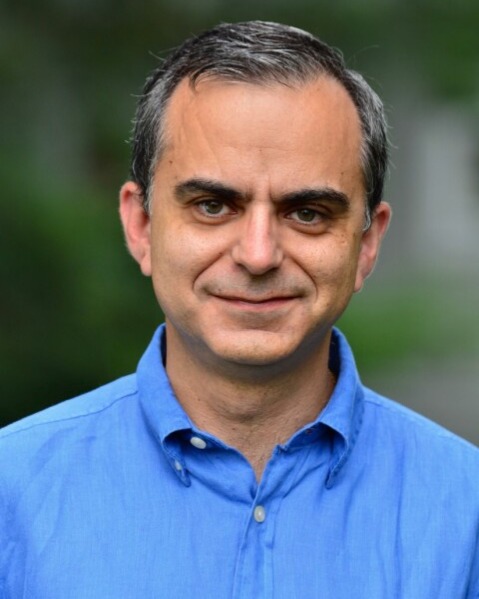
Patricio A. Fernandez
· Associate ProfessorUniversity of Texas at Austin · Philosophy
Research topics
- Quantum mechanics
- Physics
- Computer Science
- Materials science
- Condensed matter physics
- Optoelectronics
- Computational science
Selected publications
Local negative permittivity and topological phase transition in polar skyrmions
Nature Materials · 2020 · 196 citations
- Condensed matter physics
- Materials science
- Physics
SIESTA: recent developments and applications
The Journal of Chemical Physics · 2020 · 407 citations
- Computer Science
- Computer Science
- Computational science
A review of the present status, recent enhancements, and applicability of the SIESTA program is presented. Since its debut in the mid-nineties, SIESTA's flexibility, efficiency and free distribution has given advanced materials simulation capabilities to many groups worldwide. The core methodological scheme of SIESTA combines finite-support pseudo-atomic orbitals as basis sets, norm-conserving pseudopotentials, and a real-space grid for the representation of charge density and potentials and the computation of their associated matrix elements. Here we describe the more recent implementations on top of that core scheme, which include: full spin-orbit interaction, non-repeated and multiple-contact ballistic electron transport, DFT+U and hybrid functionals, time-dependent DFT, novel reduced-scaling solvers, density-functional perturbation theory, efficient Van der Waals non-local density functionals, and enhanced molecular-dynamics options. In addition, a substantial effort has been made in enhancing interoperability and interfacing with other codes and utilities, such as Wannier90 and the second-principles modelling it can be used for, an AiiDA plugin for workflow automatization, interface to Lua for steering SIESTA runs, and various postprocessing utilities. SIESTA has also been engaged in the Electronic Structure Library effort from its inception, which has allowed the sharing of various low level libraries, as well as data standards and support for them, in particular the PSML definition and library for transferable pseudopotentials, and the interface to the ELSI library of solvers. Code sharing is made easier by the new open-source licensing model of the program. This review also presents examples of application of the capabilities of the code, as well as a view of on-going and future developments.
Frequent coauthors
- 74 shared
Javier Junquera
Universidad de Cantabria
- 67 shared
J. A. Aramburu
Universidad de Cantabria
- 57 shared
James E. Boggs
The University of Texas at Austin
- 49 shared
H. Mäder
- 49 shared
J. Demaison
Laboratoire de Physique des Lasers, Atomes et Molécules
- 49 shared
L. H. Coudert
Institut des Sciences Moléculaires d'Orsay
- 40 shared
M. Moreno
Universidad de Cantabria
- 39 shared
M. T. Barriuso
Universidad de Cantabria
Similar researchers at University of Texas at Austin
- Resume-aware match score
- Save to shortlist
- AI-drafted outreach
See your match with Patricio A. Fernandez
PhdFit ranks faculty by your research interests, methods, and publications — grounded in their actual work, not templates.
- Free to start
- No credit card
- 30-second signup